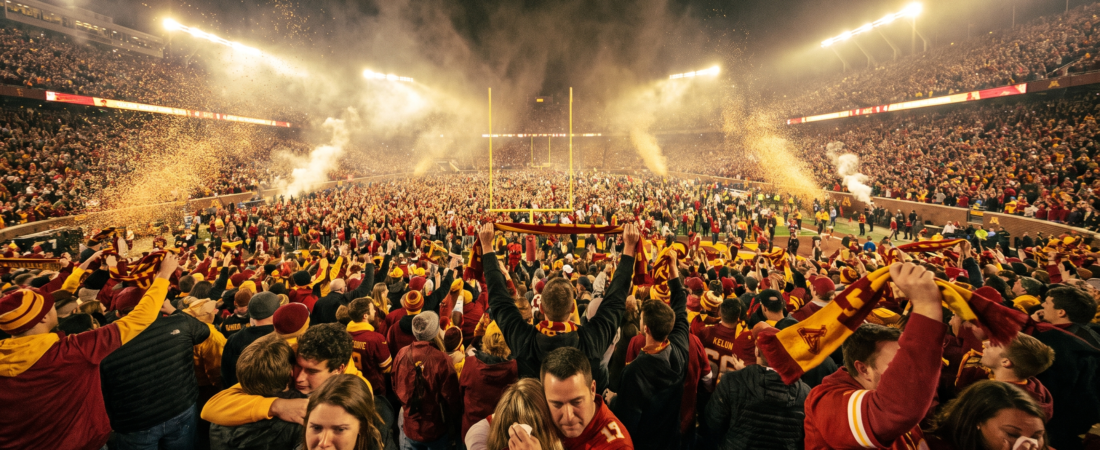
For five weeks this summer, three countries stopped being three countries. Between 11 June and 19 July 2026, forty-eight teams played across sixteen cities in the United States, Mexico and Canada, and 3,605,357 people went through the turnstiles – a new World Cup attendance record, past the 1994 mark that had stood for thirty-two years.
I am not a football writer. I came to this the way I come to everything on this site: as someone interested in what happens when a culture throws a party. And this was the largest party I have ever walked into.
What was actually different about 2026
Two things, and both changed the feel of it.
The first was the expansion to 48 teams, arranged in twelve groups of four. More teams meant more first-timers, more small nations, and more people in the stands who had waited their entire lives to be there. The emotional register of a debutant nation’s support is completely different from that of a habitual contender, and this tournament was full of it.
The second was the geography. Sixteen host cities across a continent means the tournament never sat in one place long enough to become routine. Each city got its own turn to be transformed, then handed it on. Diaspora communities that had lived quietly in a city for decades suddenly had a week when their flag was the loudest thing downtown.
How it ended
On 19 July, at MetLife Stadium in East Rutherford, New Jersey, Spain beat Argentina 1–0 after extra time, and Rodri lifted the trophy. After the weeks I had spent in Seville earlier this year – in the flamenco bars, at Semana Santa, learning how seriously that country takes a shared emotion – watching Spain win felt startlingly personal.
The tournament’s leading scorer was Lionel Messi with six goals, in what almost everyone in every stadium understood to be his last World Cup. The final ended the only way a tournament that size could: with a continent’s worth of people crying in a car park at one in the morning.
What I will actually remember
Not the football, mostly. I remember:
- Walking into the stands in Atlanta with the roof opening above us and the noise arriving before the view did.
- A plaza in a city I will not name, a thousand strangers watching one screen, and the two seconds of total silence before a goal was confirmed.
- A food row outside a stadium where tacos, jollof rice, arepas and Moroccan pastries queued up side by side and everyone ate everything.
- Face paint. So much face paint. I ended the tournament having worn the colours of five different countries and been sincerely adopted by all of them.
- Being taught a chant in a language I do not speak by a grandmother who took the job extremely seriously.
What a World Cup does to a city
This is the part that interests me most, and the part that outlasts the football.
For roughly a week, a host city becomes a temporary version of the whole world. Restaurants that serve one small community suddenly have queues around the block. Languages that were background noise become the main event. Neighbourhoods that visitors never go to become the neighbourhood everybody wants to be in, because that is where the fans of that country gather.
And then it moves on, and the city keeps a small amount of it. That is the thing about mega-events: the stadium is temporary, but the discovery that there was a Uzbek restaurant eight blocks away is permanent.
If you are planning for 2030
The next one is already sketched: a centenary tournament with matches in Morocco, Spain and Portugal, plus opening fixtures in Uruguay, Argentina and Paraguay. Which is, for this site, an almost comic alignment – three of the places I have spent this year writing about.
What I learned that I will use then:
- You do not need a ticket. The fan festivals and watch parties were the better cultural experience, and they were free.
- Pick the city, not the match. A group game in a city you want to see beats a big fixture in one you do not.
- Arrive two days early. The build-up is half the event and much of it happens before match day.
- Eat where the fans of the visiting country eat. Every host city has that restaurant. Find it.
- Book accommodation absurdly early and expect to stay outside the centre.
Questions I get asked most
Was it worth travelling for if you are not a football fan?
Completely. I would put a World Cup fan festival alongside Holi and Semana Santa as one of the great mass cultural experiences, and it costs nothing to attend.
Were the host cities overwhelmed?
Less than people feared. The bottleneck was accommodation and, on match days, getting home afterwards. Transit before the game was fine; transit at midnight was character-building.
Best single day of the tournament?
A match day in Atlanta, from the morning crowds on the train to a street chant with strangers hours after the final whistle.
Keep exploring: the full World Cup 2026 guide, match day in Atlanta, and how to do a World Cup without a ticket.
— Lina