The short version
Imilchil sits at about 2,200 metres in the eastern High Atlas, three to four hours of mountain road from the nearest town of any size. It is the home of the Aït Hdiddou, an Amazigh people whose September gathering — the moussem — is one of the most misdescribed events in Morocco, and whose two lakes are named after a bride and a groom who were never allowed to become either.
Almost everything written about this place in English calls it a bride market. It is not one, and this page explains what it is instead.
Who the Aït Hdiddou are
A confederation of Amazigh villages spread along the Assif Melloul — the white river — and the high plateau above it. They speak Tamazight at home. Until recently they were transhumant: valley villages in winter, high pastures in summer, moving the flocks up as the snow released the grass and down again before it closed. Plenty of families still do a version of it.
The institution worth knowing is the agdal: a pasture closed by collective decision and reopened on an agreed day, enforced by the community rather than by anyone official. It lets the grass recover, it is one of the oldest working conservation systems in these mountains, and it is still observed. Practically, it means some ground you might want to camp on is closed, and the closure is not a suggestion.
The legend of the two lakes
A young man of one fraction loved a young woman of another. The families refused. Kept apart, the two of them wept until their tears made two lakes, and each drowned in their own. The water is still there: Tislit, the bride, wide and shallow seven kilometres from the village; and Isli, the groom, higher, colder, harder to reach, and at around ninety metres the deepest natural lake in Morocco.
You will hear the story with different names attached, and the variation is the point rather than a flaw — it is oral tradition doing its job. Strip out the tears and what is left is social machinery: a confederation of groups who quarrel over grazing and water needs marriages across its own internal lines, and a story about two young people destroyed by a refusal is a very efficient argument for saying yes.
Watch the film
A wedding in the High Atlas: silver, striped capes and the drums that start after dark
Up where the road runs out, a mountain wedding: hand-woven capes pinned with silver at both shoulders, kohl and henna done slowly, bread and mint tea passed around a low table, and a circle of dancers pressed shoulder to shoulder once the temperature drops and the bendirs come out of the fire.
Filmed for the Culture With Lina series. Follow @culturewithlina for the rest.
What actually happens at the moussem
A moussem is an annual gathering at a saint’s shrine — here, Sidi Hmad Lmghenni — combining pilgrimage, market, family reunion and celebration. It runs three days in September, and the dates are set by the community around the herding and harvest calendar rather than fixed in advance. Treat any date you find online as provisional and confirm it locally before booking flights.
- It is first a fair. The largest livestock and goods market of the year for a scattered mountain population. Strip out the romance and that is the load-bearing function.
- Engagements, not weddings. Couples become formally engaged. The wedding itself happens later, at home, in its own season.
- Families are central. Parents come. A match is a negotiation between two households, and most couples are not strangers — they know of each other through kin networks that span the valley.
- Ahidous after dark. A line of dancers shoulder to shoulder, moving in tiny synchronised steps, carrying sung poetry called izlan that is frequently a duel between two circles. That poetry is the real content of the night.
What people wear, and what it means
The handira — tahendirt in Tamazight — is a hand-woven wool cape in dense bands of madder red, black and cream. Historically the combination of colours and the alignment of the bands identified the wearer’s fraction and her position within it: legible across a crowded field, which is exactly the situation the moussem creates. It is pinned at both shoulders with a pair of triangular silver fibulae, tizerzai, joined by a chain across the chest.
One caution. Every article about Imilchil claims a pointed headdress means a woman is unmarried and a rounded one means she is married. Whatever the truth of it once was, walking through a crowd reading strangers’ marital status off their clothes is precisely the behaviour that makes people feel inspected.
Getting there
- From Tinghir — through the Todgha Gorge and Aït Hani, roughly 160 km in three to four hours. The easiest and the most beautiful. If you only drive one approach, drive this.
- From Midelt — about 165 km, three and a half to four hours. The route for anyone arriving from Fes or Meknes.
- From Beni Mellal or El Ksiba — five to six hours over the northern plateau, with unpaved and storm-damaged sections that change year to year. Ask locally; take a 4×4.
- From Marrakech — eight to ten hours whichever way you go. A full day, not a day trip.
The number that matters more than any distance: in these mountains you average 40 to 50 km/h, not 80. And do not drive these roads after dark — no lighting, no barriers, a great deal of livestock.
Five things worth your time
- Dawn at the livestock fair. Cold, low light, smoke, and almost nobody competing for the photographs. The best hour of the whole moussem.
- Tislit at first light. The wind drops before dawn and the water goes flat. It is the only hour it does.
- The track to Isli. Nine or ten kilometres of rough going, or a two-hour walk. There is nothing there but water and rock, which is the entire point.
- The climb towards Bab n’Ouayad. Around 2,800 metres, half a day, nothing technical, and both lakes in one frame at the top.
- The night sky. No light pollution and two kilometres of altitude. Around new moon the Milky Way is bright enough to show in the lake.
Three things nobody tells you
- There is no reliable ATM. Bring dirhams in small notes from Tinghir or Midelt, and fill the tank before you climb.
- September nights approach freezing. A fleece is not enough at 2,200 metres. Bring a proper insulated jacket even when the afternoon is burning.
- Winter is not scenery. Snow closes the passes roughly November to April and the villages become genuinely isolated. If you visit in summer you are seeing the easy four months.
When to go
Late May to early October. September brings the moussem, the apple harvest and the best light of the year, along with the cold nights. October is the quiet month — gold, empty, still open — and it is the one people who have been before tend to choose.
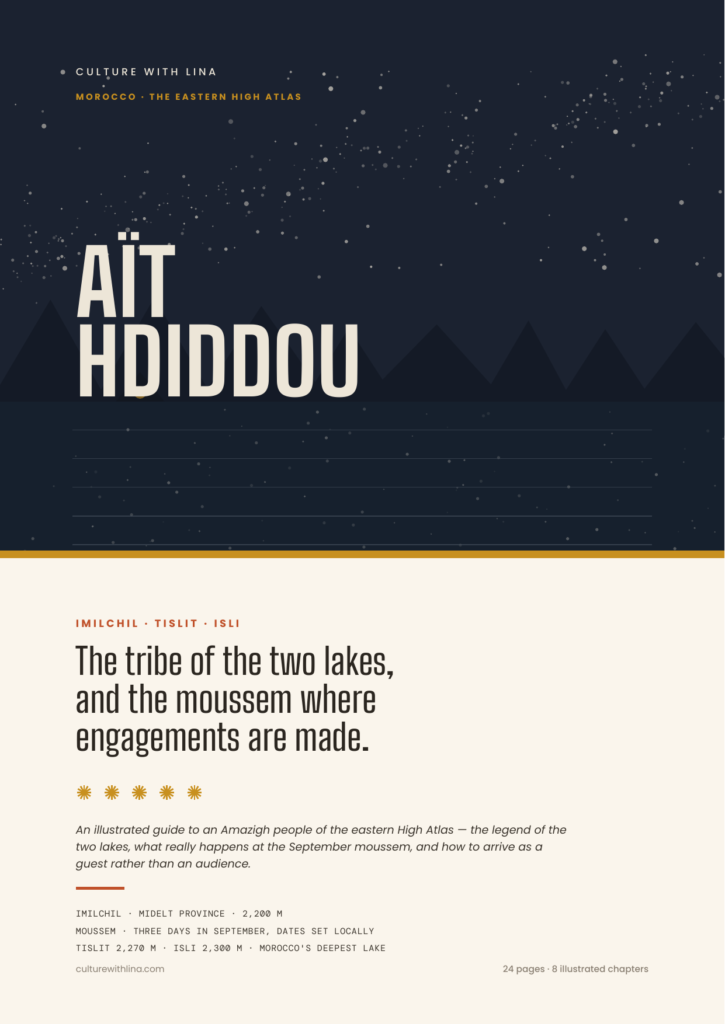
The guide to this place
Aït Hdiddou — The Tribe of the Two Lakes | Culture & Travel Guide
The complete illustrated guide to the Aït Hdiddou of the eastern High Atlas. 24 pages, eight illustrated chapters, and the detail that decides whether this trip works: what really happens at the September moussem, how the dates are actually set, four approach roads with honest drive times, room prices at 2,200 metres, how to read a handira, and three full itineraries.Instant PDF download. Written to be read before you go and carried on your phone once you are there.
- The moussem broken down hour by hour, from the 06:30 livestock fair to ahidous at 21:00
- How the dates are actually set, and who to ask to confirm them
- Four approach roads with honest drive times
- Room prices at 2,200 metres
- How to read a handira, and how to buy one well
- Three full itineraries
Instant PDF download. Licensed for personal use.
Read next
- Morocco — the whole country hub: cities, weddings, food and the long way home.
- The Sahara — if you are pairing the mountains with the desert.
- Aït Hdiddou — The Tribe of the Two Lakes — the complete 24-page illustrated guide: the moussem hour by hour, four approach roads, room prices and three itineraries.