
Barcelona is the capital of Catalonia, a Mediterranean port of roughly 1.6 million people squeezed between the Collserola hills and the sea. It has been Roman, a medieval sea power, an industrial boomtown and an Olympic reinvention, and it remains one of the easiest big cities in Europe to understand, because much of it was laid out on a grid.
It is also the city most likely to disappoint visitors who do the same four things in the same four hours and then eat a bad paella on a boulevard locals avoid. This guide is for travelers who want to book the few things that genuinely sell out, sleep in the right neighborhood, and spend the rest of their time in the city rather than in its queues.
Barcelona at a glance
| Where it is | Northeastern Spain, on the Mediterranean; capital of Catalonia. |
|---|---|
| Best time to go | April to June and September to October. |
| How long to stay | Three days for the essentials; five with a day trip. |
| Getting there | Barcelona–El Prat airport, about 15 km southwest, or high-speed train to Barcelona Sants. |
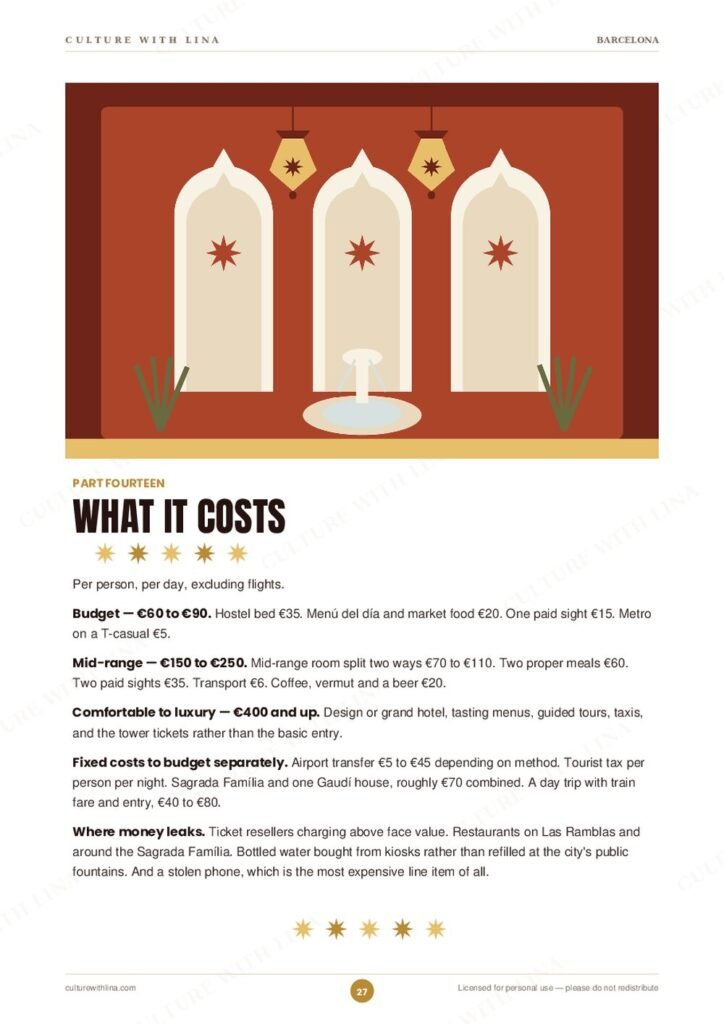
| Daily budget (planning range) | Per person, excluding flights: budget €60 to €90, mid-range €150 to €250, luxury €400 and up. |
| Language(s) | Catalan and Spanish; English widely spoken in tourism. |
| Good for | Architecture, food, festivals, museums and city-plus-coast trips. |
All prices here are planning ranges in euros, not quotes. Ticket prices rise most years, so check official sites.
The story of Barcelona
The old city, Ciutat Vella, holds four quarters: the dense, medieval Gothic Quarter; El Born, the prettiest and best for eating; El Raval, gritty and creative; and Barceloneta, the old fishing district by the beach. In the 19th century the city spilled into L’Eixample, planned by Ildefons Cerdà as a grid of octagonal blocks with cut corners, and that is where the modernista architecture lives. Gràcia, once an independent village, kept its small squares when the city absorbed it.
Much of what looks old is not. A good deal of the Gothic Quarter’s “medieval” look was reconstructed in the early 20th century, some of it for the 1929 International Exposition. The Sagrada Família was begun in 1882 and is still unfinished, Park Güell was a failed housing development, and the beaches were created for the 1992 Olympics. This is a city that keeps rebuilding its own image.
One tension is worth knowing. Barcelona receives several times more visitors a year than it has residents, and it has capped cruise arrivals, taxed overnight stays and announced plans to phase out tourist apartment licenses by 2028. None of it is aimed at you, but good and bad guests are unusually visible here.
What to see in Barcelona
Sagrada Família
Roughly €26 to €40, with towers extra on a separate timed slot. Come for the interior, a forest of branching columns lit by stained glass: cool blues and greens in the morning, reds and oranges late in the afternoon. Book direct, well ahead, and allow 90 minutes.
Park Güell
The Monumental Zone, with the mosaic bench and lizard, costs roughly €10 to €18 on timed entry; the rest of the park is free. Take the first slot or go late afternoon, since midday is a crush. It is a steep walk from the metro, or take bus 24.
Casa Batlló and La Pedrera
Casa Batlló (roughly €35 to €50) is the most theatrical Gaudí house, with a bone-and-scale façade. La Pedrera (roughly €28 to €40) is best for its rooftop of chimney “warriors.” If budget is short, choose one and photograph both façades early.
Palau de la Música Catalana and Sant Pau
Neither is by Gaudí. Domènech i Montaner’s Palau is, for many visitors, the finest interior in the city; a tour runs roughly €20 to €26, but a concert is better. Hospital de Sant Pau (roughly €16 to €20), ten minutes’ walk from the Sagrada Família, is a vast modernista complex and far quieter.
The Gothic Quarter and El Born
Walk before 9am to see Plaça del Rei, Plaça Sant Felip Neri’s shrapnel-scarred wall and the cathedral cloister with its thirteen geese. In El Born, Santa Maria del Mar is the better church, and the free El Born Centre de Cultura i Memòria shows a neighborhood destroyed after the 1714 siege.
Picasso Museum
Roughly €12 to €15, free on certain evenings and first Sundays. It is strongest on the early work most people have never seen. Book ahead.
Montjuïc
The southern hill holds the castle, the Fundació Joan Miró and MNAC, whose Romanesque frescoes from Pyrenean chapels are world-class and almost always quiet. The funicular is covered by a metro fare; the cable car is not.
Bunkers del Carmel
A free Civil War battery with the best 360-degree view of the city. Arrive 45 minutes before sunset, keep quiet and take your rubbish: people live directly below, and evening access is now restricted.
Skip the “skip-the-line” resellers and La Rambla itself, which is not a sight.
The festa major: castells and Catalan celebration
Barcelona celebrates through the festa major, the patron festival of a neighborhood or the whole city. The biggest is La Mercè, around 24 September. Gràcia’s festa major in mid-August sees residents decorate their own streets.
Castells, the human towers
An amateur club, the colla castellera, builds a tower of people up to nine or ten levels high. First the pinya forms: a dense crowd of hundreds packed at the base to support the tower and catch anyone who falls. Then the levels rise, and finally a child, the enxaneta, climbs to the top and raises four fingers for the four stripes of the Catalan flag. Castells are free to watch and recognized by UNESCO. The motto, força, equilibri, valor i seny, means strength, balance, courage and seny, a Catalan word for grounded good judgment.
Correfoc, sardana and giants
In the correfoc, devils and dragons carry fireworks through the streets while crowds dance under the sparks. If you join in, wear old cotton with long sleeves, a hat and closed shoes; otherwise stay behind the barriers. The sardana is a circle dance with joined hands, done to a cobla band and sometimes danced outside the cathedral on weekends. Gegants and capgrossos are giant processional figures, some centuries old.
At a Catalan wedding
Most weddings are now civil, but guests often receive small gifts called detalls, cava flows throughout, and some couples hire a colla to build a tower.
Never push into a pinya, use flash near the enxaneta or block a correfoc route.
What to eat in Barcelona
- Pa amb tomàquet: bread rubbed with tomato, olive oil and salt, the base of the whole cuisine.
- Arròs negre or fideuà: squid-ink rice or its short-noodle cousin, cooked to order; a 30-to-40-minute wait is a good sign.
- Calçots: grilled spring onions with romesco sauce, roughly January to March.
- Escalivada: roasted peppers, eggplant and onion in olive oil.
- Botifarra amb mongetes: Catalan sausage with white beans.
- Bombas: Barceloneta’s fried potato balls with meat, spicy sauce and aioli.
- Crema catalana: custard under burnt sugar, and a standing local argument with crème brûlée.
Paella is Valencian; skip it anywhere with a photo menu. Lunch runs about 1:30 to 3:30pm, dinner from 9pm. The weekday menú del día (typically €13 to €20) is the best value, and a Sunday vermut is worth doing once.
Getting there and getting around
From El Prat, the Aerobús reaches Plaça Catalunya in about 35 minutes for roughly €7 to €8. Metro L9 Sud costs about €5 to €6 on a special airport fare and needs a change. The R2 Nord train, from Terminal 2 only, costs about €4 to €5. A taxi runs roughly €35 to €45. Barcelona Sants is the main rail station, with AVE trains to Madrid in about 2 hours 30 minutes.
In town, buy a T-casual: ten journeys on metro, bus, tram and city trains for around €12 to €13, for one person. The metro runs until midnight on weekdays, 2am on Fridays and all night Saturdays. Line L3 serves most sights and is the pickpocket line. The old city is walkable, taxis are metered, and Bicing bikes are for residents only. Do not rent a car for the city.
Where to stay
- El Born: the best all-round base, with the best restaurants and everything walkable.
- Gràcia: for living like a local, with lively squares; about fifteen minutes by metro from the center.
- Eixample Dreta: elegant, central and quiet at night. Good for first-timers.
- Gothic Quarter: atmospheric but noisy and pickpocket central. Fine for two nights.
- El Raval: cheapest central option and mixed; check the exact street.
- Poblenou: quiet and modern near better beaches. Good for families.
Per double room, expect roughly €40 to €90 on a budget, €120 to €220 mid-range and €300 and up for luxury, plus tourist taxes charged at checkout. Only book apartments with an official HUT license number.
Etiquette, dress and safety
Catalan is a language, not a dialect of Spanish. Bon dia, si us plau, gràcies and adéu earn real warmth. Independence is a divided question; ask with curiosity rather than arriving with a view. Greet shopkeepers, keep voices down in residential streets at night, and do not walk around shirtless or in swimwear, which can bring fines.
Barcelona is physically safe; violent crime against visitors is rare. Pickpocketing is the real problem, especially on La Rambla, metro L3, Barceloneta beach and around the Gaudí sites. Common tricks:
- The distraction: a spill, a map or dropped coins while an accomplice takes your bag.
- The metro door: a bag lifted as the doors close.
- The friendly hug: common near the beach and in nightlife areas.
- The chair: a bag hung on a terrace chair vanishes in seconds.
- Fake police: asking to check your wallet for counterfeit notes.
Wear a zipped bag in front, keep your phone in a front pocket, and never leave belongings on the sand. Report thefts to the Mossos d’Esquadra for insurance. The emergency number is 112, and tap water is safe.
A 5-day itinerary
Day 1
Morning: arrive and settle in. Afternoon: Gothic Quarter walk and the cathedral. Evening: late dinner in El Born.
Day 2
Morning: Sagrada Família at opening, then Sant Pau. Afternoon: lunch in the Eixample, then Casa Batlló. Evening: a Palau de la Música concert if the program allows.
Day 3
Morning: Park Güell, first slot. Afternoon: Gràcia’s squares and Casa Vicens, Gaudí’s first house. Evening: vermut, then sunset at Bunkers del Carmel.
Day 4
Morning: train to Montserrat, 60 to 90 minutes, for the monastery and the boys’ choir around midday. Afternoon: walk toward Sant Jeroni, or choose Girona or Sitges instead. Evening: back for dinner.
Day 5
Morning: Picasso Museum and Sant Antoni market. Afternoon: MNAC on Montjuïc, then Bogatell beach. Evening: blue hour from the Bogatell end.
The premium Barcelona guide
Barcelona — The City That Built Itself | Culture & Travel Guide
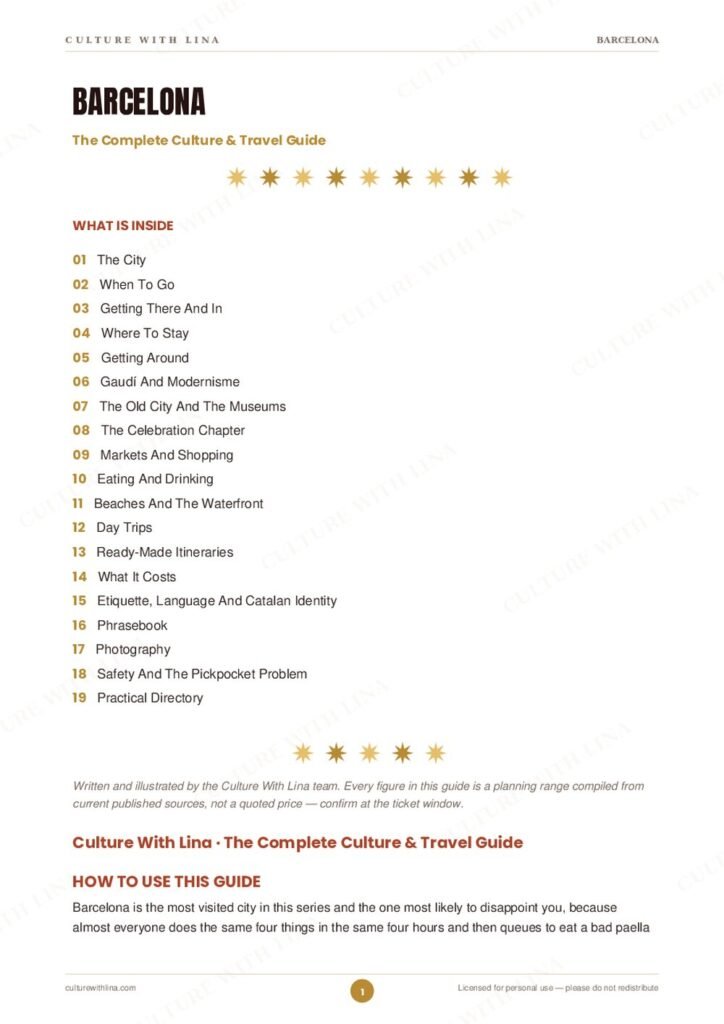
A Barcelona travel guide in 38 illustrated pages. Gaudí without the queues, the celebration chapter (castellers and correfoc), what to order instead of paella, and a full pickpocket chapter.
- When to go, where to stay and how to get around, neighborhood by neighborhood
- Gaudí and Modernisme, the old city and the museums, with what is overrated
- The celebration chapter: castells, correfoc, sardana, giants and Catalan weddings
- Eating and drinking, markets, beaches, day trips and ready-made itineraries
- What it costs, Catalan etiquette, a phrasebook, photography spots and pickpocket safety
Instant PDF download. Licensed for personal use.
Barcelona: frequently asked questions
How many days do you need in Barcelona?
Three days covers the Gaudí highlights, the old city and Montjuïc. Five allows a day trip and unhurried time in Gràcia.
Should you book the Sagrada Família in advance?
Yes. Timed slots sell out, so book direct on the official site days or weeks ahead, as with Park Güell and the Gaudí houses.
Is Barcelona safe for tourists?
Physically, yes. Pickpocketing is common in crowds, so wear a zipped bag in front and keep your phone in a front pocket.
Is paella a Barcelona dish?
No, it is Valencian. Order arròs negre or fideuà, cooked to order, instead.
When is the best time to visit Barcelona?
April to June and September to October. September adds the warmest sea and La Mercè; July and August are hot and crowded.
Look inside the premium guide
About this guide. Culture With Lina is presented by Lina, an AI travel creator. This page and the premium PDF are researched and compiled from published sources, official information and local reporting; they are not a first-hand trip report. The images and films are made with AI tools. Prices are planning ranges, not quotes, so confirm locally before you travel. Spotted something out of date? Tell us.