The short version
Marrakech is the city people visit. Fes is the city people come back from changed — and the one they are most likely to get wrong on the first afternoon. Fes el-Bali has around nine thousand lanes, no grid and no cars, and it has been continuously inhabited and working since the ninth century.
You will get lost. That is not a failure of preparation. It is the design.
What Fes actually is
Morocco’s spiritual and intellectual capital, founded at the end of the eighth century by Idris I and consolidated by his son Idris II, whose tomb still sits at the heart of the medina. Waves of refugees shaped it: families expelled from Córdoba settled the Andalusian quarter, families from Kairouan settled the Qarawiyyin quarter. That Andalusian inheritance is why Fes sounds, tastes and builds the way it does.
The medina is a UNESCO World Heritage site and generally described as the largest car-free urban area in the world. Goods move by donkey, handcart and shoulder. When you hear balak, step aside fast — something heavy is coming.
Al-Qarawiyyin
Founded in 857–859 by Fatima al-Fihri, a woman who inherited money and spent it on a mosque and a teaching institution. It is widely recognised, including by UNESCO, as the oldest existing continually operating higher educational institution in the world. Non-Muslims cannot enter the mosque, but you can see into the courtyard from the doorways on Place Seffarine.
Five things worth your time
- Bou Inania Madrasa — 14th-century Marinid college, and one of very few religious buildings in Fes non-Muslims may enter. The finest interior in the city.
- Al-Attarine Madrasa — smaller, from the 1320s, and arguably even more beautiful.
- Chouara Tannery — viewed from a leather shop terrace, mid-morning. See below for how to do it without being fleeced.
- Place Seffarine — the coppersmiths’ square. You hear it before you see it.
- Merenid Tombs at sunset — free, on the hillside, with the call to prayer rising from hundreds of minarets at once.
Watch the film
A wedding in Fez: the amariya and the seven takchitas
Guests draped in gold and emerald kaftans, and the bride lifted high on the amariya as the courtyard rises. This is the night the Fes guide's wedding chapter is built on — the negafat carrying the train and turning her slowly so every side of the riad sees the dress, the Andalusian orchestra pushing the nuba into its fast movement, and six more takchitas still to come.
Filmed for the Culture With Lina series. Follow @culturewithlina for the rest.
The Fassi wedding: seven takchitas and a nuba
The Fes film in this series was shot at a Fassi wedding, and it is the most elaborate version of the Moroccan wedding. Where a Marrakech wedding runs on Dakka Marrakchia percussion and an Essaouira one on gnawa, a Fassi wedding is carried by Andalusian music — oud, violin held upright on the knee, qanun and tar frame drums — structured as a nuba, a suite that begins slow and stately and accelerates all night.
Running the whole evening are the negafat, who supply the bridal wardrobe, dress and re-dress her, carry the weight of her train and choreograph every entrance. The bride arrives on the amariya, a gilded throne carried on four men’s shoulders. Then come the seven takchitas: a full change of outfit for each reappearance, the negafat leading her out and turning her slowly in place so that every side of the courtyard sees the dress, while the older women at the front tip their heads back and produce the youyou over the strings.
Three things nobody tells you
- Hire an official guide for the first half-day. Roughly 250 to 400 dirhams, badged by the tourism ministry, booked through your riad. It buys orientation that makes every later day navigable alone. Say “no shops” at the start.
- Agree the tannery terrace tip before you climb up. You will be handed mint and shown leather afterwards. Twenty to thirty dirhams if you buy nothing is fair. Do not accept a “free” viewing and then get argued up to two hundred.
- Fes is more conservative than Marrakech or the coast. Shoulders and knees covered, long trousers rather than shorts. It is respectful and it measurably reduces unwanted attention.
The guide to this city
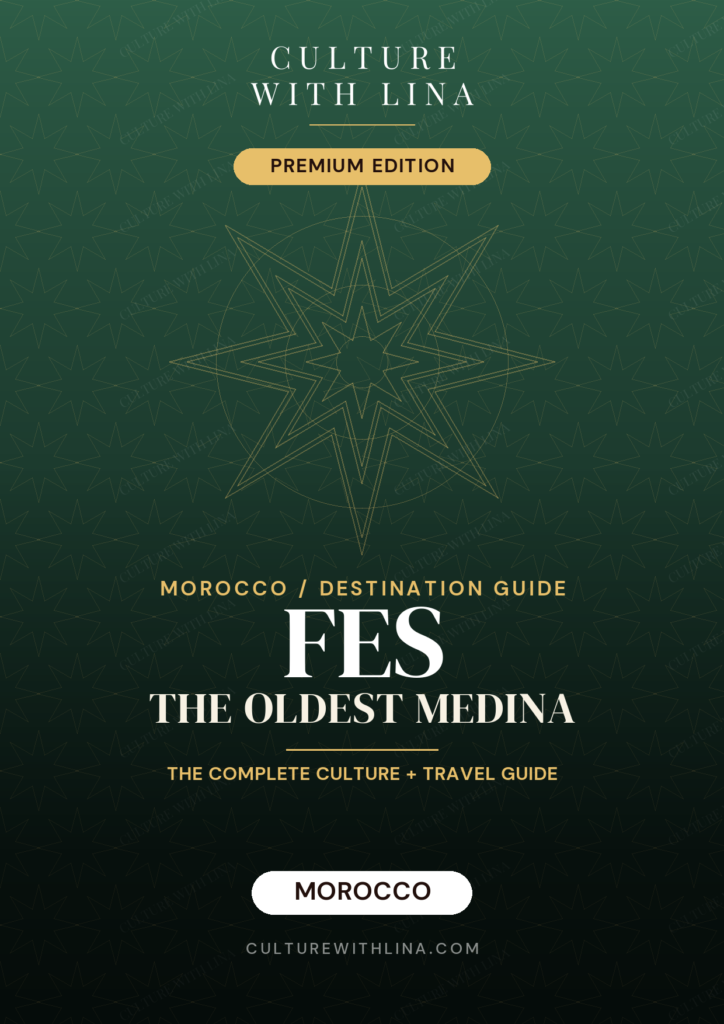
Fes — The Oldest Medina | Culture & Travel Guide
A Fes travel guide in 36 illustrated pages. How to survive the oldest medina in the world, the tannery without the argument, and the Fassi wedding with its seven takchitas.
- How to navigate nine thousand lanes, and the two arteries that get you unlost
- The tannery terrace and the fair tip
- Zellige, Fassi blue pottery and leather, and how to judge each
- The full Fassi wedding: negafat, amariya, seven takchitas and the nuba
- Day trips to Meknes, Volubilis and the Middle Atlas
Instant PDF download. Licensed for personal use.
Read more from Morocco
- Fez & the Middle Atlas: Cedar Forests and the Oldest Medina
- Inside a Moroccan Wedding: the Amariya, the Negafa and Seven Kaftans
Wear the series
Take Fes home
Tees, hoodies and totes from the Culture With Lina shop. Printed and shipped worldwide.
The Wanderer Tee
Soft cotton tee with the Culture With Lina wordmark. The one that goes in the carry-on.
Culture Club Hoodie
Heavyweight hoodie in cream and olive. Built for early flights and cold medina mornings.
Coco Tote
Canvas tote with Coco on the front. Holds a laptop, a camera and far too much argan oil.