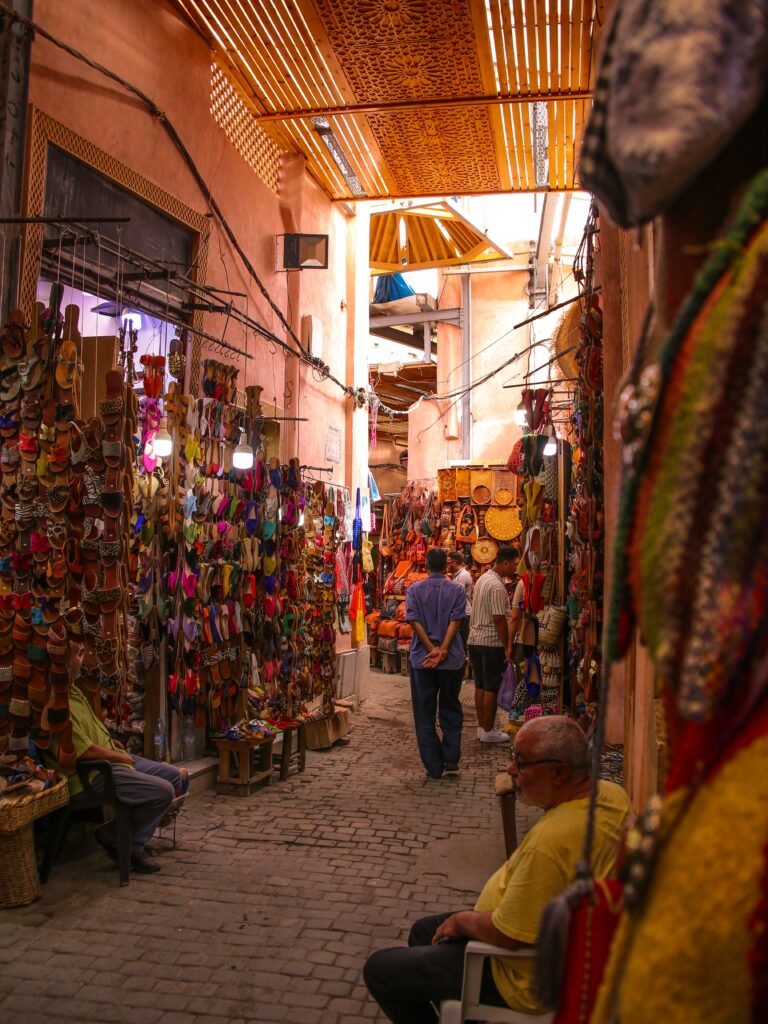
Marrakech is Morocco’s cultural and tourism capital, a walled medina of ochre-pink rammed earth at the foot of the High Atlas. It rewards the traveler who slows down. The people who leave frustrated are usually the ones who tried to do it in a hurry, in the wrong season, with every hour booked.
This free guide is for first-time and returning visitors who want a working plan: when to come, where to sleep, how the souks are organized, which monuments earn their ticket, and how to handle the hustles without letting them spoil the trip.
Marrakech at a glance
| Where it is | Central Morocco, on the Haouz plain at 466 meters, with the High Atlas directly to the south |
|---|---|
| Best time to go | March to May and September to November; winter is cold at night but bright and underrated |
| How long to stay | Three to five days, including one day out of the city |
| Getting there | Marrakech Menara Airport (RAK), 6 km from the center; trains from Casablanca (about 3 hours) and Rabat (about 4) |
| Daily budget (planning range) | Backpacker 350 to 600 MAD; mid-range 900 to 1,800 MAD; luxury from 3,500 MAD per person, excluding flights |
| Language(s) | Darija and Tamazight; French widely spoken; English growing in tourism |
| Good for | Riads, souks and crafts, palaces and gardens, food, hammams, Atlas day trips |
The story of Marrakech
The Almoravid dynasty founded Marrakech in 1070, where trans-Saharan caravan routes met the passes of the High Atlas. It became the capital of an empire that at one point reached into Spain, lost that status, regained it under the Saadians in the 16th century, lost it again, and settled into its current role. The 12th-century Koutoubia minaret is the architectural ancestor of the Giralda in Seville and the Hassan Tower in Rabat.
The city’s color comes from pisé, the local rammed earth, and from a municipal rule that keeps new construction in the same ochre-pink range. That is why the whole place reads as one material, even where it is brand new.
For visitors, Marrakech has four parts. The medina is the walled old city, a UNESCO World Heritage site. Gueliz is the colonial-era new town, with boulevards, galleries and the restaurants locals choose for themselves. Hivernage holds the large international hotels. The Palmeraie is a belt of palm groves and pool retreats 20 to 40 minutes from everything else.
What to see in Marrakech
Admission prices here are planning ranges and change without notice, so confirm at the ticket window. Most sites open around 9am.
Jemaa el-Fna and the souks
The main square is ordinary by day; from about 6pm the food stalls assemble and it becomes theater. North of it, the souks are a historic guild system, each section dedicated to one trade: Semmarine for textiles and babouches, Haddadine for metalwork, Cherratine for leather, Attarine for spices and argan oil. Souk Sebbaghine, the dyers’ lane with wool drying overhead, is best between 10am and noon. Tip: the Mouassine end is calmer and more design-led, with some fixed-price shops.
Ben Youssef Madrasa
A 14th-century Merinid Quranic college, expanded under the Saadians and reopened in 2022 after restoration. Its courtyard of zellige, carved cedar and Kufic stucco is the finest single interior in the city, and the tiny upstairs student cells show how austere life was. Planning range: 50 to 70 MAD. Tip: go at opening; by 11am the reflection pool is crowded.
Bahia Palace
Built between the 1860s and 1890s for the grand vizier Si Moussa and his son Ba Ahmed, it sprawls without a plan through painted cedar ceilings and marble courtyards. Allow 60 to 90 minutes; planning range 70 to 100 MAD. Tip: come in the first two hours of the day and head straight to the far courtyards.
Saadian Tombs and El Badi Palace
The Saadian royal necropolis was sealed by Moulay Ismail and effectively lost until 1917. Its Hall of Twelve Columns, built for Ahmad al-Mansur, uses Carrara marble and cedar unlike anything else in the city. It is small and congests quickly. El Badi, once called “the incomparable,” is now a vast ruin of courtyards and sunken orange groves with storks on the walls. Tip: pair them on one afternoon.
Jardin Majorelle and the YSL Museum
Around 170 MAD for the garden, roughly 230 MAD with the Pierre Bergé Museum of Berber Arts, and around 330 MAD for a combined ticket adding the Yves Saint Laurent Museum, which traditionally closes on Wednesdays. Tip: book online days ahead in high season and come at opening or in the last 90 minutes.
Koutoubia Mosque
Non-Muslims may not enter, but the 77-meter minaret is the city’s reference point. Tip: see it at dusk from the gardens on its northern side.
Le Jardin Secret and Maison de la Photographie
Le Jardin Secret is a restored riad garden on Rue Mouassine with a working khettara irrigation channel and a tower with one of the best medina views. Maison de la Photographie holds Moroccan photography from the 1870s to the 1950s and a rooftop café facing the Atlas. Tip: both are quiet escapes when the souks become too much.
What to skip
The tanneries are the city’s most persistent hustle: someone hands you mint, walks you to a terrace and asks for a large “tip.” If you want to see them, arrange it through your riad at a fixed price. Skip souk “Berber pharmacy” demonstrations and any cooperative a guide steers you into unprompted.
The Marrakech wedding
A traditional Moroccan wedding historically ran across three to seven days. Modern urban weddings compress it, but most elements survive, and knowing them explains the neggafa shopfronts and takchita workshops you pass in the medina. In Lina’s films the wedding is dramatized with AI; the traditions shown are real. Details vary between families.
- Khotba, the engagement. The groom’s family formally asks for the bride’s hand, bringing gifts such as sugar cones, milk, dates and fabric.
- The contract. The aqd al-nikah is signed before two adouls, traditional notaries, and the dower is agreed. This is the legal marriage; the party may come months later.
- Hammam night. The bride goes to the hammam with her closest women, with milk, rose water, ghassoul clay and singing.
- Laylat al-Henna. The bride traditionally wears green while a henna artist paints her hands and feet. Motifs vary by region, more geometric in the south and more floral in the north. The groom is absent.
- The main night. Often 9pm until dawn. The bride makes three to seven entrances in different outfits, managed by the neggafa, a wedding director and stylist specific to Morocco. The peak is her arrival in the amariya, a palanquin carried by four men, greeted by the youyou, a sustained trilling ululation.
- Afterward. A family breakfast, and sometimes a seventh-day meal, now often skipped in cities.
The city’s signature sound is Dakka Marrakchia, a UNESCO-recognized percussion form in which a dozen or more men play taarija clay drums with layered clapping in call-and-response. If you are ever invited, dress formally and modestly, bring cash in an envelope for the family, and never photograph anyone at the henna night without permission.
What to eat in Marrakech
- Tanjia Marrakchia: the city’s own dish, beef or lamb with preserved lemon, cumin, saffron and smen, slow-cooked in a clay urn in the embers of a hammam furnace; many places need a day’s notice.
- Tagine: chicken with preserved lemon and olives or lamb with prunes and almonds; a good one has a glossy, reduced sauce.
- Pastilla: layered warqa pastry with pigeon or chicken, almonds and cinnamon, sweet and savory at once.
- Mechoui: whole lamb slow-roasted in a pit and sold by weight at the stalls off Jemaa el-Fna.
- Couscous: the Friday dish in Moroccan homes, steamed and served with seven vegetables or caramelized onion and raisin.
- Harira and bissara: the tomato, lentil and chickpea soup, and a broad bean purée that makes a cheap, excellent breakfast.
At the night stalls, eat where Moroccan families are eating and agree the total first. Alcohol is served in licensed hotels, riads and Gueliz restaurants, not at medina stalls.
Getting there and getting around
Marrakech Menara Airport (RAK) is 15 to 25 minutes from the center, with passport queues of 45 to 90 minutes at peak times. A pre-arranged riad transfer (planning range 150 to 250 MAD) is worth it on a first visit, because someone walks you to a door you would not otherwise find. The official taxi desk charges roughly 100 to 150 MAD; agree the fare at the desk. Bus 19 runs to Jemaa el-Fna and Gueliz. ONCF trains leave from Gueliz; first class is a small premium and guarantees a seat.
In the medina, walk. Beige petits taxis must use the meter: say “compteur, s’il vous plaît.” Medina-to-Gueliz runs roughly 20 to 40 MAD, with a legitimate 50% surcharge after 8pm; if a driver quotes a flat 100 MAD, try the next one. A private driver for a day trip runs roughly 700 to 1,200 MAD. Do not rent a car for the city itself.
Where to stay
Stay in a riad, a traditional courtyard house, for at least part of the trip. The appeal is silence in a city of 1.5 million. Riads do character and rooftop breakfasts well, and lifts, luggage and winter heating badly.
- Around Jemaa el-Fna and the Kasbah: closest to everything, and noisiest.
- Mouassine and Dar el Bacha: the best compromise, central and calmer.
- Riad Laarous and Bab Doukkala: quieter and residential, a 15-minute walk in.
- The Mellah: the historic Jewish quarter near Bahia Palace, quiet and less polished.
- Gueliz or Hivernage: hotels with lifts and pools, better for mobility limits or small children.
- The Palmeraie: for a honeymoon or a reset, not a first visit.
Planning ranges per double room: budget 150 to 500 MAD, mid-range 600 to 1,600 MAD, luxury from 2,500 MAD. Ask how far the riad is from the nearest taxi point, and in winter confirm real heating.
Etiquette, dress and safety
In the medina, women will be most comfortable with shoulders and knees covered and a scarf in the bag. Men should not go shirtless away from a pool. Greet before you transact with “salam alaikum,” give and receive with the right hand, and accept the tea. Ask before photographing people, especially women. Non-Muslims may not enter mosques. Same-sex relationships are criminalized under Moroccan law, so public discretion is the pragmatic advice.
Marrakech is statistically safe; the issue is friction. Know these hustles:
- The helpful stranger who says the street is closed and leads you to a shop. Say “la, shukran” and keep walking.
- Henna in the square, started on your hand before a price is agreed.
- The “broken” taxi meter. Agree the meter or fare before the door closes.
- Monkey and snake photos, which are charged and often involve mistreated animals.
- False guides. Official guides carry a tourism ministry badge.
When bargaining, decide your ceiling privately, counter at about 30% of the opening price, and be ready to walk away. Emergency numbers: police 190 from a mobile, ambulance and fire 15.
A 3-day itinerary
Day 1
Morning: Ben Youssef Madrasa at opening, then the metalworkers’ and dyers’ souks. Afternoon: lunch in the medina, then Bahia Palace. Evening: rooftop tea above Jemaa el-Fna, then a stall dinner in the square.
Day 2
Morning: Jardin Majorelle at opening, pre-booked, and the YSL Museum. Afternoon: lunch in Gueliz, then the Saadian Tombs and El Badi. Evening: a hammam around 6pm and a quiet riad dinner.
Day 3
Morning: the Ourika valley for the lower Setti Fatma falls, or Le Jardin Secret in town. Afternoon: a riverside lunch, or slow shopping in Mouassine. Evening: sunset dinner in the Agafay desert, a stony landscape 30 to 45 minutes away, not the Sahara. With more time, add a night in Essaouira.
The premium Marrakech guide
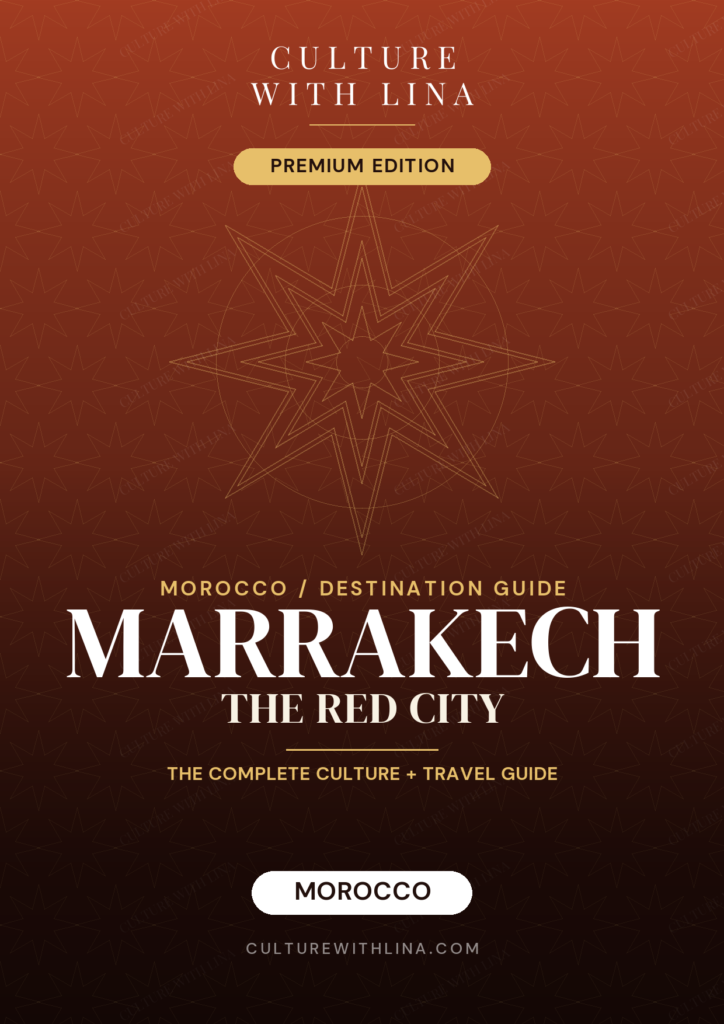
Marrakech — The Red City | Culture & Travel Guide
A Marrakech travel guide in 40 illustrated pages. The medina decoded souk by souk, a bargaining script that works, every monument with the right arrival hour, and the full wedding sequence.
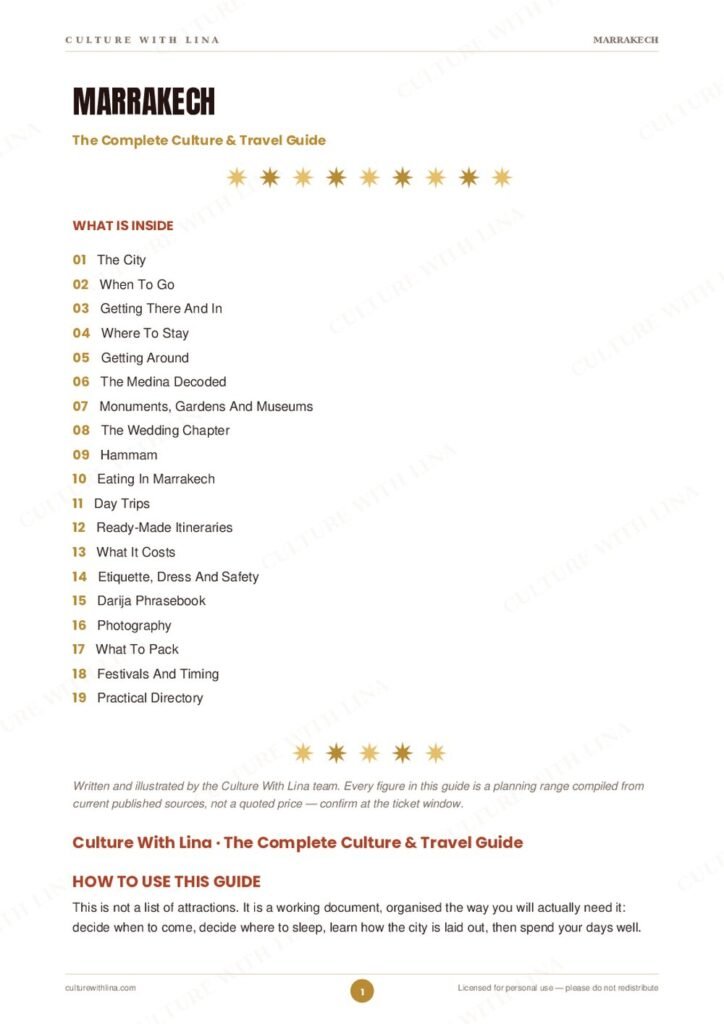
- The medina decoded: souk-by-souk map of trades and a bargaining script
- Monuments, gardens and museums with honest verdicts and planning prices
- The full wedding chapter: neggafa, amariya, takchita and Dakka Marrakchia
- Day trips, ready-made itineraries and a what-it-costs breakdown
- Darija phrasebook, photography spots, packing list and practical directory
Instant PDF download. Licensed for personal use.
Marrakech: frequently asked questions
How many days do you need in Marrakech?
Three days covers the main monuments, the souks and one day trip. Five days adds an Atlas day and time to shop without rushing.
Is Marrakech safe for tourists?
Yes. Violent crime against visitors is rare. Persistent selling and small scams are common; watch bags in crowds and take taxis at night.
What should women wear in Marrakech?
In the medina, cover shoulders and knees with loose trousers or long skirts, and carry a scarf. Gueliz is more relaxed.
Can you drink the tap water in Marrakech?
It is chlorinated and locals drink it, but bottled water is the low-risk choice for a short trip.
Can you visit the Sahara on a day trip from Marrakech?
No. Merzouga is eight to nine hours each way and needs at least three days. Agafay is the realistic day-trip substitute.
Look inside the premium guide
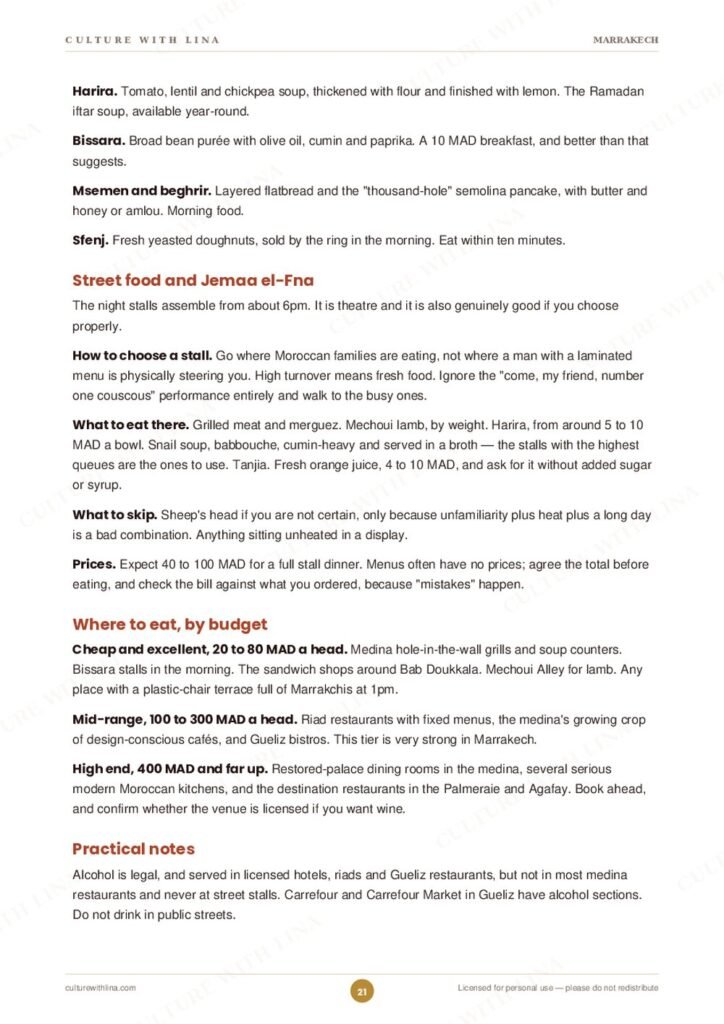
About this guide. Culture With Lina is presented by Lina, an AI travel creator. This page and the premium PDF are researched and compiled from published sources, official information and local reporting; they are not a first-hand trip report. The images and films are made with AI tools. Prices are planning ranges, not quotes, so confirm locally before you travel. Spotted something out of date? Tell us.
Before you go: two practical guides for Marrakech: how bargaining works in the souks and what to expect at a hammam.
Before you eat out: our practical guide to eating in Morocco covers the dishes you will see on menus, table manners and how to approach street food.