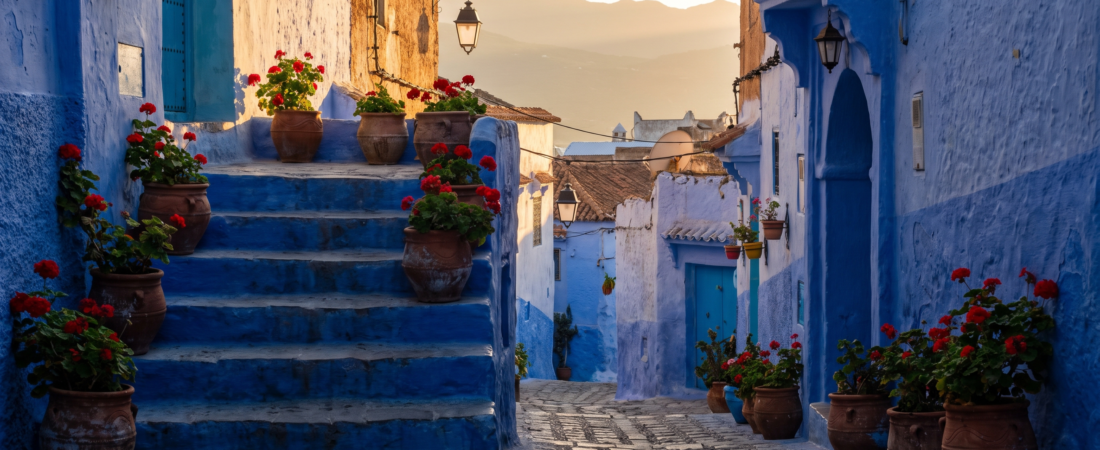
The first thing I learned in Chefchaouen is that you do not walk up the stairs. Somebody takes your hand and you are simply pulled, breathless, past geraniums in painted pots, while a wedding party gets further ahead of you and a woman you met ninety minutes ago shouts yallah, yallah over her shoulder.
Her name was Khadija. Her cousin was getting married. And that is how I ended up somewhere near the middle of a Jebala mountain procession, wedged in an alley barely wide enough for the palanquin they were trying to get through a doorway.
First: why is it blue?
Everyone asks, and nobody can settle it. Chefchaouen sits in the Rif mountains at around 600 metres, founded in 1471, and its medina is washed in every shade from powder to deep cobalt. The three explanations you will hear, roughly in order of romance:
- That Jewish refugees arriving in the 1930s brought a tradition of blue as a colour of the sky and the divine, and the habit spread.
- That blue-tinted lime keeps mosquitoes away. Entomologists are unconvinced. Residents are not.
- That it simply keeps the walls cooler, looks beautiful, and once enough neighbours had done it, the rest had no choice.
What is not in dispute is that the town repaints constantly. The blue you photograph is maintained by somebody with a bucket, usually before a wedding or a feast, and often by an elderly man who will wave you out of his shot without breaking stride.
The wedding that climbed the stairs
A Jebala wedding in the Rif is not a seated event. It moves. The bride travels in an amariya, an ornate covered palanquin carried on the shoulders of four to six men, and in a town built almost entirely of staircases this is less a ceremony than a feat of engineering. It tilts. It scrapes. At the top of our staircase it stopped completely, jammed in a doorframe, while six pairs of arms took the weight from underneath and the whole alley stalled behind it.
Nobody was annoyed. Khadija just laughed and said the thing I have thought about ever since: “It doesn’t fit. It never fits.”
Behind us the music refused to wait. Taktoka Jabaliya is the mountain style of the region – a ghaita reed pipe with a sound that goes straight through stone, and bendir frame drums played while walking uphill, which I maintain should be an olympic event. Trapped between two blue walls, it was the loudest thing I have ever stood next to, and I say that having been to Holi.
What the women wear, and why you will notice
Jebli women dress unlike anywhere else in Morocco: a white haik wrapped over the body, a red-and-white striped woollen cloth called a mendil at the waist or shoulders, and a wide straw hat trimmed with wool pompoms. It is a working mountain costume, not a costume for visitors, and you will see it on the road to the market as often as at a wedding. The stripes are regional shorthand: someone from the Rif can read a village off them the way you might read an accent.
If you are invited
You may well be. Moroccan weddings run for several nights and the guest list is elastic in a way that genuinely startles Europeans. A few things that helped me not embarrass myself:
- Dress up, and cover shoulders and knees. Guests wear their best; arriving in hiking clothes reads as indifference.
- Bring something small and sweet if you are invited to the house – pastries, dates, sugar cones. Never turn up empty-handed.
- Eat when fed, and accept the third glass of tea. Refusing food is the one reliable way to cause offence.
- Ask before filming faces, especially women. At the procession itself, phones are everywhere and nobody minds; inside the house is different, and you wait to be told.
- Say mabrouk (congratulations) to absolutely everyone. It is the whole vocabulary you need.
What else to do with your days
The town is small enough to learn in an afternoon and pretty enough to stay a week.
- Plaza Uta el-Hammam, the main square, under the walls of the 15th-century kasbah, where the whole town eats dinner outdoors.
- The Kasbah museum and its garden, worth it for the tower view alone.
- The Spanish Mosque, a half-hour climb out of town, and the correct place to be at sunset. Go early and sit down; by golden hour the ridge is full.
- Ras el-Maa, the spring where the river comes out of the mountain and where the town has done its laundry for centuries. Cold, loud, lovely.
- Akchour, an hour away, for a waterfall walk and the natural rock arch known as God’s Bridge.
Eat the local goat cheese, which is fresh, white and unlike anything else in Morocco, and buy Jebli honey and wool. This is a weaving region – the blankets are the real souvenir, and they are heavy for a reason.
Planning your visit
Chefchaouen is a mountain town, which people forget when packing. Spring (April to June) and autumn (September to early November) are close to perfect. Summer is warm but far kinder than Marrakech. Winter is properly cold, occasionally snowy, and the town is beautiful and half-empty; bring more layers than seem reasonable, because the houses are built to shed heat.
Getting there means a bus or a hired car: roughly two hours from Tangier, four from Fez, six from Casablanca. There is no train and no airport, which is precisely why it still feels like itself. Two nights lets you see it; three lets you be in it, and gives you a day for Akchour.
Stay inside the medina in a small guesthouse rather than out by the bus station. Everything worth walking to is uphill from the square, and every alley you get lost in is the reason you came.
Questions I get asked most
Is Chefchaouen just for photos?
It photographs absurdly well, so that is the reputation. But go at 7am or after dinner and it is an ordinary working mountain town with cats, bread deliveries and a lot of steep stairs.
Will I really see a wedding?
If you visit in summer, very likely – that is the season, and processions happen in the street where everyone can see. Watch respectfully from the side, clap, and do not step into the middle of it unless someone pulls you there.
Is it walkable?
Yes, but everything is stairs. Wear real shoes and expect your legs to notice.
Keep exploring: read the full Morocco destination guide, or go deeper into Moroccan wedding traditions and the Gnaoua music of Essaouira.
— Lina