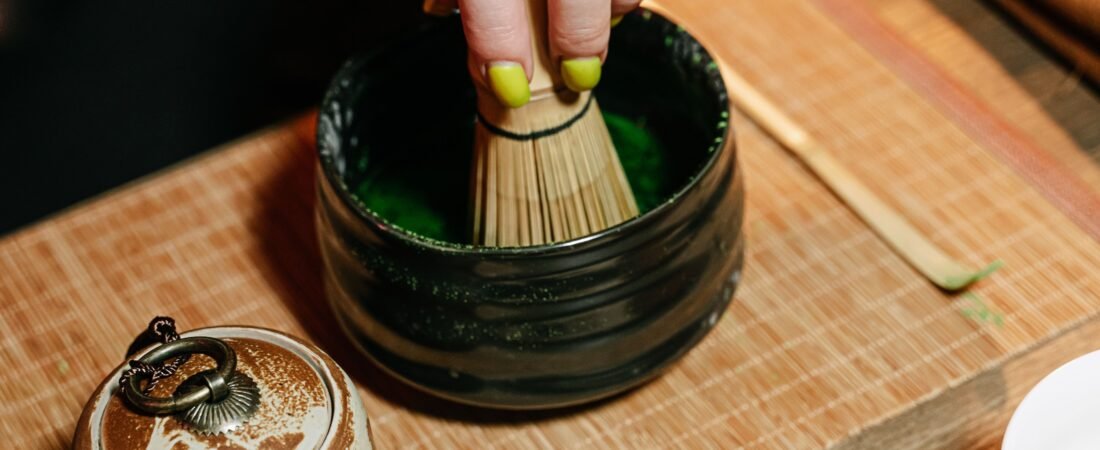
I signed up for a Kyoto tea ceremony thinking it would be a pleasant hour of cultural tourism. I left having been quietly, thoroughly rearranged.
Chanoyu, “the way of tea,” is not a beverage service. It is a four-century-old choreography in which every gesture, the fold of a cloth, the turn of a bowl, the angle of the whisk, has been considered, refined, and stripped of everything unnecessary. Watching it performed properly is like watching someone think clearly with their hands.
What actually happens
Our host, a tea master in a soft grey kimono, led us through a low garden to the tea house. You enter through a door so low you must bow to pass, a deliberate design: samurai once had to leave their swords outside, and everyone, whatever their rank, enters tea humbled.
Inside: tatami, a hanging scroll, a single seasonal flower, and near-silence. She cleansed each utensil in slow, precise movements that were somehow riveting. Water murmured in the iron kettle, a sound with its own name, matsukaze, “wind in the pines.” She whisked the matcha, bright green and frothed, and served each guest with a bow. You turn the bowl before drinking, admire it after, and say thank you. That is all, and it is enormous.
The philosophy underneath has a phrase: ichi-go ichi-e, “one time, one meeting.” This exact gathering, these people, this light, will never occur again, so it deserves complete attention. I have thought about it roughly weekly since, usually while doing three things at once.
Four centuries of getting simpler
Tea reached Japan from China more than a thousand years ago in the sleeves of Buddhist monks, who drank it to stay awake through long meditation. But the ceremony as it exists today was shaped in the sixteenth century, above all by the master Sen no Rikyu, who stripped away opulence in favor of small rooms, humble utensils, and total presence. His aesthetic, the one people now call wabi-sabi, finds beauty in the imperfect and the unfinished: a bowl with an irregular glaze is treasured over a flawless one, because it could only be itself.
Schools of tea founded by Rikyu’s descendants still teach today, centuries on, with students all over the world. That is worth sitting with. The thing you are watching in that quiet Kyoto room is not a reenactment; it is a living discipline, passed hand to hand, whisk to whisk, in an unbroken line, and your host has likely studied it for decades. The bow at the end is not theater.
How to experience it as a visitor
- Kyoto has many ceremonies open to visitors, from casual 45-minute introductions to formal seatings. Book ahead; small rooms fill fast.
- Look for sessions where the host explains as she goes. As a first-timer you want the annotated version.
- Wear socks without holes (shoes come off), sit through some floor-seating, and put the phone away entirely. One session usually allows a photo moment at the end.
- Etiquette is taught on the spot and nobody expects perfection; sincerity outranks accuracy.
- Sweet first, then tea: the wagashi sweet is eaten before drinking, its sweetness designed against the matcha’s pleasant bitterness.
Planning your Kyoto tea moment
Kyoto is loveliest in spring and autumn, which is also when the whole world agrees with you; if crowds wear on you, the shoulder months and even deep winter have their own quiet charm, and tea is served year-round. A rainy afternoon, honestly, might be the perfect ceremony weather. Give Kyoto three or four days as a city, and let the ceremony anchor one of them rather than squeezing it between temples.
Getting there is easy: a little over two hours from Tokyo by shinkansen, or roughly an hour and a half from Kansai airport by train. For the ceremony itself, introductory group sessions generally run somewhere in the range of $20 to 60 per person, with private or formal seatings costing more; book directly with the tea house and check its site for current times and prices, since small rooms mean small calendars. Morning sessions tend to be quieter than afternoon ones.
Making a Kyoto day of it
- A temple garden at opening time. The rock garden at Ryoan-ji or the moss of Gio-ji, before the crowds, extends the same stillness.
- The Philosopher’s Path, a canal-side walk between temples, best strolled slowly for obvious thematic reasons.
- Gion in the early evening, the old geisha district of wooden teahouses, walked respectfully: no chasing anyone for photos.
- A proper matcha stop: Uji, thirty minutes south, has grown Japan’s finest tea for 800 years, and its parfaits are the reward at the end of the pilgrimage.
Small things that change the experience
Arrive ten minutes early and unhurried; the ceremony begins in your nervous system before it begins in the room. If sitting seiza, kneeling on your heels, is beyond your knees, say so when booking, since many hosts quietly provide low stools and nobody will blink. Skip perfume or strong cologne that day, because the scents of tatami, incense, and the tea itself are part of the composition. Two phrases carry you far: arigatou gozaimasu for thank you, and oishii for delicious, both deployed with a small bow. And if you fall for the whole aesthetic, some tea houses offer kimono rental alongside the ceremony, which sounds touristy and feels, in the moment, surprisingly right.
The souvenir that matters
I bought a bamboo whisk, a tin of decent matcha, and a bowl I chose too carefully. Most mornings now, ninety seconds of whisking is my small ceremony before the day starts shouting. It works. That is the entire review.
Coco remained at home for Japan (quarantine rules are serious business), and I have chosen not to tell her that Kyoto has an entire vocabulary of politeness she would have exploited ruthlessly.
Quick answers
How long does a Japanese tea ceremony last?
Visitor sessions in Kyoto usually run 45 minutes to an hour, including an explanation of the gestures. Formal traditional gatherings can stretch to several hours, but those are rarely where first-timers start.
Do I need to know the etiquette in advance?
No. Hosts teach the essentials as you go, from when to bow to how to turn the bowl, and sincerity matters far more than precision. Clean socks and a silenced phone are the only real prerequisites.
Is matcha very bitter?
Properly whisked ceremonial matcha is grassy and gently bitter rather than harsh, and the wagashi sweet eaten beforehand is designed to balance it. Most first-timers are surprised by how much they like it.
Planning your trip? Try my free Travel Budget Calculator to plan your trip with confidence.
— Lina
Planning your own tea ceremony
Kyoto makes this easy for travellers: many tea houses around Gion and Higashiyama hold sessions designed for first-timers, in English, most days of the week. Book a few days ahead in normal months and further out in cherry-blossom season and November’s autumn-leaf weeks, when the city fills. Sessions usually run under an hour; some include wearing a kimono, some pair the ceremony with a walk through a tea garden. Prices vary with how intimate and formal the experience is – check the tea house’s own page for current times and fees rather than third-party listings, which drift out of date.
The etiquette, gently
Nobody expects a visitor to know the choreography, and your host will guide every step. A few things still go a long way: arrive a little early and unhurried, slip your shoes off where shown, and silence your phone completely – this is one hour where it truly matters. Eat the sweet before you drink, since it is there to meet the bitterness of the matcha. When the bowl reaches you, a small bow, then turn it slightly before drinking – your host will show you how. None of it is a test. All of it is attention.
A little context makes it deeper
What looks like serving tea is really a whole philosophy called chado, the way of tea, shaped over centuries by Zen. The rough bowl, the bare room, the single flower in the alcove – that is wabi-sabi, the beauty of the imperfect and the impermanent. And the spirit of the hour is ichi-go ichi-e: this meeting, exactly this one, will never happen again. Once you have felt that in a tatami room, you start noticing it everywhere.
Questions I am always asked
Do I need to speak Japanese?
No – many Kyoto tea houses hold sessions in English, and the ceremony itself communicates more through gesture and silence than words anyway.
I cannot sit on my knees for long. Is that a problem?
Not at all. Say so when you book: most places welcome guests sitting cross-legged or provide low stools, and shorter tourist ceremonies are far gentler on the legs than formal ones.
Can I take photos?
Ask first. Many hosts happily allow a few photos at set moments, but the real souvenir is the hour itself – I promise the bowl of matcha looks better in memory than on a screen.