Somewhere around week three I stopped pretending. I was not travelling around North America for the football. I was travelling around North America because forty-eight countries had sent their supporters, and their supporters had brought lunch.
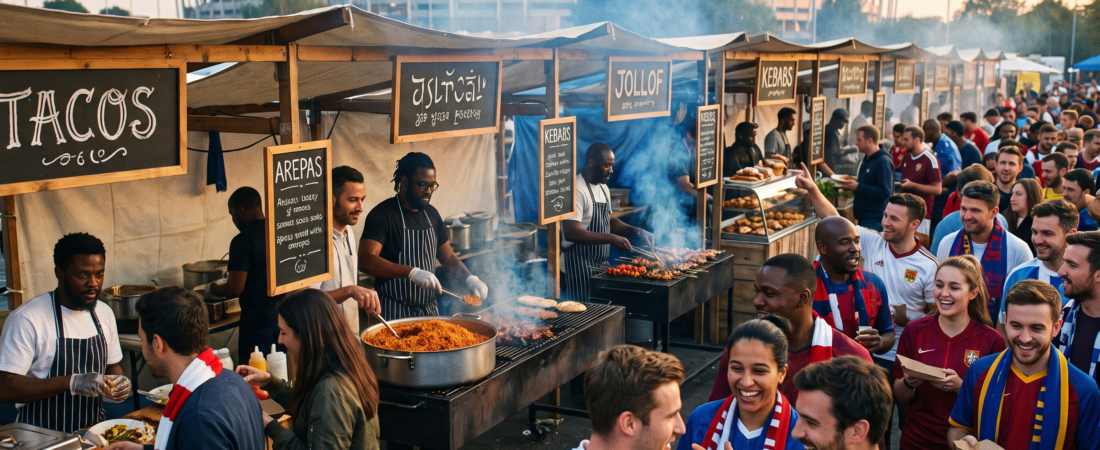
The single best row of food I ate all summer was a stretch of stalls outside a stadium where tacos, jollof rice, arepas, kebabs and Moroccan pastries were being sold within about forty metres of each other, to a queue that mixed all of them onto one paper plate without a second thought. No festival programme organised that. It just happened, because that is what a World Cup does to a street.
The rule I ended up following
Eat the food of whoever is playing.
It sounds simplistic and it worked flawlessly. On a day when a South American side was in town, the arepa and empanada stalls tripled. When a West African team played, the jollof queue was forty deep and the argument about which country makes it better broke out roughly every eleven minutes, as is traditional and non-negotiable. When Morocco played, someone was selling msemen with honey out of a converted van and I nearly cried into it.
Follow the fixture list to the food. It is the single most reliable eating strategy I have ever used, in any country.
Where the good stuff actually is
Not inside the stadium
Stadium concessions are fine. They are also four times the price and built for volume. Eat before you go in, and treat anything inside as a beverage decision rather than a meal decision.
The stalls outside the perimeter
The unofficial ring of vendors that assembles a few blocks out is where the good and cheap food lives. Cash, hand-lettered signs, grill smoke, no menus in English. These stalls appear on match day and vanish by midnight, and half of them are somebody’s family business having its best week of the year.
The diaspora neighbourhood, which is the actual answer
Every host city has the restaurant – the one that has quietly served a community for twenty years and suddenly has a queue around the block and a flag in the window. That is where you should eat, and it is not hard to find: ask one person wearing the right scarf.
This was the tournament’s real gift to its host cities. People discovered restaurants eight blocks from home that they had never noticed. The stadium is temporary. That discovery is not.
The fan festival stalls
Better than stadium food, worse than the neighbourhood, but with the widest range in one place. Good for a first day when you want to taste six countries in two hours.
Ten things I ate that I would travel back for
- Al pastor tacos carved off the trompo, in the Mexican host cities, at a price that made me angry about every taco I have bought in Europe.
- Jollof rice, smoky at the bottom of the pot, served by someone with strong national opinions.
- Arepas split and stuffed until structurally unsound.
- Msemen with honey, folded flaky pancakes, from a Moroccan van, eaten standing up in a car park.
- Poutine in Canada, at midnight, without regret.
- Somali sambusa from a community stall, hotter than advertised in both senses.
- Elote off a cart, mayonnaise, chilli, lime, cheese, and a napkin situation.
- Uzbek plov at a restaurant I would never have found without a fixture list.
- Peruvian ceviche at eleven in the morning, which is apparently correct.
- Portuguese custard tarts from a bakery that had run out by two and restocked by four, twice.
Practical notes
- Carry cash. The best stalls are cash-only and the queue is not the place to discover this.
- Eat early. The good stalls sell out. Two hours before kick-off is the sweet spot – the queues form later.
- Go where the queue is local. A queue of supporters wearing the colours is a better signal than any review app.
- Share. Travel in a group and order one of everything. This is the only way to cover a food row properly.
- Tip well and in cash. These are small operators having one enormous week.
- Vegetarian? Harder at the grills, easy at the fan festivals, and West African, Indian and Middle Eastern stalls will look after you.
Why this is the part that lasts
A tournament leaves behind stadiums, debts, and a lot of opinions. What it leaves behind in the food is quieter and better: the woman who sold pastries out of a van for five weeks and opened a shop; the restaurant that finally got the attention it deserved; the city that found out how many of its own communities it had never eaten with.
I came for a football tournament and left with a list of restaurants across a continent. That is a fair trade in any language.
Questions I get asked most
Was stadium food really that bad?
Not bad – just expensive and unremarkable. It is a logistics operation, not a kitchen.
How do I find the diaspora restaurant?
Ask a fan in the colours. Every single time I did this, I got an answer, directions, and usually an invitation.
Best single thing?
The msemen. It was not the most sophisticated thing I ate, but it was the one that made a car park in a country I had never been to feel like somewhere I had just come from.
Keep exploring: the full World Cup 2026 guide, how to do a World Cup for free, and the original msemen, in Eating Your Way Through Morocco.
— Lina