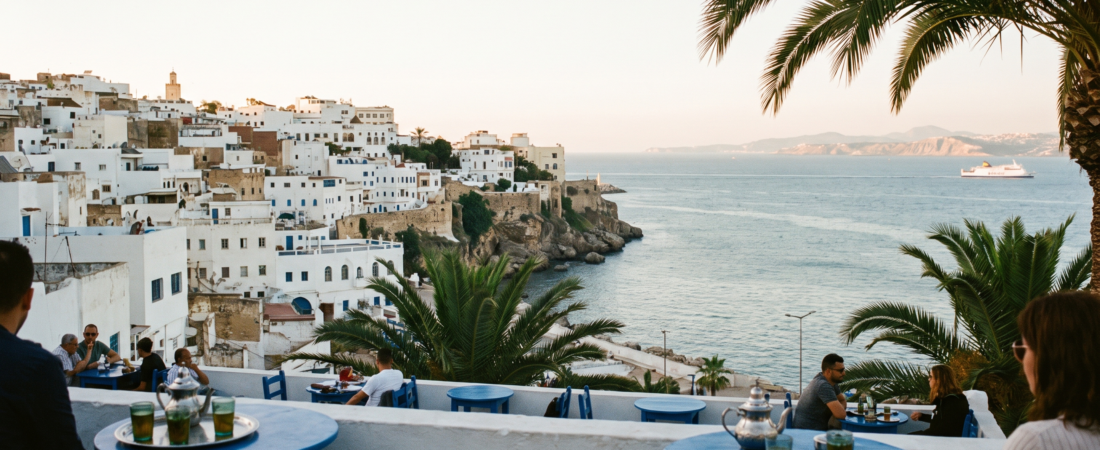
There is a cafe terrace in Tangier where, on a clear afternoon, you can drink mint tea and see Spain. Not a hazy suggestion of Spain – actual hillsides, actual buildings, fourteen kilometres of water away. I sat there having arrived from Seville a few weeks earlier and felt the geography rearrange itself in my head.
Tangier is the hinge of the whole region. Africa and Europe stare at each other across the Strait of Gibraltar, the Mediterranean meets the Atlantic just off the coast, and the city has spent most of its history being claimed, shared and argued over by everybody.
The strangest legal arrangement in modern history
From 1924 to 1956, Tangier was an International Zone – jointly administered by France, Spain, Britain and later others, with its own currency regime, minimal tax and famously relaxed oversight. It became a magnet for spies, smugglers, exiles, bankers and writers.
Paul Bowles lived here for over fifty years. Burroughs wrote much of Naked Lunch in a room in the medina. Matisse painted here and never quite recovered from the light. The Rolling Stones came for the Master Musicians of Jajouka. That reputation – louche, literary, slightly dangerous – hung over the city for decades, long after the actual International Zone ended.
It is not that city any more. Since the 2000s Tangier has been comprehensively rebuilt: a vast new port at Tanger Med, a high-speed train to Casablanca, a cleaned-up seafront, restored medina walls. Some people mourn the old disorder. Most residents do not.
What to do
- The Kasbah, the walled citadel at the top of the medina, and the Kasbah Museum in the old sultan’s palace – go for the courtyard, the mosaics and the view down over the strait.
- Petit Socco and Grand Socco, the two squares that organise the old town. Sit in Cafe Tingis on the Petit Socco and watch the city walk past; this is the entire activity and it is enough.
- Cafe Hafa, opened in 1921, terraces stepping down the cliff above the water, mint tea and a view straight at Europe. Every writer who ever lived here sat in this cafe.
- Cap Spartel and the Caves of Hercules, twenty minutes west, where the Atlantic and Mediterranean meet and a sea cave has an opening shaped almost exactly like a map of Africa.
- The American Legation Museum, the only US National Historic Landmark abroad, in a rambling medina building – a genuinely lovely small museum.
- The beach and the Corniche, especially at dusk when the whole city comes out to walk.
What Tangier tastes like
Being a port on two seas, Tangier eats extremely well and slightly differently from the rest of Morocco. Expect more fish, more Spanish influence, and the best calamares outside Andalusia. The Grand Socco market and the fish market are worth going to hungry.
Look out for pescado a la plancha straight off the grill, sardine mchermel in a charmoula marinade, and the sweet-savoury Fassi pastilla rebuilt here with seafood. And the tea. Tangier does mint tea as an afternoon-long institution, not a drink.
Where to go from here
Tangier is the best base in the north. Chefchaouen is two hours south, and the day-trip buses run constantly – though the blue city deserves a night or two of its own. Asilah, a small whitewashed Atlantic town covered in murals, is 45 minutes down the coast and criminally underrated. And Tarifa, in Spain, is a 60–90 minute ferry ride, which makes an absurd and delightful day trip: two continents, one afternoon.
Planning your visit
The high-speed Al Boraq train reaches Casablanca in a little over two hours and Rabat in around 75 minutes, which makes Tangier an easy first or last stop rather than a detour. Ferries connect to Tarifa and Algeciras several times a day.
Spring and autumn are the sweet spot – warm, clear, and with the strait at its bluest. Summer is busy with Moroccan and Spanish holidaymakers and genuinely fun. Winter is mild but wet; the north gets the weather the rest of Morocco does not.
Two nights is enough for the city; three lets you add Asilah or Cap Spartel without rushing. Stay in the medina or the Kasbah rather than the modern seafront – the atmosphere you came for is inside the walls.
Questions I get asked most
Is Tangier safe?
Yes. Its old reputation lags decades behind reality. Normal city sense in crowds, ignore anyone insisting on guiding you, and the medina is fine to walk in the evening.
Is it worth more than a stopover?
Most people give it half a day between a ferry and a bus, and that is a mistake. The city is at its best in the slow hours: late afternoon on a terrace, evening on the Corniche.
Can I really see Spain?
On a clear day, easily – the Spanish coast, the hills behind Tarifa, and at night the lights. It is the single most striking thing about the city.
Keep exploring: the full Morocco destination guide, the blue stairs of Chefchaouen two hours south, and – across the water – Spain.
— Lina