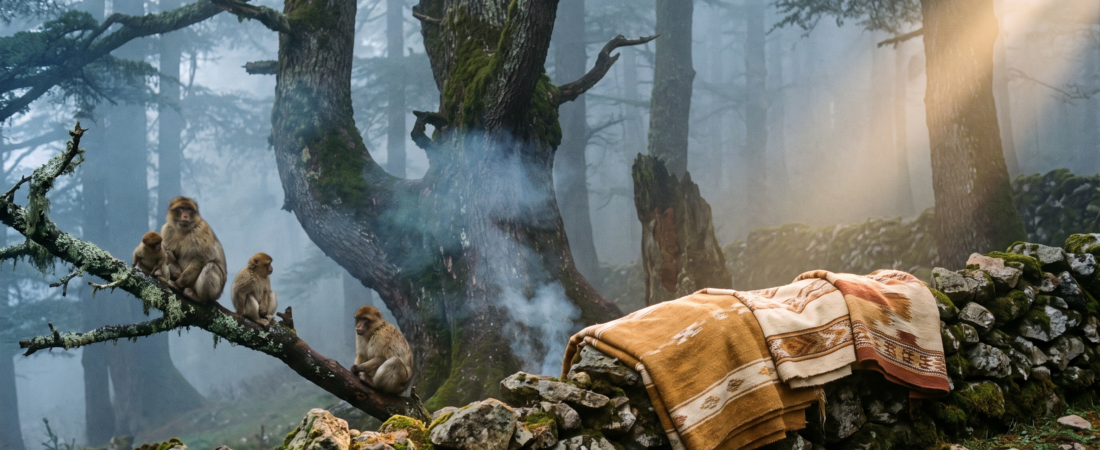
Three hours after leaving the oldest continuously inhabited medieval city in the world, I was sitting in a cedar forest in the fog, wrapped in a wool blanket the colour of ochre, being stared at by a monkey. Morocco does this. The country changes register faster than anywhere I have travelled.
Fez and the Middle Atlas belong together on an itinerary, and almost nobody puts them there. Everyone flies to Marrakech, does the desert, and goes home. This is the other Morocco – older, cooler, greener, and considerably less used to visitors.
Fez el-Bali: 9,000 alleys and no cars
Founded in the 9th century, Fez was Morocco’s capital for long stretches of its history and remains its spiritual and intellectual heart. Its old medina, Fez el-Bali, is a UNESCO World Heritage site and one of the largest car-free urban areas on earth. Goods still move by mule and handcart, and you will be flattened against a wall by both.
Where Marrakech performs for you, Fez mostly ignores you, and I found that oddly restful. It is harder to navigate, less polished, and more rewarding. Its alleys are narrower, its craftsmen more numerous, and its sense of being a working city rather than a destination much stronger.
What not to miss
- Al-Qarawiyyin, founded in 859 by Fatima al-Fihri and recognised by UNESCO and Guinness as the oldest continually operating degree-granting university in the world. Non-Muslims cannot enter the mosque, but the library and the courtyard views from neighbouring rooftops are extraordinary.
- Bou Inania and Al-Attarine Madrasas, 14th-century schools open to all visitors, and the finest carved cedar, stucco and zellij you will see anywhere. Al-Attarine in particular is a small perfect room.
- The Chouara tanneries, worked in stone vats since the 11th century using methods that have barely changed. You view them from the leather shops’ terraces above. They will hand you mint. It is not decorative.
- Bab Bou Jeloud, the blue gate, and the two main arteries that run down from it – your only reliable compass points.
- The Jewish Mellah and the Ibn Danan Synagogue in Fez el-Jdid, a part of Moroccan history too often skipped.
What Fez makes
Fez is Morocco’s craft capital and it is not close. Fassi blue-and-white ceramics, hand-cut zellij tiles, brass and copperwork hammered in the Seffarine square (you will hear it before you find it), embroidery, and leather from those tanneries. Watching a zellij cutter chip a star out of a glazed tile with a hammer is thirty seconds that will change how you look at every wall in the country.
Into the Middle Atlas
Drive south from Fez and within an hour the landscape stops being North African and starts being alpine. This is the Middle Atlas: cedar forest, volcanic lakes, cold mornings, and Amazigh (Berber) towns that feel a very long way from the coast.
- Ifrane, built by the French in the 1930s with pitched roofs and dormer windows, which everyone calls “little Switzerland” and which is genuinely disorienting to arrive in. It holds Africa’s lowest recorded temperature.
- Azrou, a real market town rather than a resort, and the gateway to the cedars. Its Tuesday souk is the best place in the region to buy Amazigh wool.
- The Cedar Forest of Azrou, home to the Gouraud Cedar and to troops of Barbary macaques – the only macaque species in Africa, and endangered. Please do not feed them; the peanut trade sold at the roadside is actively harming them. Watch, photograph, move on.
- Lakes and springs: the Dayet Aoua and Dayet Ifrah lakes, and the source of the Oum Er-Rbia, where forty-odd springs come out of a cliff at once.
Wool, tea, and the smell of wood smoke
What I remember most is not a monument. It is a stone wall outside Azrou with blankets over it in cream and ochre, sold by the women who wove them, and a glass of tea handed over in the cold with the confident assumption that I would want a second.
Middle Atlas weaving is a distinct tradition – heavy undyed wool, geometric Amazigh motifs, and the handira, the sequinned wedding cape a bride wears and later uses as a blanket. If you buy one textile in Morocco, buy it here rather than in a Marrakech tourist souk, and pay properly.
Planning your visit
Give Fez three nights – it takes a day just to stop feeling ambushed – and add two for the mountains. A hired car makes the Middle Atlas straightforward; grands taxis run between towns if you would rather not drive.
Season matters more here than elsewhere in Morocco. Spring and autumn are ideal. Summer in Fez is punishing, but the mountains an hour away are pleasant, which is exactly why Moroccan families go there. Winter brings snow to the Atlas, closes some passes, and turns Ifrane into a ski town.
Hire an official guide for your first day in the Fez medina. This is not the place to prove you can navigate; the layout defeats people who have lived there. After one guided morning you will manage on your own.
Questions I get asked most
Fez or Marrakech?
Marrakech if you want spectacle and comfort, Fez if you want depth and craft. If you have a week, do both – they are a comfortable train ride apart and they explain each other.
Are the tanneries worth it?
Yes, once. The smell is genuinely strong and the terrace access comes with a firm sales pitch. Decide your budget before you go up.
Is the Middle Atlas doable without a car?
Yes, by bus to Ifrane or Azrou and grand taxi from there, but a car turns it from an expedition into a lovely two-day loop.
Keep exploring: the full Morocco destination guide, getting lost in Marrakech on purpose, and when to go and what it costs.
— Lina
The film: a wedding in Fez
Watch the film
A wedding in Fez: the amariya and the seven takchitas
Guests draped in gold and emerald kaftans, and the bride lifted high on the amariya as the courtyard rises. This is the night the Fes guide's wedding chapter is built on — the negafat carrying the train and turning her slowly so every side of the riad sees the dress, the Andalusian orchestra pushing the nuba into its fast movement, and six more takchitas still to come.
Filmed for the Culture With Lina series. Follow @culturewithlina for the rest.