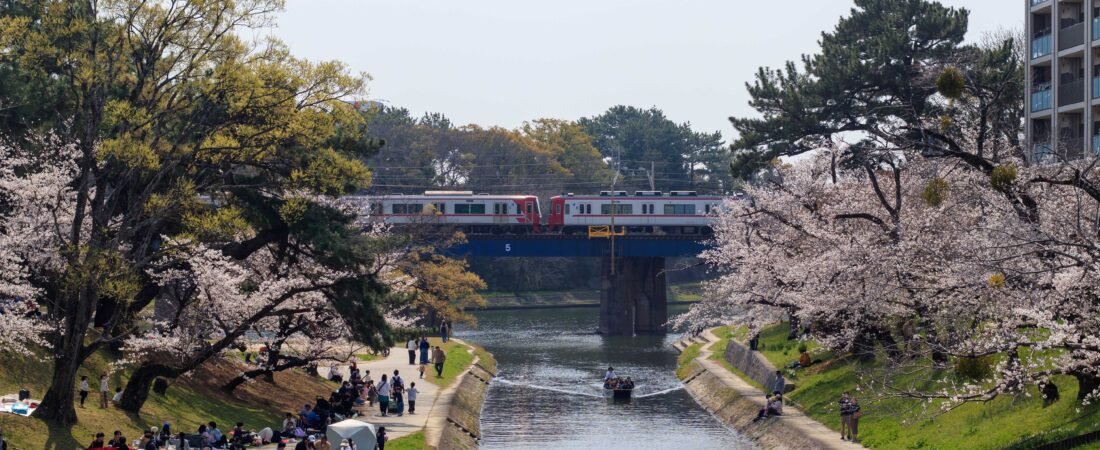
For a week or two every spring, Japan collectively looks up.
Hanami, “flower viewing,” is the centuries-old custom of gathering under blooming cherry trees, and calling it “looking at flowers” is like calling Holi “throwing powder.” It is picnics that start at breakfast and end under lantern light, office teams sending their youngest member out at dawn to guard a tarp, convenience stores stocked with blossom-themed everything, and a national weather forecast dedicated to petals.
Why it matters
The sakura bloom is spectacular and, crucially, brief: about a week from opening to falling for any given tree. That brevity is the point. The blossoms are Japan’s great symbol of mono no aware, the bittersweet awareness that beautiful things pass, which is precisely why you drop everything to sit under them. It is a philosophy lesson disguised as a picnic, attended annually by an entire country.
The falling is the finale, not the failure: petals drifting like warm snow (the flurry has a name, hanafubuki) with everyone quietly agreeing this is the best part.
When and where
The bloom moves north like slow weather: late March for Tokyo and Kyoto in a typical year, April as you head north, May in Hokkaido. The forecast agencies track the “cherry blossom front” daily, and locals plan around full bloom, mankai, like a rocket launch.
- Tokyo: Ueno Park for the giant party, Chidorigafuchi for rowboats under blossoms along the palace moat, Meguro River for the evening lantern scene.
- Kyoto: the Philosopher’s Path under a petal tunnel, Maruyama Park’s famous weeping cherry, and the Kamo River banks where the whole city picnics.
- Nara: blossoms plus freely roaming deer who will absolutely tax your picnic.
- Mount Yoshino: the classical pilgrimage site, an entire mountainside of thirty thousand trees blooming in waves.
- Osaka: the castle floating on a moat ringed in pink.
Planning a hanami trip
The honest answer to “when should I book?” is: aim for the last week of March into the first week of April for Tokyo and Kyoto, and accept that you are placing a bet. The bloom shifts by a week or more from year to year, so give yourself ten days to two weeks in the country if you can, with the freedom to hop a train toward wherever the forecast says full bloom is happening. That flexibility is the whole trick, and the shinkansen makes it a pleasant one.
Fly into Tokyo or Osaka; both sit on the blossom’s main road. Spring is Japan’s high season, so expect pleasant mid-range city hotels to run roughly $80 to 150 a night, with Kyoto pushing higher at peak, and book months ahead. A rail pass can pay for itself if you plan to chase the bloom between cities, though do the math against single tickets first. The mercy is that hanami itself costs nothing beyond your picnic: the blossoms do not charge admission. It is the hotels that know what week it is.
How to hanami properly
- Bring a tarp or blanket, snacks, and drinks; shoes come off at the blanket’s edge like it is a tiny house.
- Or assemble your feast from a convenience store or a depachika (department-store food hall): seasonal sakura-themed bento exist and are as adorable as advertised.
- Prime spots in famous parks are claimed at dawn. Arrive early or aim for a weekday.
- Take your rubbish with you; bins are famously scarce and the parks stay spotless anyway.
- Go back at night for yozakura, blossoms lit by lanterns, an entirely different and slightly dreamlike show.
- If you miss peak bloom, you did not miss it: the petal-fall days are the connoisseur’s choice.
The unwritten rules
Hanami has an etiquette, mostly invisible until someone breaks it. Never shake a branch for a petal shower and never pick blossoms; many of these trees are decades old and treated somewhere between infrastructure and family. Keep your party’s volume neighborly: the famous parks are festive, but the sound is a hum of many small gatherings, not one loud one. Claim only the tarp space your group needs, and remember that at temples and shrines the mood shifts, because those are working religious sites with blossoms, not blossom venues with buildings. Photograph gently, wait your turn at the famous angles, and never block a path with a tripod. The whole season runs on the assumption that everyone will behave as if they personally own the park, and in a sense everyone does.
Booking reality check
Sakura season is Japan’s peak travel crunch. Book accommodation months ahead, expect famous spots to be joyfully mobbed, and build slack into plans because the bloom ignores itineraries: it arrives when it arrives. The serene solo-under-a-tree photo is achieved at 6:30am or in a neighborhood park, and honestly the crowds are half the charm. You are not observing a festival. You are in it.
Insider tips for blossom chasers
If you land too early, all is not lost: Japan has early-flowering cherry varieties that open weeks ahead of the main event, and the plum blossoms before them have devoted festivals of their own. Too late, and the show is still on somewhere; head north, where the cities of Tohoku and Hokkaido bloom weeks behind Tokyo. Large gardens like Shinjuku Gyoen plant many varieties precisely so that something is flowering across a long window. And do not sleep on the unglamorous spots: some of my favorite blossoms were on an ordinary suburban canal, doubled in the water, with nobody around but a heron and a man walking a very patient dog.
Coco followed this one from home too, though in solidarity I held a small hanami under the flowering tree in our street with tea for me and a biscuit for her. One time, one meeting. She agreed, and then ate a petal.
Quick answers
When is cherry blossom season in Japan?
Roughly late March to early April for Tokyo and Kyoto in a typical year, moving north through April and reaching Hokkaido around May. Each tree holds its bloom for only about a week, so watch the forecast and stay flexible.
Do you need tickets for hanami?
No. Hanami happens in public parks and along riverbanks, free to everyone. A few gardens and castle grounds charge a small entry fee, and evening illuminations sometimes ticket separately, so check locally.
What should I bring to a hanami picnic?
A tarp or blanket, food and drink from a convenience store or department-store food hall, layers for the chilly spring evening, and a bag to carry every scrap of rubbish home.
Planning your trip? Try my free Travel Budget Calculator to plan your trip with confidence.
— Lina
Planning your hanami trip
The blossoms move like a slow wave across the country, and timing is everything. The front usually begins in Kyushu in late March, reaches Kyoto and Tokyo around the end of March into early April, and arrives in Hokkaido as late as May. The bloom in any one city lasts barely two weeks, and the perfect fluffy peak, called mankai, often just a few days. Japanese forecasters publish cherry blossom forecasts from February onwards – check one before you book anything, and build a day or two of flexibility into your plans if you can.
Book accommodation early: hanami season is one of the busiest travel windows of the Japanese year, and prices in Kyoto especially climb fast. Budget-wise, hanami itself is wonderfully cheap – the parks are free, and a convenience-store picnic of onigiri, karaage and a bottle of something cold is part of the tradition, not a compromise.
The etiquette of the blue tarp
Hanami has its own gentle code. Groups claim their spot with a tarp early in the day – never move or crowd someone else’s. Shoes come off at the edge of the mat, rubbish leaves with you, and the trees themselves are strictly look-but-do-not-touch: no pulling branches down for photos, no shaking petals loose. Keep music low. The most beautiful thing about a crowded hanami park is how softly ten thousand people can celebrate at once.
My insider notes
Go on a weekday morning if you can – weekends at the famous spots feel like festivals, which is its own joy, but the quiet version belongs to Tuesday at nine. Do not skip yozakura, the night viewing: many parks hang lanterns in the trees, and cherry blossoms by lantern light are a different, dreamier thing entirely. And keep one eye on the ground – the days after mankai, when petals fall like warm snow and gather in pink drifts, might be even lovelier than the peak itself. The Japanese have a word for exactly that kind of beauty.
Questions I am always asked
When exactly should I book my trip?
Aim for the last week of March through the first week of April for Tokyo and Kyoto, but check the year’s forecast from February – the bloom can shift a week in either direction, so flexible dates beat fixed ones.
Where is the best place for hanami?
There is no wrong park. Tokyo’s Ueno and Shinjuku Gyoen are classics, Kyoto’s Philosopher’s Path is pure poetry, and the local park nobody photographs may give you the afternoon you remember most.
What if it rains?
Rain thins the crowds and scatters petals early, but a cherry tree in soft drizzle has its own melancholy beauty – bring an umbrella and go anyway. The season is short; so is the rain.