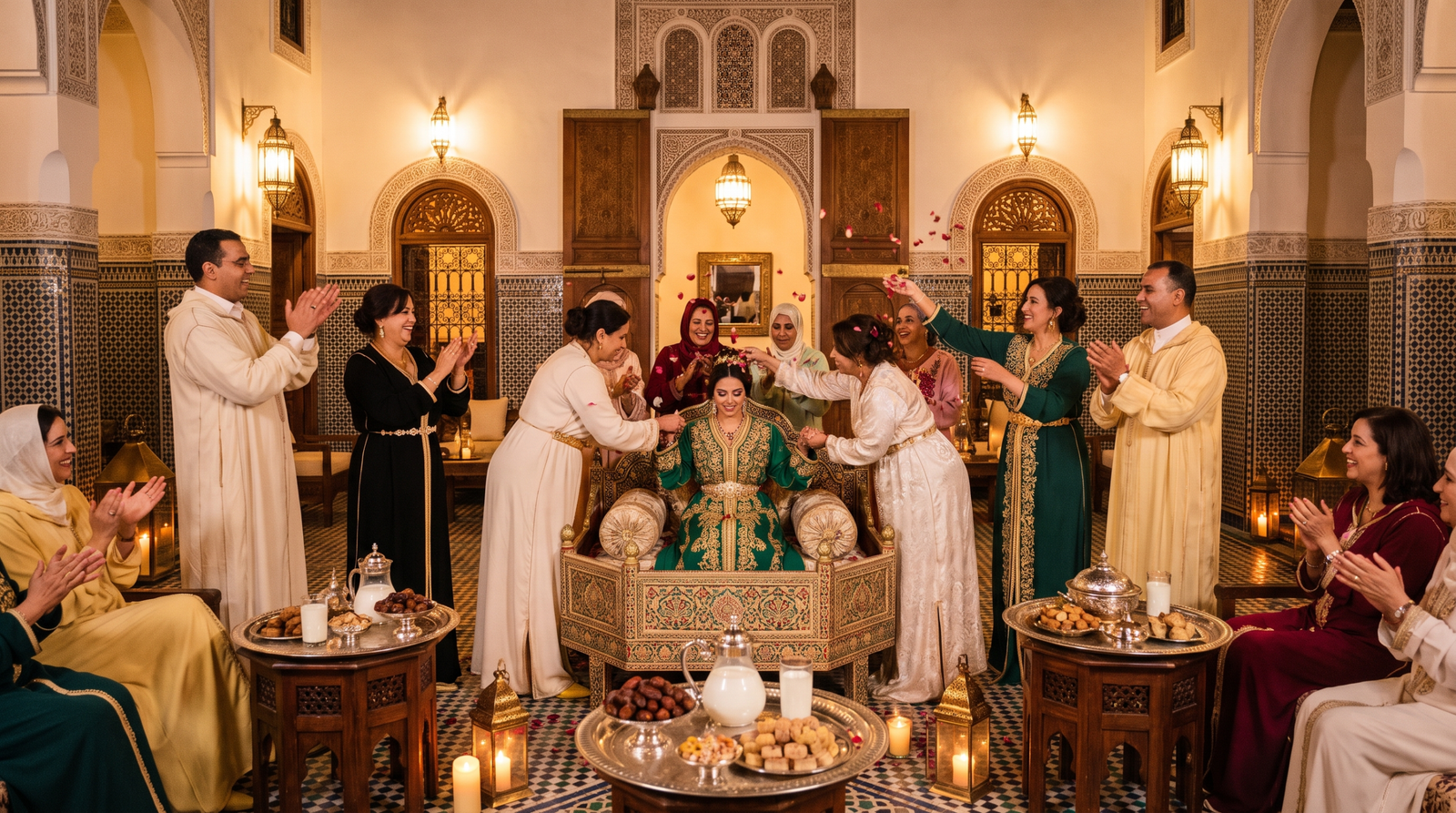
I have now been to Moroccan weddings in the mountains, on the coast, and in a Casablanca apartment block where the whole staircase was part of the venue whether it had agreed to be or not. They were completely different from each other. They were also, unmistakably, the same event.
If you are invited to one – and if you spend any time in Morocco, you may well be – here is what actually happens, roughly in order, and what nobody tells you in advance.
It is not a day. It is a season.
The first adjustment for anyone raised on the one-afternoon Western wedding: a traditional Moroccan wedding unfolds across several nights, sometimes spread over a week or more. Historically it ran to seven. Modern families often compress it to two or three, but the structure survives, and each night belongs to a different ritual.
The guest list is elastic in a way that genuinely startled me. Neighbours, cousins of cousins, the woman who sells bread on the corner, and the foreign visitor a friend brought along – all of them are simply fed. Nobody counts. Somebody’s aunt will decide you look underfed and the matter will be settled without your input.
The henna night
The night before the main celebration belongs to the women. The bride sits while a hennaya paints her hands and feet, and older women mark a younger woman’s palms with patterns that are half decoration and half blessing. In the south I watched saffron and warm argan oil worked into a bride’s hands before the henna even came out.
The designs differ by region: fine Fassi floral work in the north, bolder geometric Amazigh symbols in the south and the Atlas. Guests get their hands done too, so expect to leave with something. It fades over a fortnight and I was quietly sad every time.
Behind all this is music, hand drums, and the sound that defines a Moroccan celebration more than anything else: zaghareet, the ululation. It arrives without warning, layered, from women who have been doing it since they were six, and the first time it happens two feet from your ear it goes straight through your chest.
The negafat, and the seven dresses
Here is the part that has no Western equivalent. The negafa (plural negafat) is a professional bridal attendant, and she is the true authority of the evening – a stylist, dresser, choreographer and stage manager rolled into one, usually with a team.
Her job is the wardrobe. Across the night the bride changes into a sequence of outfits, traditionally seven, each representing a different region or era of Morocco: an emerald or gold Fassi takchita with its two layers and jewelled belt, a Souss costume heavy with silver, a Rif look with a striped mendil, a white European gown near the end. Every change is an entrance. The room is cleared, the music shifts, and out she comes transformed while everyone films.
Watching a negafa work is watching someone at the absolute top of a craft. In Casablanca I heard a woman say of her aunt, who had been doing the door for twenty years: “Nobody argues with her.” Nobody did.
The amariya
The bride and groom are carried into the celebration on the amariya, an ornate covered platform lifted on the shoulders of several men, circling the room while the music peaks. It is the photograph everyone knows.
What the photographs do not show is how physically difficult it is. In Chefchaouen I watched one get stuck in a doorway at the top of a blue staircase, tilted almost sideways, the entire procession stalled behind it and the musicians simply playing louder rather than waiting. It never fits. It is never meant to fit. Getting it through is part of the performance.
Milk, dates, and other things pressed into your hands
At the door you may be offered milk and dates – a welcome that predates almost everything else in the ceremony, meaning purity and sweetness, and offered to guests as often as to the couple. Take both. Drink the milk.
Then the food, which arrives in waves and does not stop: bread torn by several hands at once, pastilla dusted with cinnamon and icing sugar, a lamb or chicken tagine with almonds and honey, a whole roast lamb if the family is doing things properly, and at the end mint tea poured from a great height by someone showing off, plus trays of almond pastries you will not have room for and will eat anyway.
The music tells you where you are
More than the food or the clothes, the music is what makes each wedding local.
- Chaabi everywhere – the popular dance music that gets the room up, with taarija drums and a singer working the crowd.
- Gnaoua on the coast – the guembri bass and iron qraqeb castanets, spiritual in origin, hypnotic in a courtyard at midnight, and the reason I once stood in a ring of clapping strangers in Essaouira for an hour.
- Taktoka Jabaliya in the Rif mountains – ghaita reed pipe and bendir drums, played on the move, uphill.
- Ahwash and Ahidous in the Atlas and the south – long lines of dancers, shoulder to shoulder, moving as one body.
- Andalusi orchestras at grander Fassi weddings, tracing straight back to medieval Spain.
How to be a good guest
- Dress up properly. Guests wear their best. If you are offered a kaftan to borrow, say yes immediately – it is a compliment and you will be photographed a great deal.
- Bring something sweet to the house: pastries, dates, a sugar cone. Never arrive empty-handed.
- Accept everything offered. The third glass of tea is not optional in spirit, whatever anyone politely says.
- Ask before filming faces, particularly women and particularly indoors. The street procession is fair game; the henna room is not, until someone tells you it is.
- Learn one word: mabrouk. Say it to everybody, repeatedly.
- Do not expect to leave early. Things get going around the time you would normally be asleep. The amariya may not appear until two in the morning.
Questions I get asked most
Can a tourist really attend?
You cannot buy your way in, and you should be wary of anyone selling tickets to a “traditional wedding experience”. But invitations happen easily and often through a guesthouse owner, a guide, or a friend of a friend. Say yes.
What do I give?
Cash in an envelope is normal and welcome. Sweets and pastries are the safe alternative if you are unsure of the amount.
Do men and women celebrate separately?
It varies enormously – by family, region and how conservative the household is. Many celebrations are entirely mixed; some separate for certain nights, especially the henna. Follow whoever brought you.
Keep exploring: the full Morocco destination guide, the wedding that climbed the blue stairs of Chefchaouen, and what you will actually be fed in Eating Your Way Through Morocco.
— Lina
The film: a henna night in Marrakech
Watch the film
A wedding in Marrakech: the henna night
Henna drawn slowly onto open palms, dates and mint tea passed around, and the drums starting up in the courtyard. This is the night the Marrakech guide's wedding chapter is built on — the henna sitting untouched for an hour, the neggafa running the room, and the amariya still to come.
Filmed for the Culture With Lina series. Follow @culturewithlina for the rest.
The film: an amariya in Fez
The same tradition, two cities apart. In Marrakech the henna night runs to Dakka Marrakchia percussion; in Fez the amariya rises to an Andalusian orchestra and the bride changes seven times.
Watch the film
A wedding in Fez: the amariya and the seven takchitas
Guests draped in gold and emerald kaftans, and the bride lifted high on the amariya as the courtyard rises. This is the night the Fes guide's wedding chapter is built on — the negafat carrying the train and turning her slowly so every side of the riad sees the dress, the Andalusian orchestra pushing the nuba into its fast movement, and six more takchitas still to come.
Filmed for the Culture With Lina series. Follow @culturewithlina for the rest.