Description
Free to read: the Tetouan travel guide on this site covers the essentials (when to go, what to see, getting around, etiquette and an itinerary). This PDF goes deeper.
Tetouan, honestly
Tetouan is forty minutes from Europe and it shows. The medina is whitewashed rather than ochre, the doors are a particular sea green, the pastries are Andalusian, the old orchestras play music carried out of Granada, and the second language on the street is Spanish, not French. This Tetouan guide is built around what the city actually rewards.
Almost every visitor to northern Morocco drives past it on the way to Chefchaouen. That is the whole opportunity.
Below is the free version — what the city actually is, what is worth your time, what nobody tells you, and how a Tetouani wedding really runs. The paid guide is what comes after: a city guide and a complete guide to a Moroccan wedding, in one book.
What this Tetouan guide actually covers
It sits in the Rif foothills on the slope of Jebel Dersa, about 10 km from the Mediterranean and roughly 60 km from both Tangier and Chefchaouen. The medina has been UNESCO-listed since 1997. They call it the White Dove — al-Hamama al-Baida.
Granada fell in 1492, and what followed was a century of expulsion: first the Muslims and Jews of the city, then in 1609 the Moriscos, families who had converted under pressure and were pushed out anyway. Many crossed to this coast, and Tetouan was rebuilt to receive them.
They arrived as a complete urban society rather than a wave of poor migrants — masons, tilemakers, silk weavers, embroiderers, musicians, judges, merchants. That is why a city this size punches so far above its weight in crafts and music.
So when someone tells you Tetouan feels Spanish, correct them gently. The Spanish quarter came four hundred years later. What you are reacting to is Andalusia, which arrived here first — as a refugee.
That quarter is the other half of the city. From 1913 to 1956 Tetouan was the capital of the Spanish protectorate, and rather than rebuild the medina, Spain built a new one alongside it — the Ensanche — on a grid, with wide streets, balconies, cinemas and a great deal of Art Deco. Walk out of a covered medieval souk and within thirty seconds you are on a boulevard that could be in Cádiz.
Five things worth your time
- Souk el Hout at nine in the morning. The fish market, landed at Martil a few hours earlier, and the liveliest corner of the medina.
- Dar Sanaa. The School of Arts and Crafts opposite Bab Okla, where zellige, plaster, wood, leather and embroidery are taught formally. You can watch apprentices work.
- The Ethnographic Museum. In the bastion at Bab Okla, holding the city’s wedding costume, jewellery and instruments. Go here before a wedding and the whole night makes sense.
- Andalusian pastries by weight, from a pastelería in the Ensanche. Almond, honey and orange-flower water — what the city is quietly famous for.
- The Oued Laou coast road. East along the Mediterranean: cliffs, coves, small Jbala villages and almost no traffic. One of the least known drives in Morocco.
In the evening, take a café table on Place Moulay el Mehdi, then walk Avenue Mohammed V down to Place Hassan II — the Feddan — where the Royal Palace is floodlit at night.
Three things nobody tells you
- The medina is a morning city. These are food markets first, and much of it shuts by mid-afternoon. The Ensanche is the evening.
- Spanish, not French. If you speak any Spanish at all, this is the easiest city in Morocco to travel in.
- Very few beds inside the walls. There is no riad-hotel industry here. Most options are in the Ensanche, five minutes away and better value, or on the coast at Martil and M’diq.
April to June and September to October are the two good windows — warm days, green Rif, clear light, swimmable sea. July and August are beach season: hot, packed, slow on the coast roads. November to March is wet, dramatic and nearly empty.
A Moroccan wedding in Tetouan: the groom’s gift, the music, the food
Watch the film
A Moroccan wedding in Tetouan: the groom’s gift, the music, the food
The hdiya carried by hand through the medina at night behind drums, the bride lifted into an Andalusian courtyard on the amariya, an al-Ala orchestra instead of a DJ, and a seafood pastilla somewhere close to midnight.
Filmed for the Culture With Lina series. Follow @culturewithlina for the rest.
A Tetouani wedding is not a party with a ceremony in it. It is a production, run to a sequence everyone in the room already knows — which is why it looks effortless, and why a guest who does not know the sequence spends the night half a step behind.
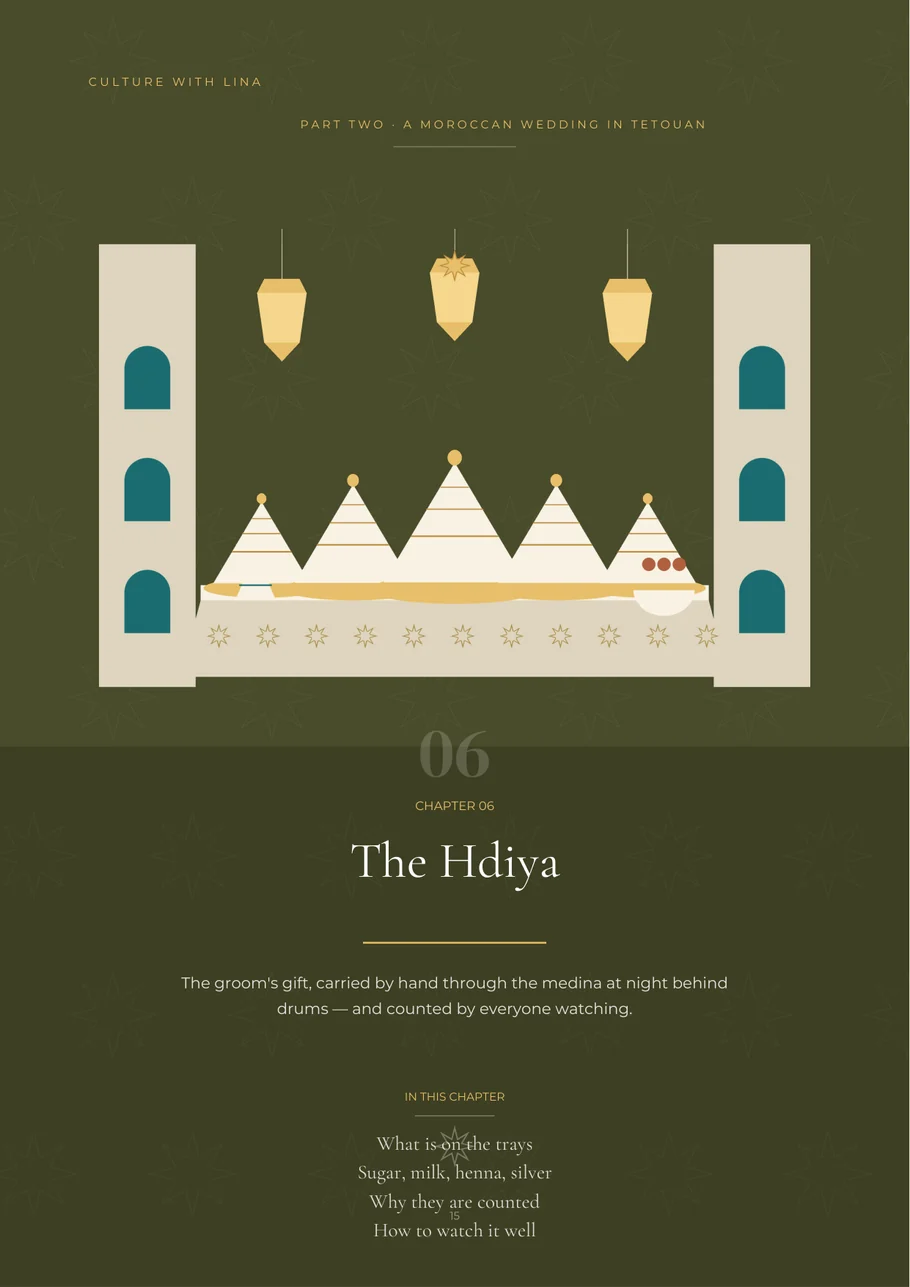
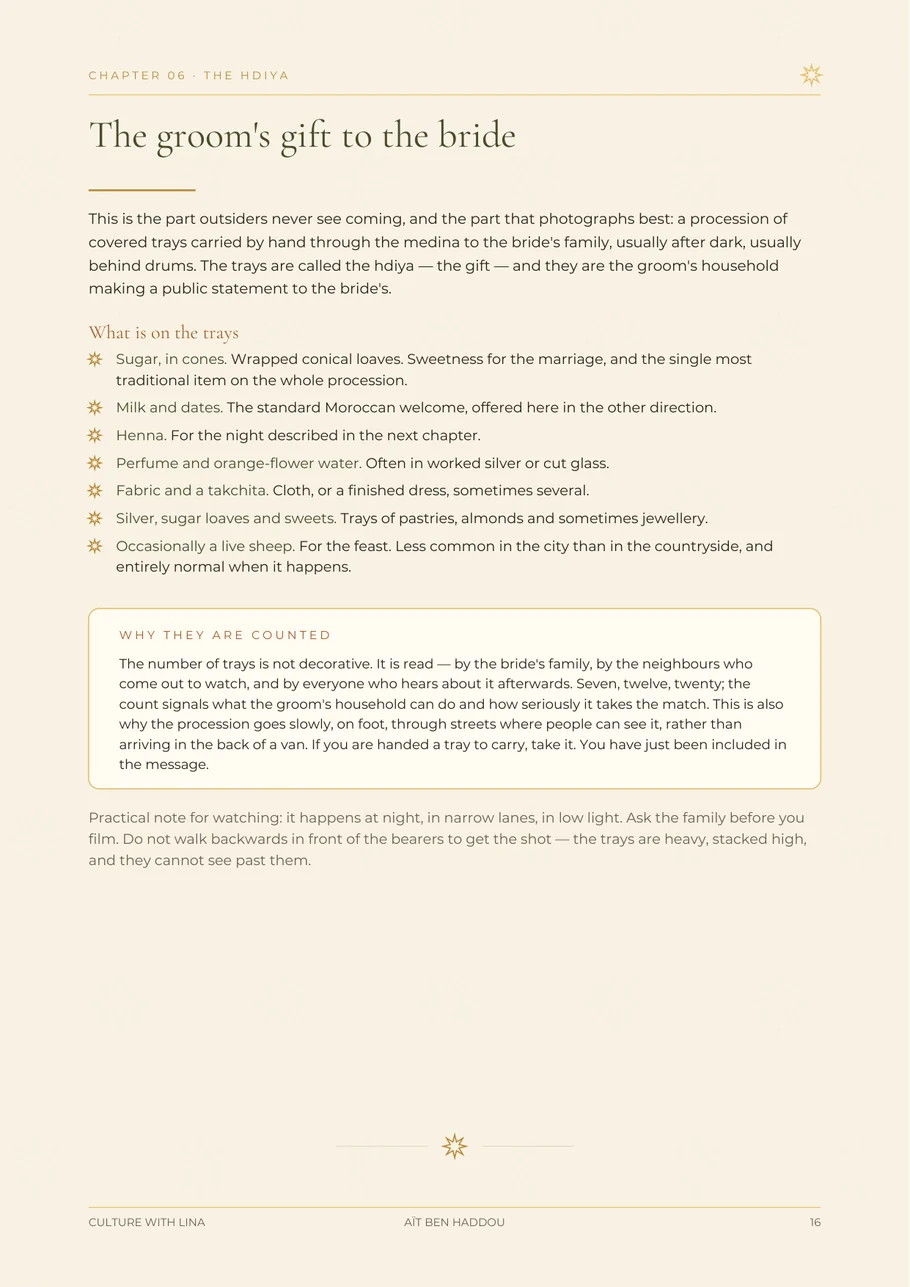
The hdiya. The part outsiders never see coming: a procession of covered trays carried by hand through the medina to the bride’s family, usually after dark, behind drums. Sugar cones, milk, dates, henna, perfume, fabric, silver, sometimes a live sheep. The number of trays is not decorative — it is read, by the bride’s family and by every neighbour who comes out to watch.
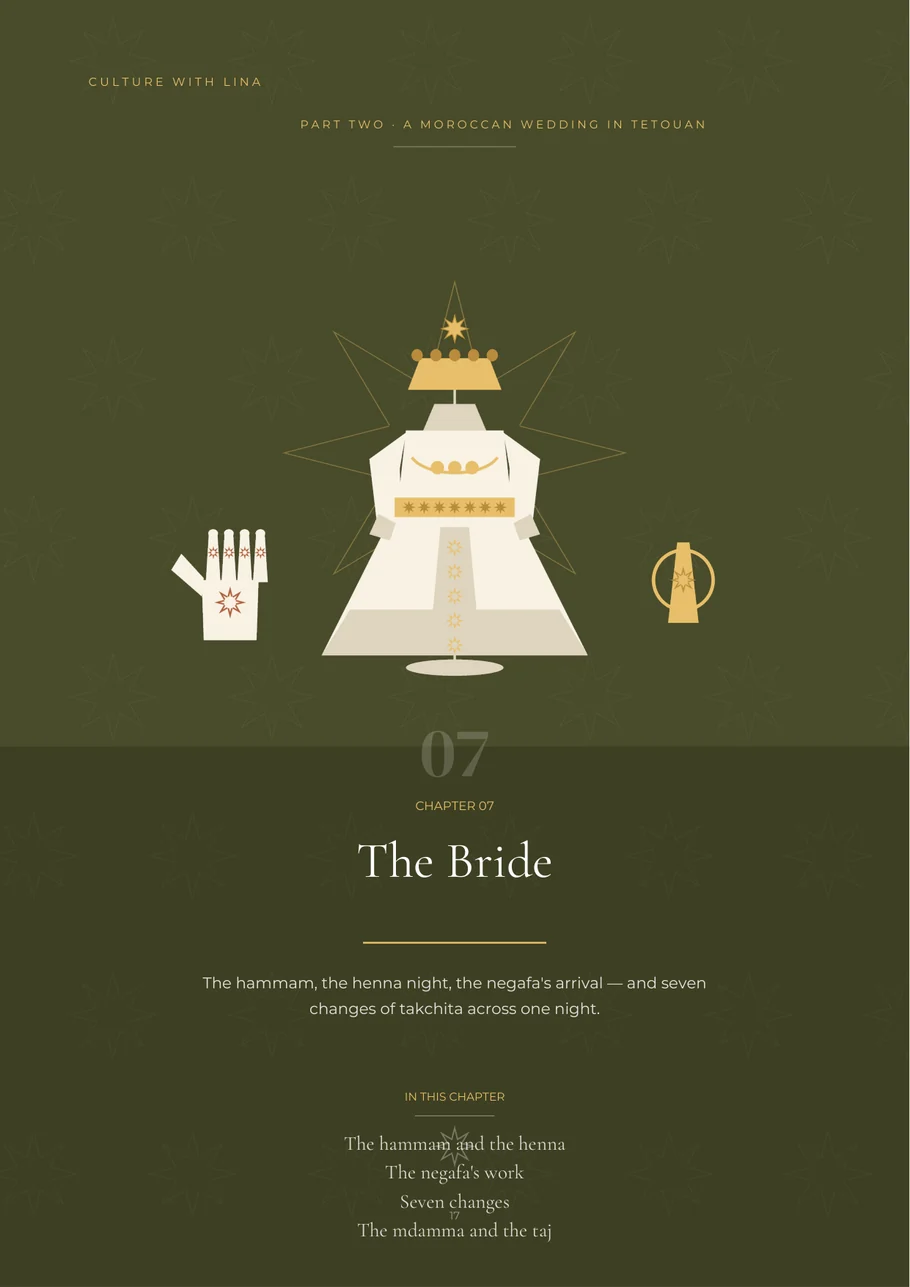
The bride. A hammam visit with her female relatives, then a henna night where a hennaya paints her hands and feet in patterns that take hours to draw and hours more to set. On the day the negafat take over — the dressers and stage managers who own the costumes and direct the entrances. She does not wear one dress; she appears in a series, commonly five to seven.
The amariya. A raised seat inside a canopied frame, carried on two poles by four to six men. The bride is brought into the courtyard above everyone’s heads, announced by a change in the music and a wave of ululation.
The music. This is where Tetouan diverges from most Moroccan weddings. Instead of opening with a DJ, it opens with an orchestra playing al-Ala — Andalusian classical music, the tradition carried out of Iberia and kept alive in this city. Later it gives way to chaabi. Both halves are the wedding.
The table. Do not eat beforehand. The main meal lands late — often around midnight — and on this coast the pastilla is frequently the seafood version, layered warqa pastry over fish, prawns and vermicelli, served whole to the table. Then pastries and mint tea at four in the morning.
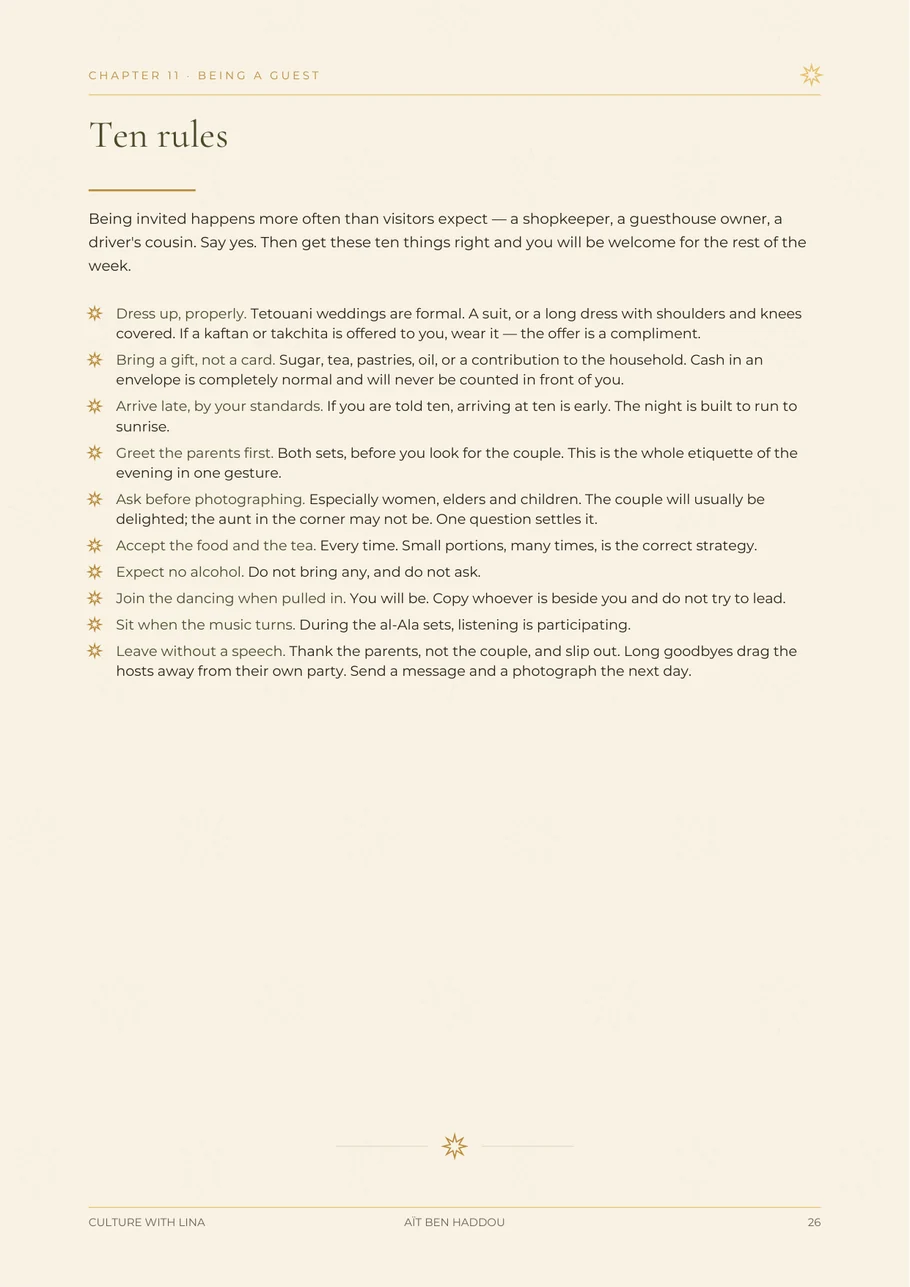
If you are ever invited: dress up properly, bring a gift rather than a card, and greet both sets of parents before you look for the couple. That single gesture is the whole etiquette of the evening. The guide walks through the full sequence, plus the ten rules that decide how you are received.
What is inside the guide
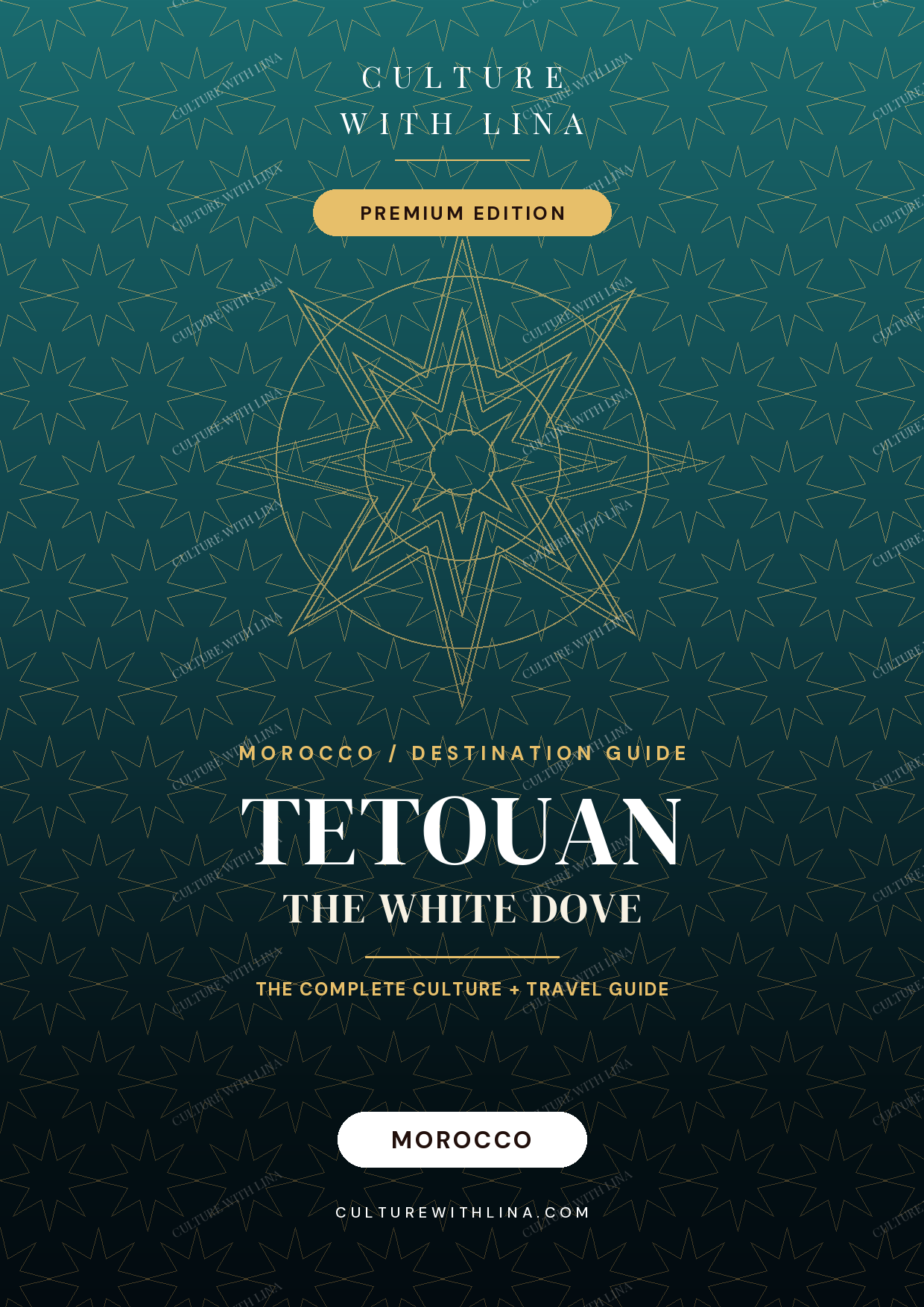
32 pages, eleven chapters, eleven original illustrations, one A4 portrait PDF.
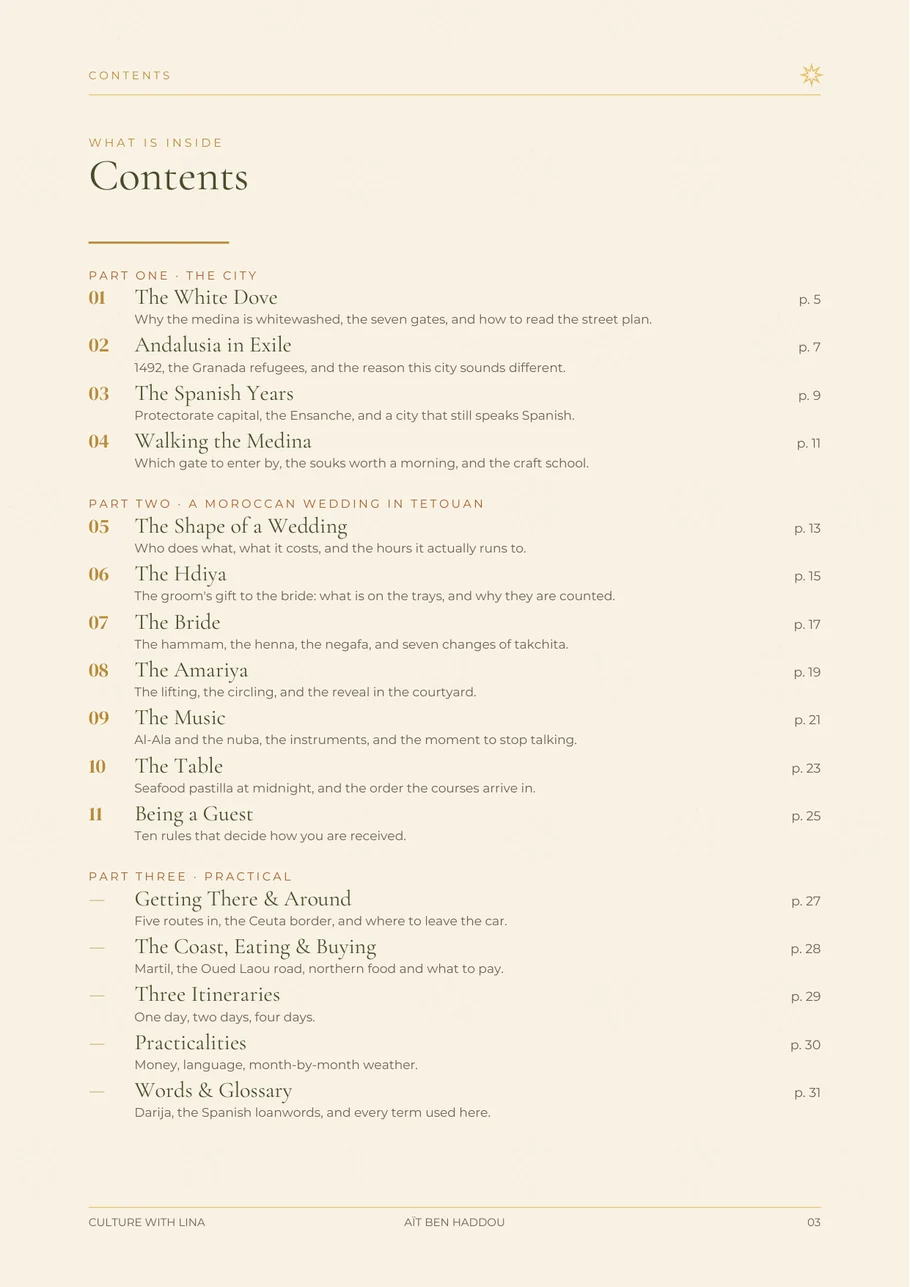
- Why the medina is lime-washed white — and how to read a wall
- The seven gates — and which one to enter by
- 1492 and the Moriscos — what the exiles left in the fabric of the city
- The Ensanche — Art Deco, boulevards, and why the north speaks Spanish
- A medina route — Souk el Hout, Guersa el Kebira, Dar Sanaa, and the museum that explains the wedding before you see it
- The Shape of a Wedding — the full sequence from negotiation to dawn, and the cast: the negafat, the amariya bearers, the orchestra, the traiteur
- The Hdiya — what is on the trays, and why the trays are counted
- The Bride — the hammam, the henna night, seven changes of takchita, the mdamma belt and the taj
- The Amariya — the lift, the circuit of the courtyard, and where to stand to actually see it
- The Music — al-Ala and the nuba, the instruments, the ululation, the chaabi after midnight
- The Table — the order the courses arrive in, the seafood pastilla, and pastries at dawn
- Being a Guest — ten rules that decide how you are received
- Practical — five routes in with honest travel times, the Ceuta border, northern food and what to pay, three itineraries, month-by-month timing and a glossary
Who it is for
- Anyone driving north to Chefchaouen or Tangier who would rather not drive past Tetouan again
- Travellers who came for the culture, not the beach
- Anyone invited to a Moroccan wedding and unsure what happens, what to wear or what to bring
- Readers who want the Andalusian half of Morocco, not the imperial-city circuit
Why this is not another listicle
It is editorially curated research, written to be useful rather than flattering. Overrated things are called overrated. Where a custom is practised differently from one family to the next, the guide says so rather than inventing one correct version. No business paid to be in here.
Format and delivery
A 32-page A4 PDF with eleven original illustrations, one per chapter, in the same series as the city guides. Instant download after checkout — no shipping, no waiting. Reads on a phone and prints at home. Your download link never expires.
Common questions
Is it useful if I am not going to a wedding?
Yes. Only Part Two is the wedding. Part One is the city on its own and Part Three is the practical half — the whole of both is listed above.
How accurate are the wedding details and the prices?
Customs vary between families, and between the medina and the new town, so the wedding chapters describe what is done rather than prescribing one version. Prices are indicative planning bands compiled editorially, not quoted prices.
Read next
- Morocco, city by city — the whole filmed series.
- Fes — the oldest medina on earth, and another wedding.
- Aït Ben Haddou — the ksar of packed earth, and a wedding below the granary.
Wear the series
Take Tetouan home
Tees, hoodies and totes from the Culture With Lina shop. Printed and shipped worldwide.
The Wanderer Tee
Soft cotton tee with the Culture With Lina wordmark. The one that goes in the carry-on.
Culture Club Hoodie
Heavyweight hoodie in cream and olive. Built for early flights and cold medina mornings.
Coco Tote
Canvas tote with Coco on the front. Holds a laptop, a camera and far too much argan oil.
Further reading: Tétouan on Wikipedia.
Reviews
There are no reviews yet.