Description
Free to read: the Aït Ben Haddou travel guide on this site covers the essentials (when to go, what to see, getting around, etiquette and an itinerary). This PDF goes deeper.
Aït Ben Haddou, honestly
You have already seen Aït Ben Haddou. Almost everyone has. It has stood in for Jerusalem, for Thebes, for the edge of the Roman empire, for a slave city in a fantasy series. What almost nobody arrives knowing is that it is a real village, that a handful of families still live inside the walls, and that the thing making it look eternal — earth mixed with straw and packed into wooden forms — is also the thing that makes it fragile enough to need rebuilding every few years. This Aït Ben Haddou guide separates the film set from the village people still live in.
Come for two hours in the middle of the day and you will see a film set. Stay a night on the east bank and you get the place itself.
Below is the free version — what the ksar actually is, what is worth your time, and the three things nobody tells you before you drive up. The paid guide is everything after that: the complete illustrated guide to the ksar on the Ounila.
What this Aït Ben Haddou guide actually covers
It sits on the west bank of the Ounila, about 30 km from Ouarzazate and roughly four hours from Marrakech over the Tizi n’Tichka. UNESCO-listed since 1987. The river is dry or near-dry most of the year, and getting across it is part of the arrival — though flash flow here comes from weather you cannot see, so if the water is up and moving, do not wade it.
A ksar is a fortified village, and this one is built of pisé: damp earth from the riverbank, mixed with straw and sometimes lime, packed in layers into timber formwork and left to dry hard in the sun. Look closely at any large wall and you can read the horizontal seams where one lift ended and the next began.
Thick earth holds the night’s cool through a 40°C afternoon. Its weakness is water: rain strips the surface, so an earthen building needs a fresh render every few years or it starts to dissolve. Half the ruined-looking corners here are not ancient. They are recently unmaintained.
At the summit sits the agadir, the collective granary — grain storage placed where it is hardest to reach and easiest to defend, and the clearest statement of what the whole structure was for.
Five things worth your time
- Sunrise from the east bank. The sun comes up behind you and lights the whole west face. Empty, cool, and the best hour of the day.
- The climb at golden hour. The walls go from grey-brown to apricot in about twenty minutes.
- Telouet on the way in. The Glaoui kasbah upstream — painted cedar ceilings and zellige in rooms with holes in the roof.
- A rooftop dinner facing the hill. Order the tagine a few hours ahead, or the tanjia a day ahead.
- The Ounila backroad. Leaving the N9 at Telouet and dropping down the old valley road is the most beautiful approach in this part of Morocco.
Three things nobody tells you
- Sleep facing the ksar, not on it. The view you came for is of the hill. A terrace room on the east bank gives you sunset, floodlight and sunrise without moving.
- Add an hour to the Tichka. It is a proper mountain road, under reconstruction most years. Whatever your map app says, do not plan to arrive after dark.
- There is no shade above the gate. Hat, sun cream, more water than feels necessary, and shoes with grip for dust over rock.
When to go
March to May and September to November are the two good windows — warm days, cool nights, long light. June to August brings 40°C+ afternoons, so start at dawn and rest at midday. December to February is cold at night with snow on the pass and occasional closures, but beautifully empty.
Sixty years on camera
The ksar’s second career began in the 1960s and never stopped: clear light, cheap crews, a skyline with no telephone poles. Lawrence of Arabia, Jesus of Nazareth, The Mummy, Gladiator, Kingdom of Heaven, Babel, and Yunkai in Game of Thrones — all shot here or a few kilometres away.
The ksar does not explain itself, so it is worth knowing what you are looking at. The houses, lanes, towers and the granary are real. Some gates and crenellations near the approach were production additions, left standing and now weathered into looking original. And the film economy cuts both ways: it has paid for genuine repair, and it has also encouraged fast repair in cement, which traps moisture inside a pisé wall and rots it from within. Once you can spot the grey patches you cannot unsee them.
A wedding beyond time
Watch the film
A wedding in the kasbah: earth walls, the amariya and drums after dark
A wedding in a courtyard below the granary. Guests seated around the walls as the light goes apricot, the couple lifted shoulder-high in the amariya, bread baked in the ashes, and a circle that holds until the cold comes down off the Atlas.
Filmed for the Culture With Lina series. Follow @culturewithlina for the rest.
A wedding in a courtyard below the granary: guests seated around the walls as the light goes apricot, bread baked in the ashes, and a circle that holds until the cold comes down off the Atlas. It runs across days, it belongs to two extended families, and as a visitor you are the guest of a household rather than a ticket holder.
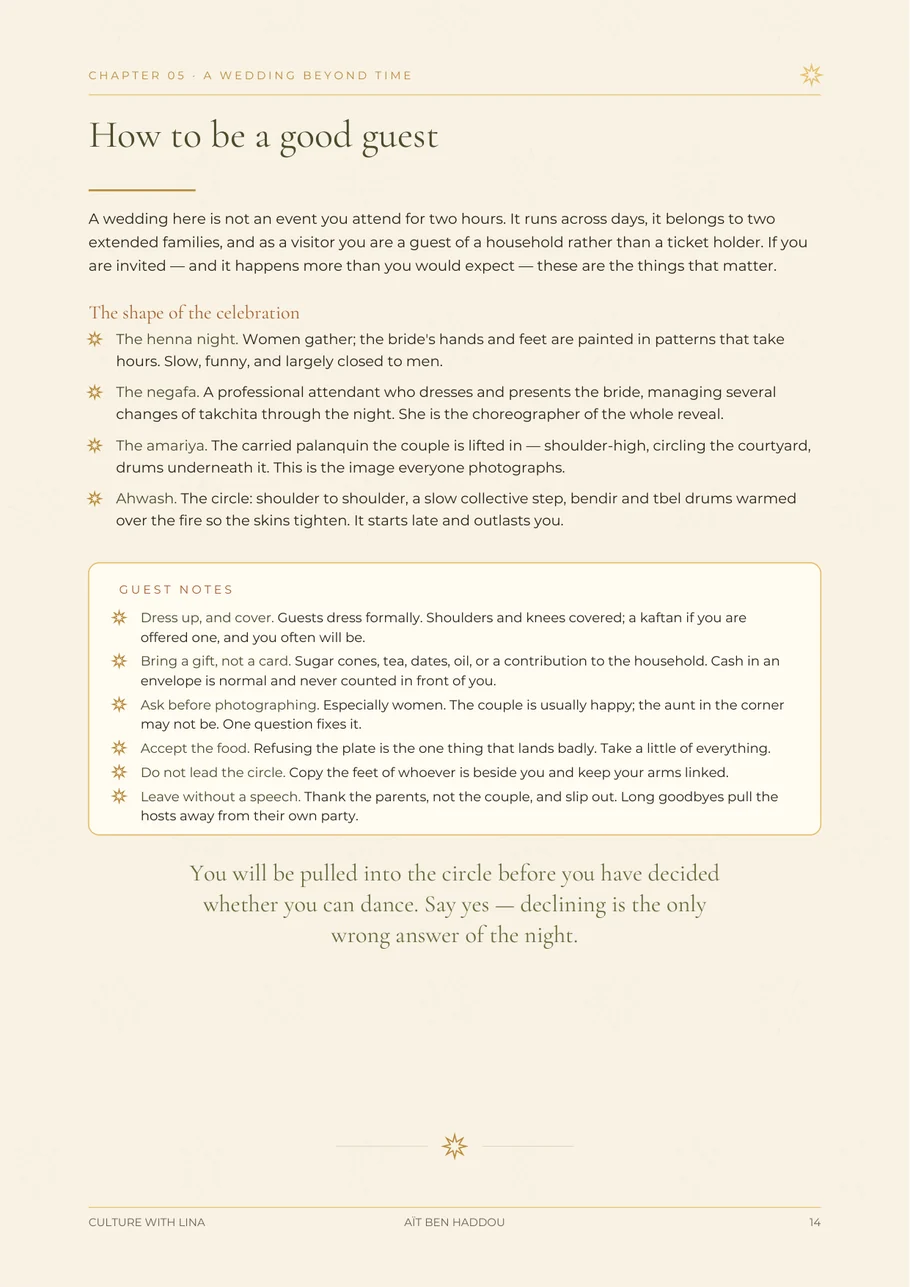
The shape of it: a henna night, largely closed to men, where the bride’s hands and feet are painted in patterns that take hours. A negafa — the professional attendant who dresses and presents the bride, managing several changes of takchita through the night. The amariya, the carried palanquin the couple is lifted in, circling the courtyard with drums underneath it. Then ahwash: the circle, shoulder to shoulder, a slow collective step to bendir and tbel drums warmed over the fire so the skins tighten.
If you are invited — and it happens more than you would expect — dress formally, bring sugar, tea, dates or oil rather than a card. Take a little of everything you are offered: refusing the plate is the one thing that lands badly. You will be pulled into the circle before you have decided whether you can dance. Say yes.
What is inside the guide
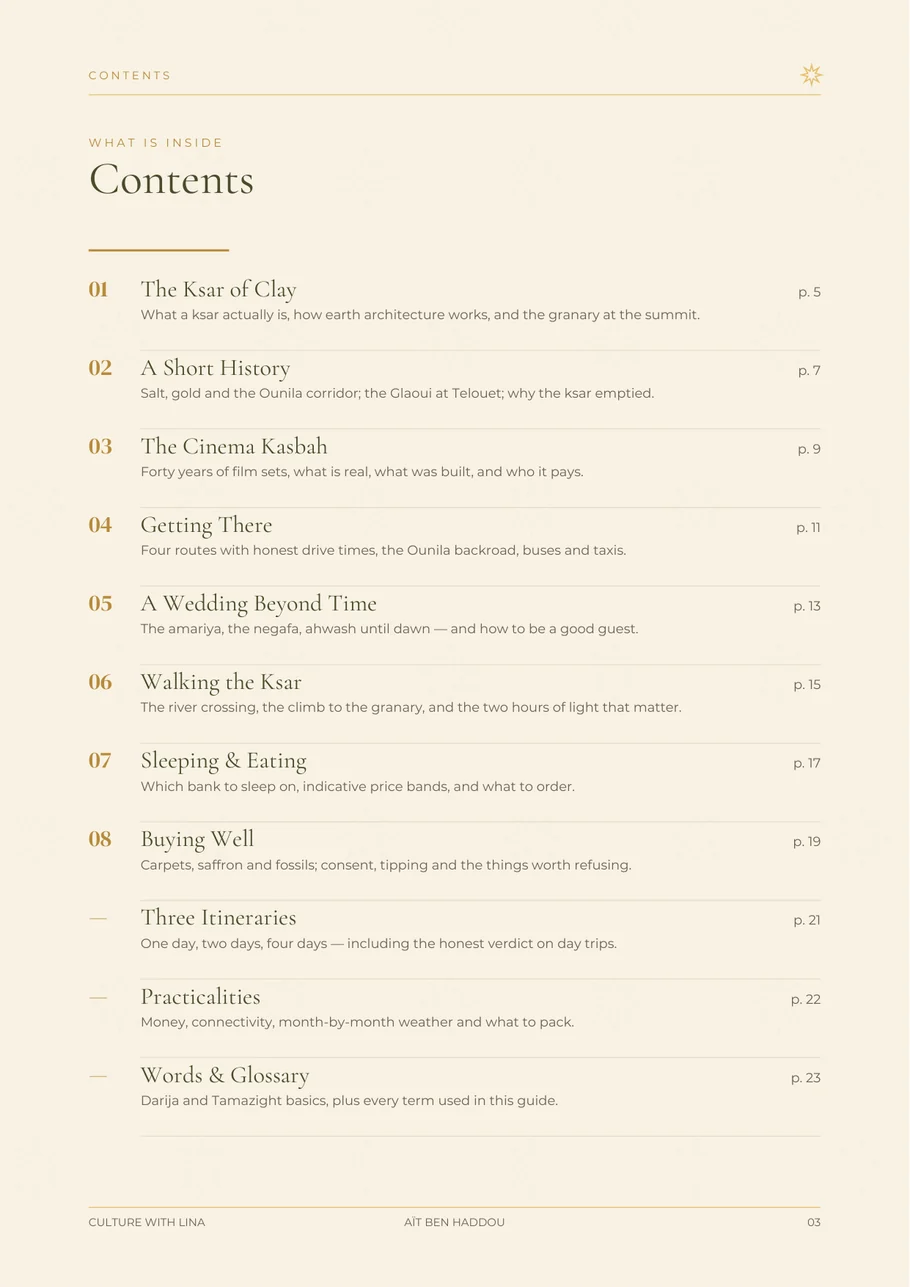
24 pages, eight illustrated chapters, one PDF.
- The Ksar of Clay — how pisé works, the collective granary, the two villages, and the restoration argument you cannot unsee
- A Short History — the Ounila trade corridor, Telouet and the Glaoui, and why the ksar emptied within living memory
- The Cinema Kasbah — what is real versus built for the shot, and the studios at Ouarzazate
- Getting There — four routes with honest drive times, the Ounila backroad, coaches and grand taxis
- A Wedding Beyond Time — the full shape of the days, and the guest notes that keep you from getting it wrong
- Walking the Ksar — the river crossing, the climb to the granary, and the two hours of light that justify staying the night
- Sleeping & Eating — which bank to sleep on, indicative price bands, and what to order a day ahead
- Buying Well — carpets, saffron and fossils; bargaining lightly, consent before the camera, and tipping
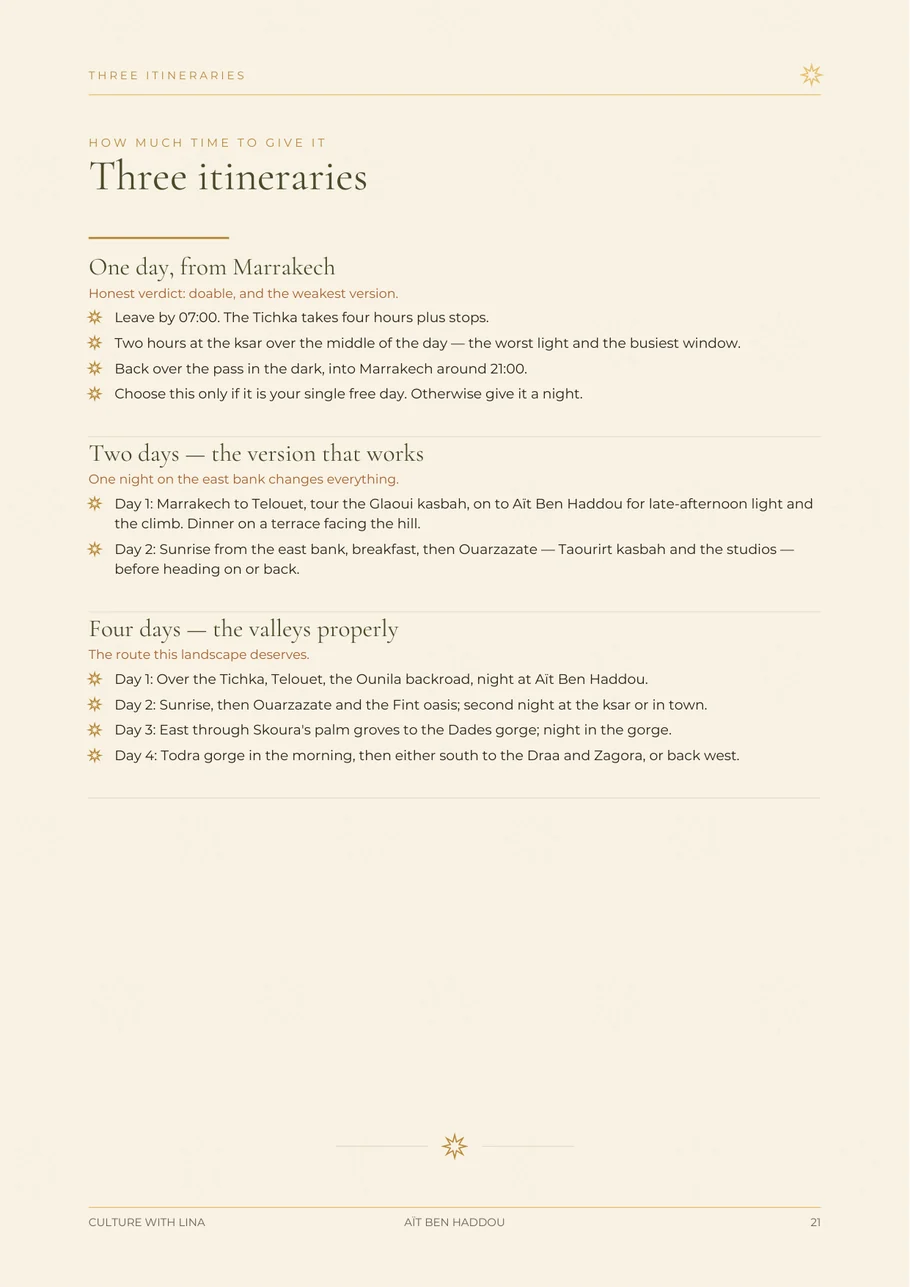
- Also inside — three itineraries of one, two and four days, the honest verdict on day trips from Marrakech, month-by-month timing, cash, signal and water, Darija and Tamazight basics, and a glossary
Who it is for
- Anyone with one night here and one chance to get it right
- Travellers who came for the place, not the film set
- Photographers who want the light, not the coach hour
- Anyone who may be invited into a family celebration and wants to arrive as a good guest
Why this is not another listicle
Researched and compiled editorially, and written to be useful rather than flattering: what the wall is made of, why it is dissolving, and what the place was for before any of it was filmed.
Format and delivery
Instant PDF download, licensed for personal use. No app, no login.
Common questions
How current are the prices and hours?
They are indicative bands rather than fixed quotes, so confirm locally before you rely on them.
Can I read it on my phone?
It is written to be read before you go and carried on your phone once you are there.
Is it only about the ksar itself?
No. Half the chapters cover everything around it: how you get there, where you sleep, what you eat and what you buy.
Read next
- Morocco, city by city — the whole filmed series.
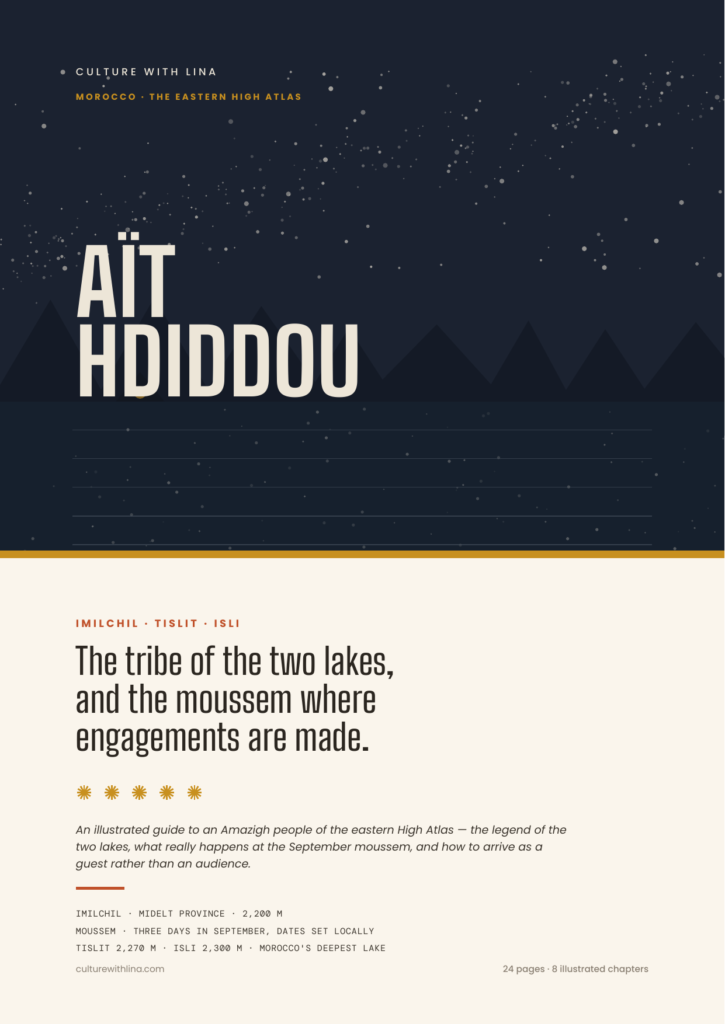
- Aït Hdiddou — Imilchil at 2,200 metres, and the moussem that is not a bride market.
- The Sahara — past the last paved road, and a wedding in the dunes.
Wear the series
Take Aït Ben Haddou home
Tees, hoodies and totes from the Culture With Lina shop. Printed and shipped worldwide.
The Wanderer Tee
Soft cotton tee with the Culture With Lina wordmark. The one that goes in the carry-on.
Culture Club Hoodie
Heavyweight hoodie in cream and olive. Built for early flights and cold medina mornings.
Coco Tote
Canvas tote with Coco on the front. Holds a laptop, a camera and far too much argan oil.
Further reading: Aït Benhaddou on Wikipedia.
Reviews
There are no reviews yet.