
Description
Free to read: the Chefchaouen travel guide on this site covers the essentials (when to go, what to see, getting around, etiquette and an itinerary). This PDF goes deeper.
Chefchaouen, honestly
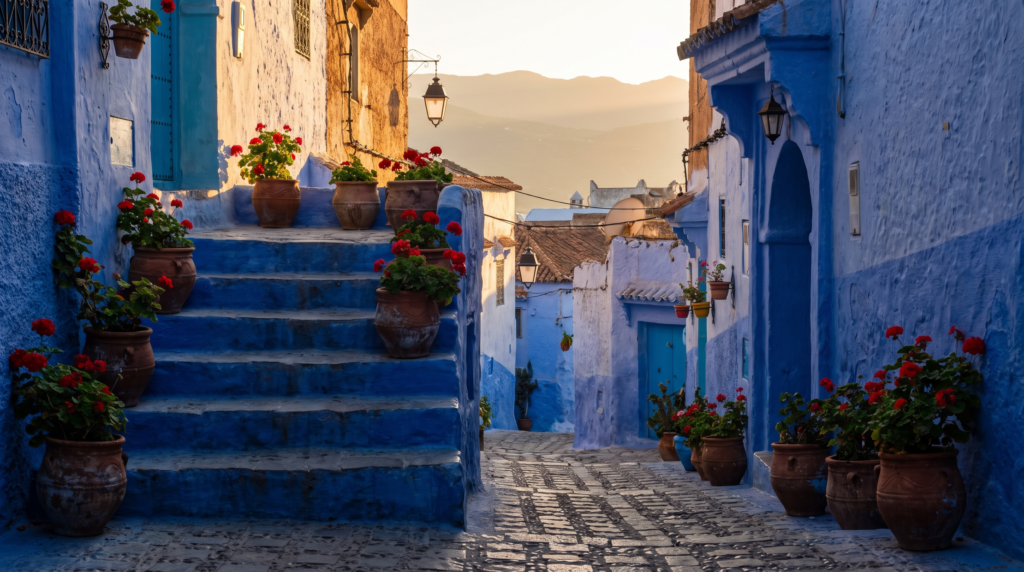
Chefchaouen is the most photographed town in Morocco and one of the least understood. People arrive for the blue, shoot the same staircase everyone shoots, and leave the next morning without knowing why the town is blue, who built it, or that it keeps one of the most distinctive wedding traditions in the country — including a women’s music you will not hear anywhere else.
Below is the free version — what the town actually is, what is worth your time, what nobody tells you, and how a Chefchaouen wedding runs. The paid guide is what comes after: a city guide and a complete guide to a Chefchaouen wedding, in one book.
What this Chefchaouen guide actually covers
The town sits in a fold of the western Rif at around 600 metres, about 60 km from Tetouan and 115 km from Tangier. The name comes from the Amazigh word for horns: look up from the main square and you will see the two peaks it refers to.
It was founded in 1471 by Moulay Ali Ben Rachid as a small kasbah from which the mountain tribes could hold out against Portuguese raids along the coast. After the fall of Granada in 1492 it filled with Muslims and Jews expelled from Andalusia, who brought whitewashed walls, tiled roofs, courtyard houses and a quarter still called Rif el-Andalus. For centuries it stayed closed and conservative; very few Europeans entered before Spanish troops arrived in 1920.
As for the blue, nobody knows for certain. The most repeated story credits Jewish families who painted walls the colour of sky and heaven. Others say blue lime keeps houses cool, or keeps mosquitoes away. Whatever started it, the blue is now kept up on purpose — walls are repainted, often every spring, because the town knows why people come. The likeliest truth is several of these at once, amplified by photography.
Five things worth your time
- The blue lanes at 7:30. Soft light, nearly empty streets, and none of the day-trippers from Tangier and Fes. By late morning the famous corners have queues.
- The Kasbah tower. The red-walled fortress on Outa el Hammam, with a small museum and a climb to a view over the rooftops.
- Ras el Maa. The spring at the top of the medina, where women still wash clothes in the stone basins. Ask before photographing them.
- The Spanish Mosque at sunset. Thirty minutes’ walk up from the spring. The whole town turns blue-grey below you.
- Akchour and God’s Bridge. An hour away by road: a gorge of waterfalls and green pools, and a natural rock arch. The mountains are the other half of Chefchaouen.
Three things nobody tells you
- These are homes. The famous doors are people’s front doors, and some residents have put up signs asking visitors to stop. Do not sit on doorsteps, ask before photographing anyone, and never pay children for pictures.
- You will be offered kif. The Rif is the heart of Morocco’s cannabis cultivation. Cultivation is legal for medical and industrial use since 2021; recreational use is not. A polite, firm la, shukran ends the conversation.
- It is a town of stairs. The higher the riad, the better the view and the longer the climb with luggage. Porters wait at the gates — agree the price first.
A Chefchaouen wedding: the hammam, the henna and the hadra
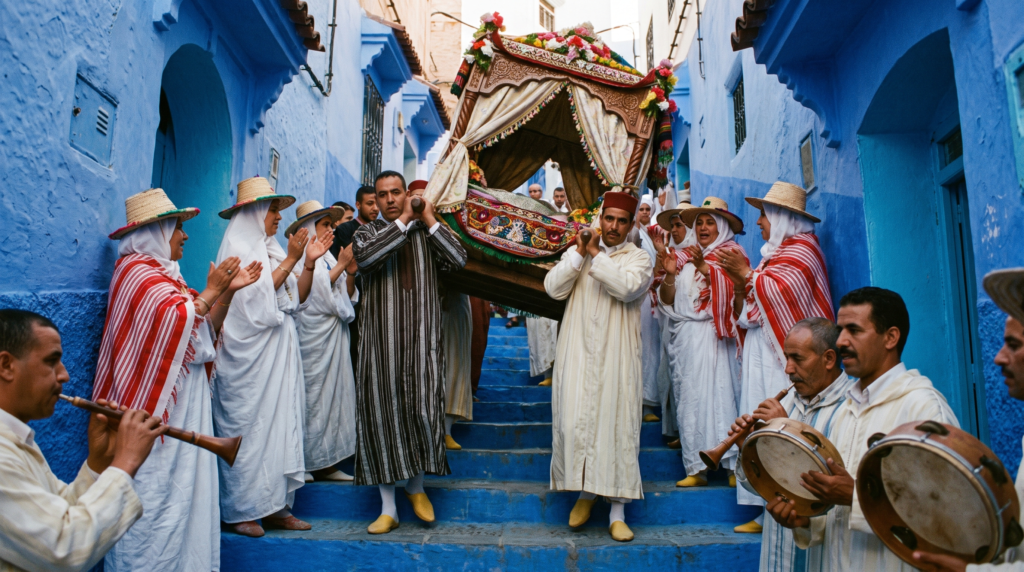
Lina’s Chefchaouen series follows a Chefchaouen wedding across four films: arriving in the blue town, the bride’s hammam procession, getting ready, and the henna day. The films are dramatised, and the bride and her family are characters — but the traditions they show are real, and they are what the guide explains.
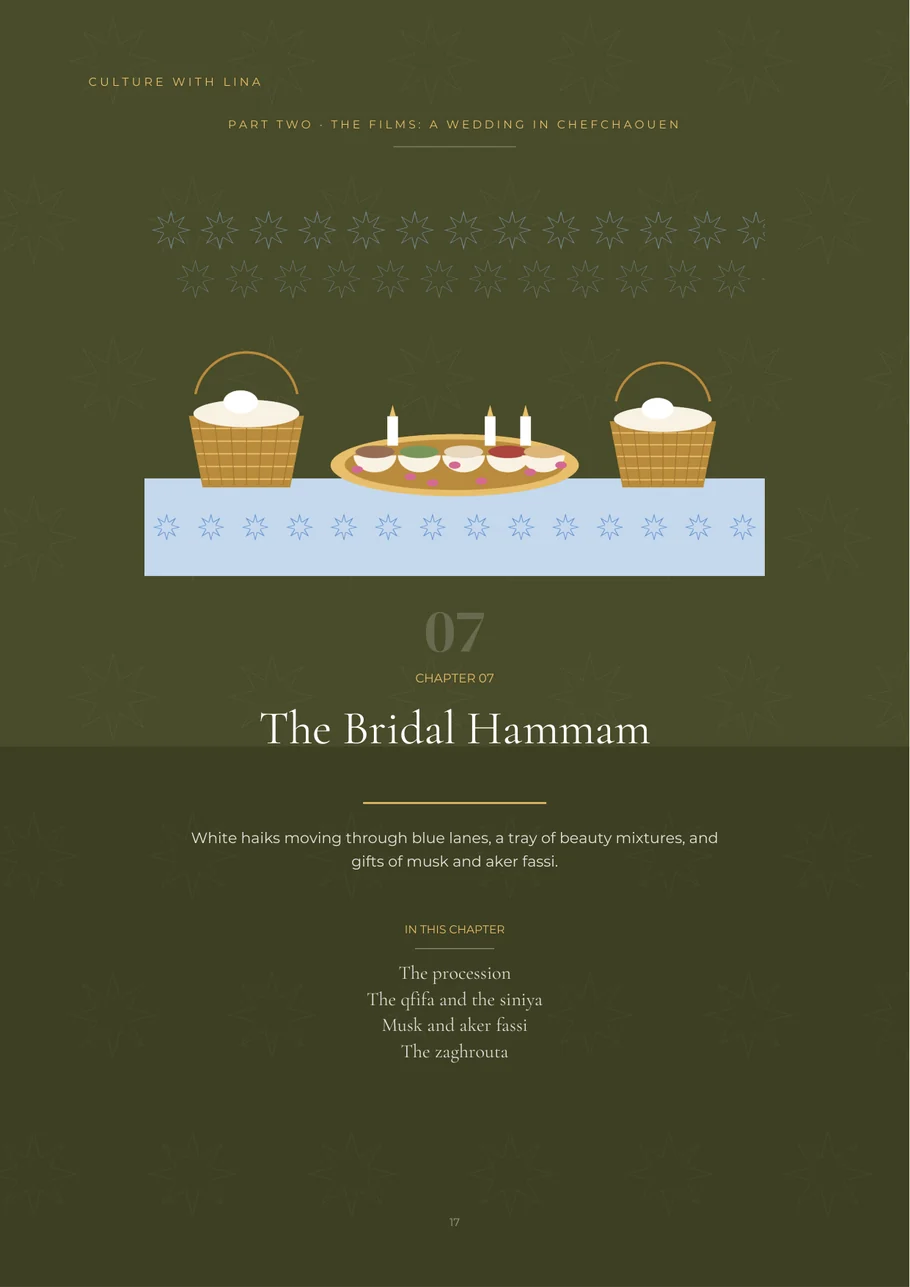
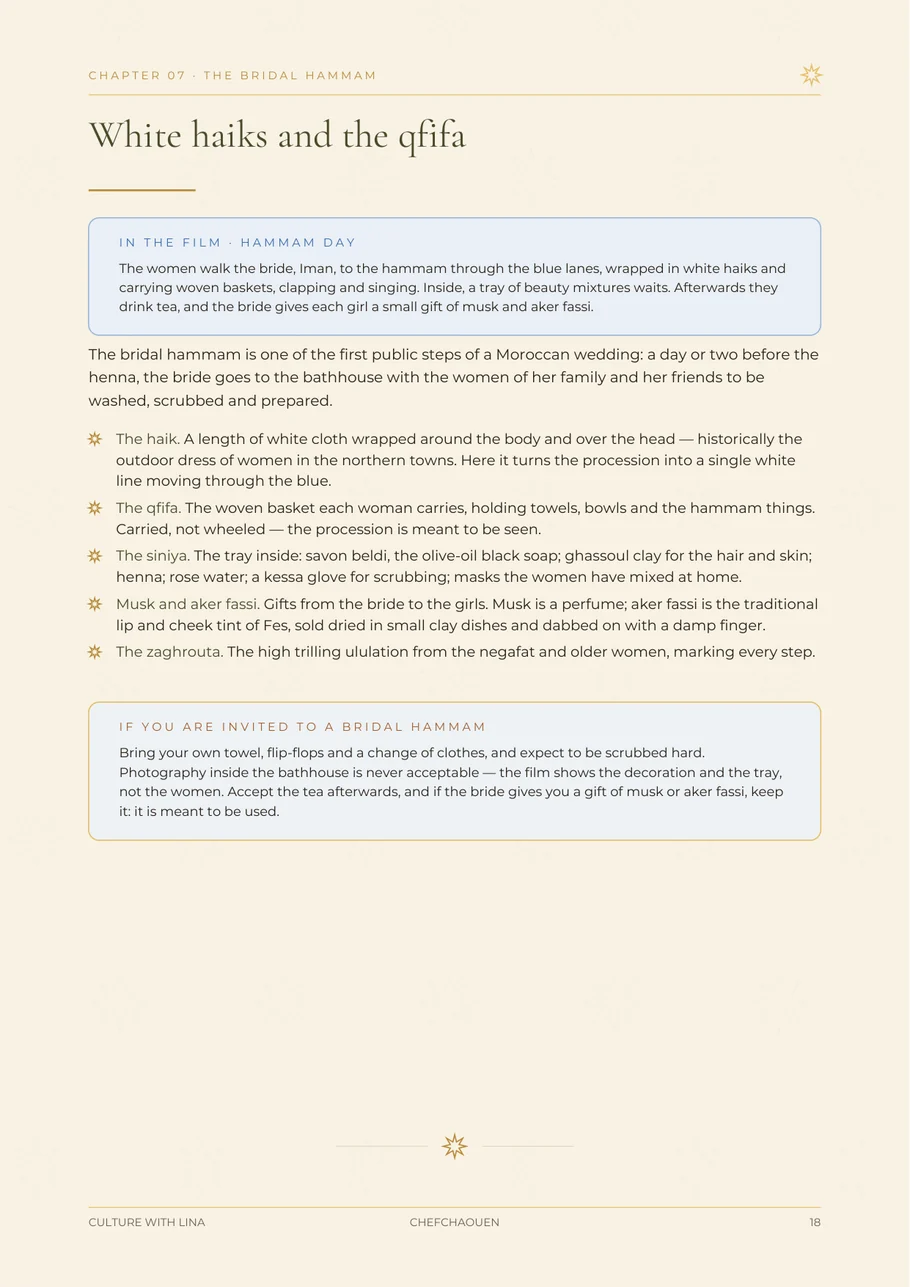
The bridal hammam. A day or two before the henna, the women walk the bride to the bathhouse through the blue lanes, wrapped in white haiks and carrying woven qfifa baskets, clapping and singing. Inside waits a tray of beauty preparations — black soap, ghassoul clay, henna, rose water. Afterwards, over tea, the bride gives each girl a small gift of musk and aker fassi, the traditional lip and cheek tint of Fes.
The henna day. A women-only celebration in a decorated riad, with a raised seat for the bride among cushions, candles and roses. She enters in green — often the colour of the henna in Morocco — led by her negafa, and a hennaya paints her hands and feet.
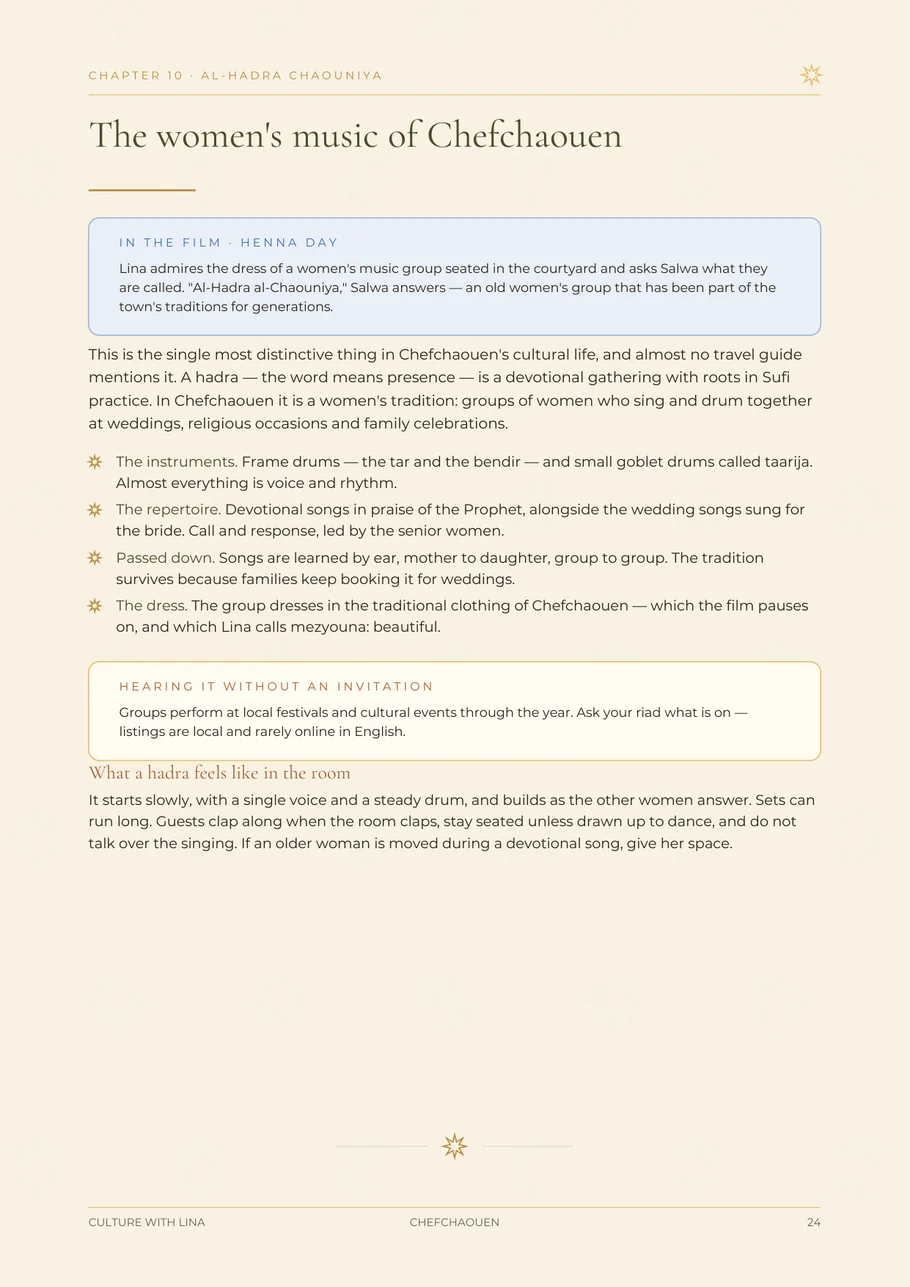
Al-Hadra Chaouniya. The single most distinctive thing in the town’s cultural life: a women’s musical tradition with roots in Sufi practice, sung and drummed on frame drums, passed from mother to daughter and still booked for weddings. Almost no guide in English mentions it.
The farewell song. The bride sits in a plain white caftan at the centre of a semicircle of women, a sheer veil held above her, while the older women sing a farewell chosen to make her cry. The tears are part of the ritual. Then the sweets come round, and the celebration carries on.
Follow @culturewithlina on Instagram, TikTok and YouTube for the four Chefchaouen films.
What is inside the guide
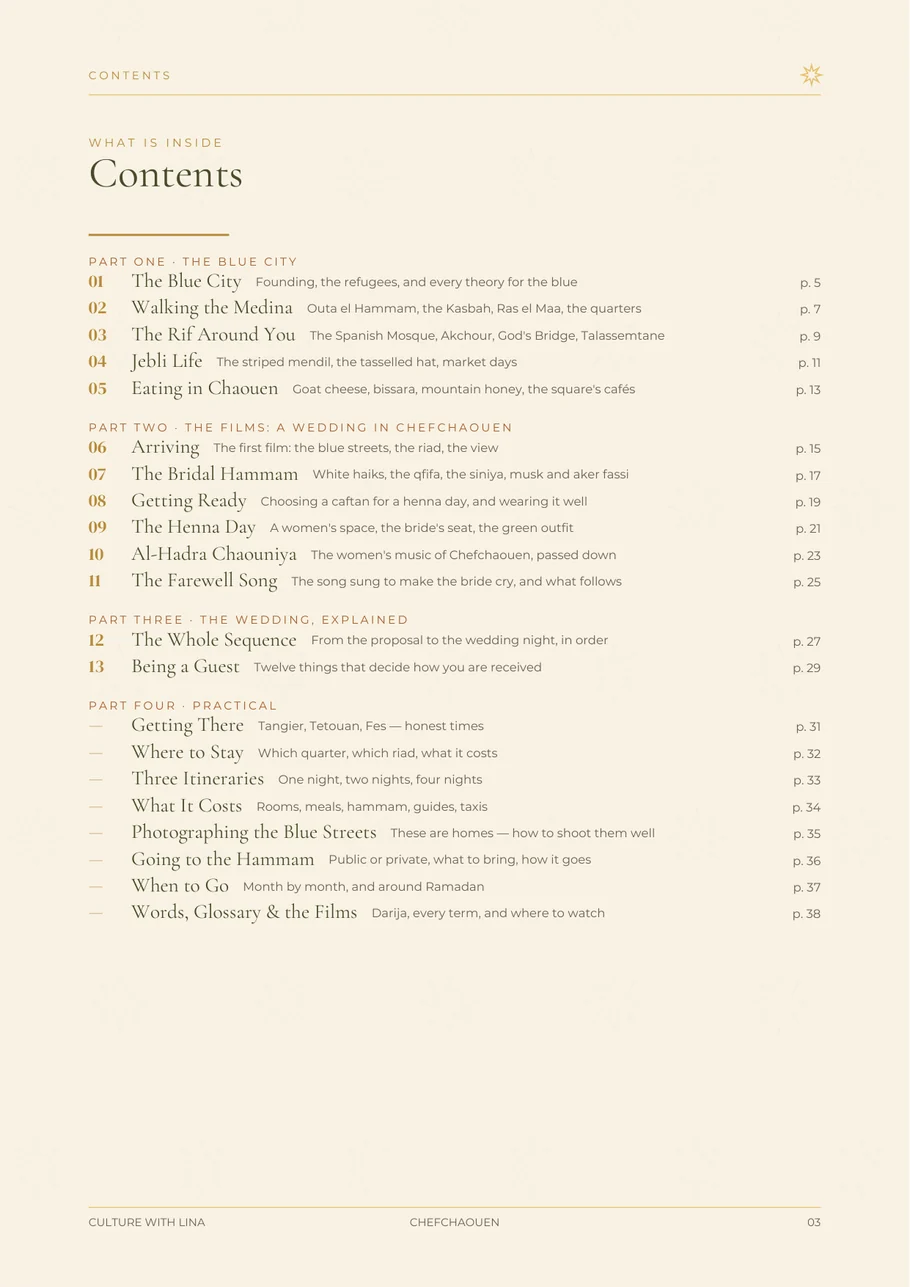
- Part One — The Blue City. The 1471 founding and the refugees, five competing theories for the blue, a two-hour loop through the medina, the Rif around it, Jebli life and market days, and mountain food.
- Part Two — The Films. Six chapters that follow the four films scene by scene: arriving and choosing a riad, the bridal hammam, what to wear to a henna day, the henna day itself, al-Hadra Chaouniya, and the farewell song.
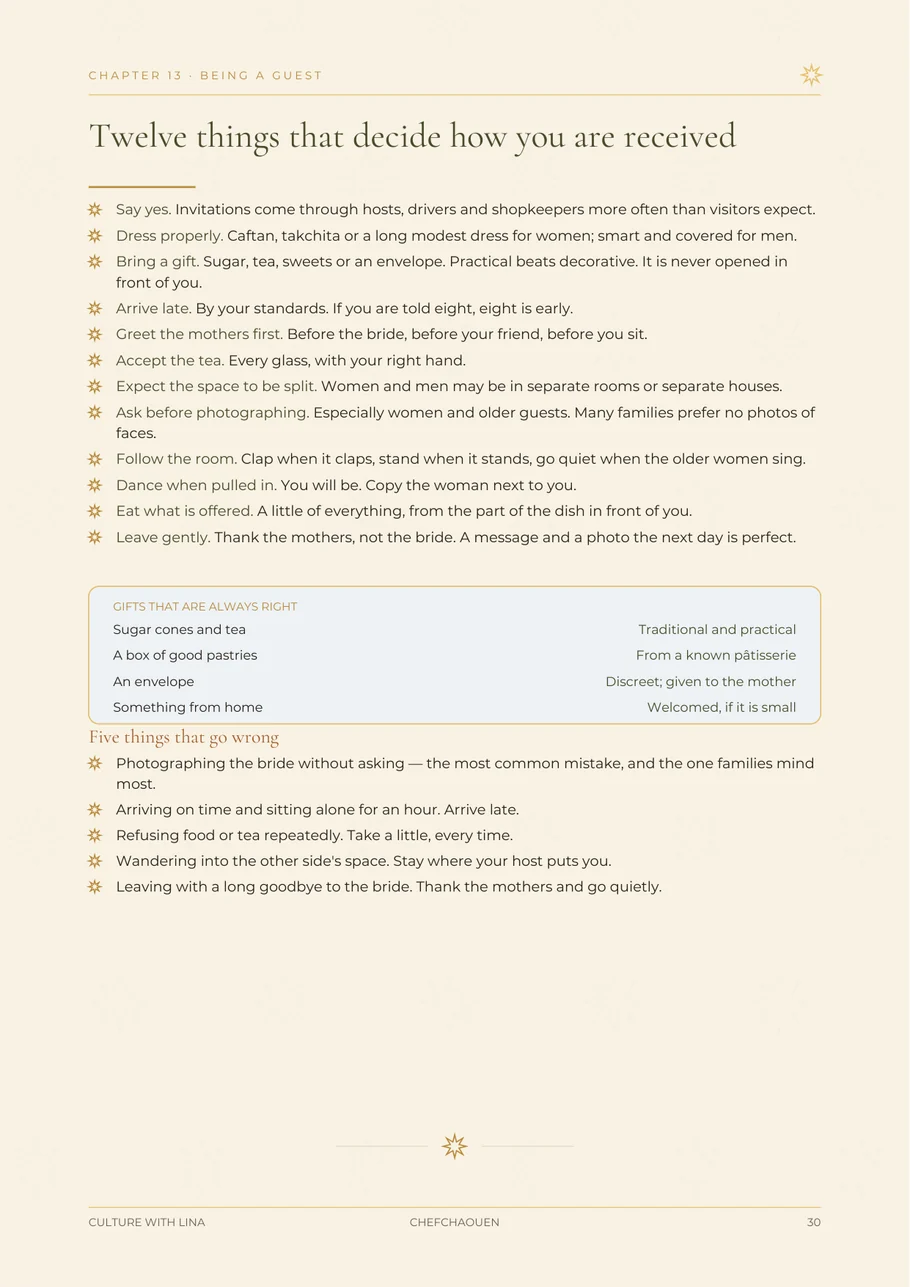
- Part Three — The Wedding, Explained. The whole sequence from the proposal to the wedding night, and twelve rules for being a good guest.
- Part Four — Practical. Getting there, where to stay, three itineraries, what it costs, photographing the blue streets respectfully, going to the hammam yourself, when to go, and a glossary.
Who it is for
Travellers who want more from Chefchaouen than the staircase photograph: people who want to understand what they are looking at, anyone invited to a Moroccan wedding — a Chefchaouen wedding in particular — who wants to get it right, and readers who follow Lina’s films and want the story behind them.
Why this is not another listicle
Every tradition is explained in the order it happens, so you can follow a Chefchaouen wedding in real time. Where customs differ between families, the guide says so instead of inventing one correct version. Prices are labelled as planning ranges rather than dressed up as quotes. And it covers the things almost nothing in English does — the women’s hadra, the farewell song, and a plain warning about black henna.
Format and delivery
A 40-page A4 PDF with thirteen chapters and thirteen original illustrations, in the same series as the other Culture With Lina guides. Instant download after checkout. Reads on a phone and prints at home.
Common questions
What actually happens at a Chefchaouen wedding?
A Chefchaouen wedding runs over several days rather than one evening. The bridal hammam comes first, a procession of women in white haiks; then the henna day, with the bride seated among candles while the musicians of al-Hadra Chaouniya play; then the farewell song, sung to make her cry before she leaves her family’s house. The guide takes each stage of a Chefchaouen wedding in turn and explains what is expected of the guests at each one.
Is it useful if I am not going to a Chefchaouen wedding?
Yes. Half the guide is the town itself — the medina, the mountains, the food, and where to stay — and the Chefchaouen wedding chapters explain customs you will see around you anyway.
Are the films real?
The films are dramatised with AI tools, and Lina, the bride and her family are characters. The places, the dress, the rituals and the music they show are real, and the guide explains each one.
How accurate are the Chefchaouen wedding details and the prices?
The Chefchaouen wedding chapters describe what is typical in Chefchaouen and the north, and note where families differ. Prices are planning ranges compiled from published sources — confirm locally before you rely on them.
Read next
- Tetouan — The White Dove & A Moroccan Wedding — an hour and a quarter away, with its own wedding traditions and the best caftan rentals in the north.
- Chefchaouen: The Blue City, and the Wedding That Climbed the Stairs — the journal story.
- All Morocco guides — the whole series.

Reviews
There are no reviews yet.