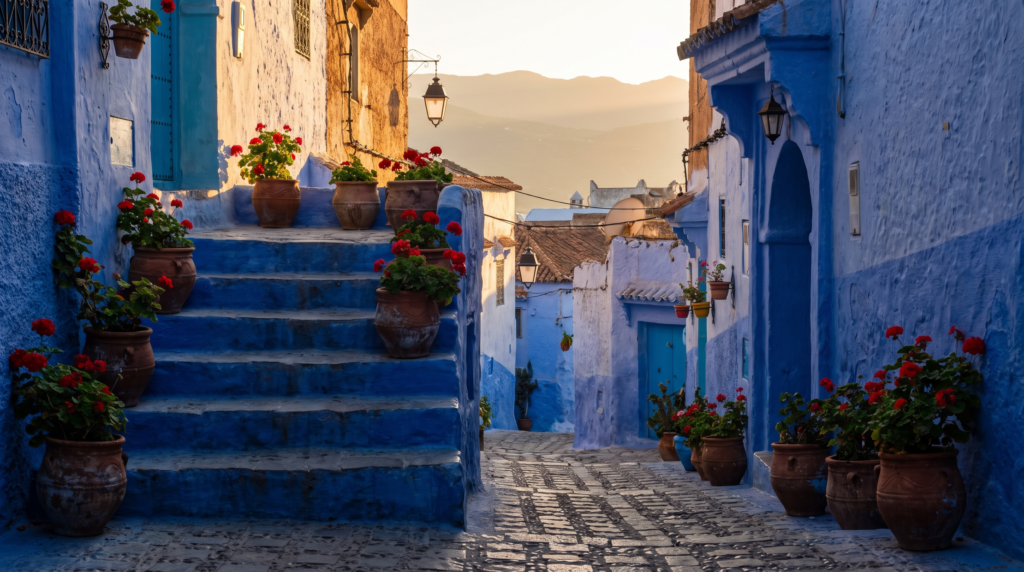
Chefchaouen is a small mountain town in Morocco’s Rif, famous for a medina painted in shades of blue. It is the most photographed town in the country and one of the least understood. Many visitors arrive for the blue, shoot the same staircase everyone shoots, and leave the next morning without learning who built the town, why it is blue, or that it keeps a women’s music tradition found nowhere else.
This guide is for travelers who want more than the photo. It covers the town’s history, a route through the medina, the waterfalls and forests of the Rif, the mountain food, and how a Chefchaouen wedding unfolds, from the bridal hammam procession to the farewell song.
Chefchaouen at a glance
| Where it is | The western Rif mountains of northern Morocco, around 600 m up, about 60 km from Tetouan and 115 km from Tangier |
|---|---|
| Best time to go | March to May for green hills and running waterfalls; September and October for clear light and fewer people |
| How long to stay | Two nights for the town; four if you want the mountains too |
| Getting there | CTM coach from Tangier, Tetouan, Fes or Casablanca; shared grand taxi from Tetouan; private driver. Nearest useful airport: Tangier Ibn Battouta. |
| Daily budget (planning range) | Double rooms from 25 to 45 EUR (simple) up to 130 to 220 EUR (boutique riad with views); a tagine in a small restaurant 7 to 12 EUR; a bissara breakfast 1 to 3 EUR |
| Language(s) | Darija (Moroccan Arabic), with the local Jbala dialect in the surrounding villages; French is common in tourism |
| Good for | Photography, easy mountain hiking, slow travel, crafts, and anyone curious about northern Moroccan wedding traditions |
Prices on this page are planning ranges compiled from published sources, not quotes. Cash rules in the medina, and there are ATMs near Outa el Hammam and in the new town.
The story of Chefchaouen
Chefchaouen was founded in 1471 by Moulay Ali Ben Rachid as a small kasbah, a fortress from which the mountain tribes could resist Portuguese raids along the coast. It sits in a fold of the Rif below two peaks, and its name comes from the Amazigh word for horns. Look up from the main square and you will see them.
After the fall of Granada in 1492, Muslims and Jews expelled from Andalusia filled the town. They brought whitewashed walls, tiled roofs, inner courtyards and a quarter still called Rif el-Andalus. For centuries Chefchaouen stayed closed to outsiders and deeply conservative, and very few Europeans entered it before Spanish troops arrived in 1920. Today it is one of the communities named in UNESCO’s listing of the Mediterranean diet as intangible cultural heritage, a recognition of daily life rather than monuments.
As for the blue, nobody knows for certain. The most repeated story credits Jewish families who painted walls blue, a color tied to heaven in Jewish tradition. Others say blue lime keeps houses cool or deters mosquitoes. Whatever started it, the blue is now kept up deliberately, with walls often repainted each spring.
What to see in Chefchaouen
The medina climbs a slope, so orientation is easy: uphill is east toward the mountains and the spring, downhill is west toward the new town. Everything in the medina is within about twenty minutes’ walk.
Outa el Hammam
The cobbled main square is ringed with cafés and is the easiest landmark to navigate back to. Tea here is overpriced, so pay it once for the Kasbah view, then find a café a few lanes up.
The Kasbah and the Grand Mosque
The red-walled fortress on the square has a garden, a small ethnographic museum and the old cells. Entry is around 1 EUR. Climb the tower for the view over the rooftops.
Beside it, the Grand Mosque has an octagonal minaret, an Andalusian form unusual in Morocco. Non-Muslims cannot enter.
The blue lanes and the quarters
Souika is the oldest quarter, Rif el-Andalus was the refugees’ quarter, and Onsar climbs toward the spring. Wander between them without a map. Walk the lanes between 7:30 and 9:30am, when the light is soft and the day-trippers from Tangier and Fes have not arrived yet. By late morning the famous corners have queues.
Ras el Maa
At the top of the medina, mountain water comes out of the rock at this spring. Women still wash clothes in the stone basins, so ask before photographing them. If you get lost in the upper medina, keep climbing until you hear water.
The Spanish Mosque
This 1920s mosque on the hill east of town was built during the Spanish period and never used. It is about thirty minutes’ walk from Ras el Maa. Go for sunset, when the medina turns blue-gray below you.
Akchour and God’s Bridge
About an hour away by road, Akchour is a river gorge with a chain of waterfalls and green pools. The lower falls are an easy walk; the upper falls take a few hours and good shoes. God’s Bridge, a natural rock arch over the gorge, is on a separate path of around an hour, and combining it with the lower falls fills a day.
Take a shared grand taxi or a car and driver, and agree the return time first. Bring shoes with grip, water and food. Avoid the gorge after heavy rain, when the river rises fast.
Market days and Jebli crafts
The villages around town belong to the Jbala, the mountain people of the western Rif. On Monday and Thursday mornings they come down to sell goat cheese, vegetables, bread and eggs. Look for the red-and-white striped mendil women wrap over their clothes, and the wide straw hats hung with woolen tassels.
Talassemtane National Park
The park south and east of town protects the rare Moroccan fir. This is serious hiking country, so go with a local guide; a half-day guide runs roughly 25 to 40 EUR.
A Chefchaouen wedding, stage by stage
Chefchaouen celebrates weddings in its own way, and the town’s women keep one of the most distinctive musical traditions in Morocco. Lina’s films dramatize a Chaouen wedding with AI; the bride and guests are characters, but the traditions shown are real. Families add, drop and reorder steps, so read this as the usual shape in northern Morocco rather than a fixed script.
- The proposal. The groom’s family formally visits the bride’s with sugar and gifts, and the families reach agreement.
- The contract. The marriage is registered before two adouls, notaries of religious law, often separately from the celebration.
- The hdiya. The groom’s gifts are carried to the bride’s house on covered trays: sugar, henna, fabric, perfume and sometimes jewelry.
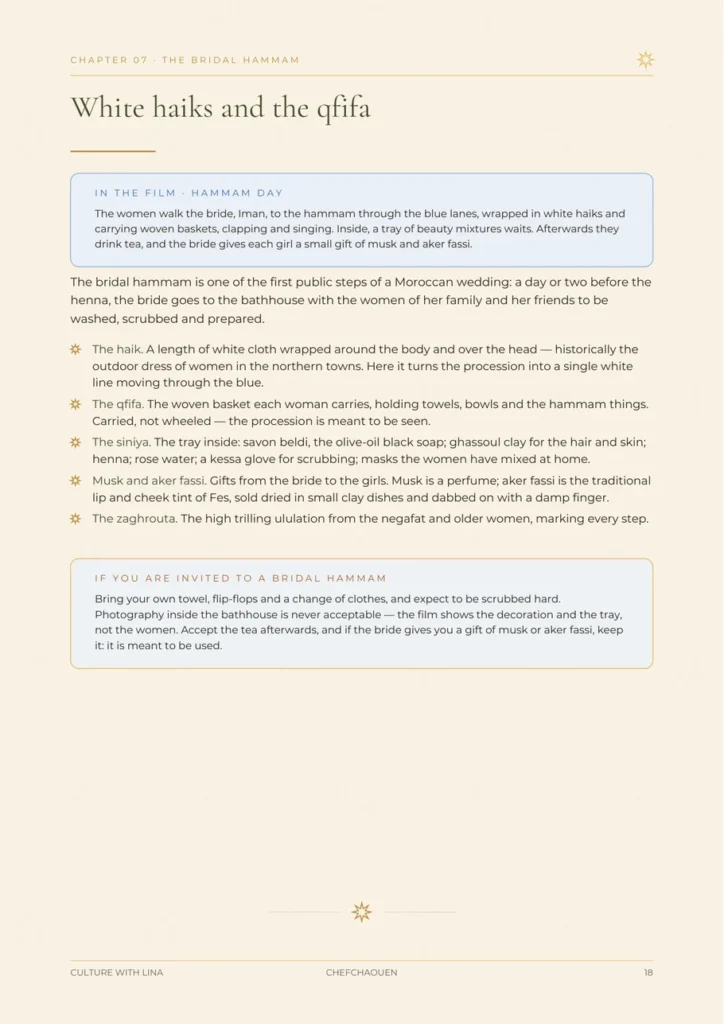
- The bridal hammam. A day or two before the henna, the women walk the bride to the bathhouse wrapped in white haiks, once the outdoor dress of women in northern towns, clapping, singing and carrying woven qfifa baskets. Inside waits a siniya, a tray of black soap, ghassoul clay, henna, rose water and a kessa glove. Afterward the bride may give each girl musk or aker fassi, the traditional lip and cheek tint of Fes.
- The henna day. A women-only gathering. The bride, often dressed in green for fertility and good fortune, is led in by her negafa and sits on a raised, decorated seat while the hennaya paints her hands and feet.
- Al-Hadra Chaouniya. Women’s groups sing and play frame drums, the tar and bendir, and small goblet drums called taarija. The tradition has Sufi roots, mixes devotional songs with wedding songs, and is learned by ear, mother to daughter.
- The farewell song. In some families the older women sing a farewell to the bride, who sits in a plain white caftan beneath a sheer veil held above her. The words are chosen to make her cry, marking her departure from her family’s house. The tears are expected, and the mood lifts as soon as the sweets go round.
- The wedding night. A larger celebration, often in a hall or big riad, running from evening until dawn. The bride changes outfits several times and is carried in on the amariya, a canopied platform lifted shoulder-high, before a late feast.
If you are invited, wear a light caftan to the henna day. Refuse black henna outright: it is often colored with PPD, a hair-dye chemical that can cause severe skin reactions. Natural henna stains orange-brown.
What to eat in Chefchaouen
- Jben. The local fresh goat cheese is soft and slightly sour, sold wrapped in palm leaves at the market and best eaten with bread and olive oil.
- Bissara. Dried fava bean soup with olive oil and cumin is the classic cold-morning breakfast and costs a few dirhams.
- Mountain honey. Dark, strong Rif honeys such as thyme and carob are worth buying from cooperatives rather than stalls on the square.
- Tagine. Goat or lamb with prunes and almonds, or vegetables; in small places, order ahead.
- Msemen and rghaif. These layered griddle flatbreads come with honey and butter or with amlou.
- Friday couscous. Friday is couscous day, so plan one lunch or dinner around it.
The best meals are in small family places up the lanes and in riads that cook for guests.
Getting there and getting around
Approximate road times: Tetouan about 60 km and 1¼ hours; Tangier and its airport about 115 km and 2½ to 3 hours; Fes about 200 km and 4 hours. CTM runs daily coaches from Tangier, Tetouan, Fes and Casablanca; the Tangier fare is roughly 8 to 12 EUR. Book a day ahead in high season, and buy your onward ticket on arrival because afternoon buses to Fes and Tangier fill in summer. Shared grand taxis from Tetouan leave when full, at about 4 to 6 EUR a seat, or you can buy the whole car. A private driver is the comfortable choice from Tangier or Fes.
The CTM station sits below the medina, about fifteen minutes’ walk up to Bab el Ain, the main gate. Cars cannot enter the medina, so park outside and walk. Porters with carts charge roughly 2 to 5 EUR; agree the price first.
Where to stay
- Upper medina, toward Ras el Maa. The best views and the quietest nights, with the most stairs. Suits couples who want a roof terrace.
- Near Outa el Hammam. Central and flatter, with cafés nearby but more evening noise. Best for families.
- Elsewhere in the medina. Lanes and stairs, quiet after dark and the blue outside your door, which is the point of coming.
- The new town. Cheaper and flatter, and still walkable to the medina. Good for tight budgets or anyone for whom stairs are a problem.
Before booking, ask how far the riad is from a taxi drop-off and confirm heating for November to March. Lower-floor rooms can be small and dark. Rates rise over Moroccan holidays, Easter and August.
Etiquette, dress and safety
Chefchaouen’s famous corners are people’s front doors, and some residents have put up signs asking visitors to stop photographing. Do not sit on doorsteps or pose against closed doors as if they were a set. Ask before photographing anyone, especially women, older residents and children, and respect a no. Do not pay children for photos. Step aside for residents, and leave the tripod at the riad.
Dress modestly, with shoulders and knees covered. Pack an evening layer in every season and shoes with grip for stairs. During Ramadan, cafés close by day, so eat and drink indoors during daylight.
The Rif is the center of Morocco’s cannabis cultivation, and you will be offered kif in the medina. Morocco legalized cultivation for medical and industrial use in 2021, but recreational use remains illegal. A polite, firm “la, shukran” ends the conversation. Do not photograph fields or farmers in the countryside.
A 3-day itinerary
Day 1
Morning: Travel from Tangier, Tetouan or Fes. Afternoon: Check in, enter at Bab el Ain and walk up to Ras el Maa while it is light. Evening: Take the path to the Spanish Mosque for sunset, then walk back down as the lamps come on and eat up the lanes rather than on the square.
Day 2
Morning: Blue lanes at 7:30, then the Kasbah and its tower, and the market if it is Monday or Thursday. Afternoon: Goat cheese for lunch, then a hammam; a private one with a scrub runs roughly 20 to 40 EUR. Evening: Ask your riad whether any hadra group is performing, then dinner.
Day 3
Morning: Leave early for Akchour; a car and driver there and back costs roughly 30 to 45 EUR. Afternoon: The lower falls and God’s Bridge, with a packed lunch. Evening: A quiet last night in town, or continue to Tetouan, an hour and a quarter away.
The premium Chefchaouen guide
Chefchaouen — The Blue City & A Wedding in Chefchaouen | Culture & Events Guide
The blue city, and a wedding inside it. 40 pages, thirteen chapters, thirteen original illustrations. Part One is Chefchaouen itself — founded as a mountain fortress in 1471, filled by refugees from Granada, and blue for reasons nobody fully agrees on. Part Two follows the four Chefchaouen films scene by scene: the bridal hammam procession in white haiks, the henna day, al-Hadra Chaouniya — the women’s music you will hear nowhere else — and the farewell song sung to make the bride cry. Instant PDF download.
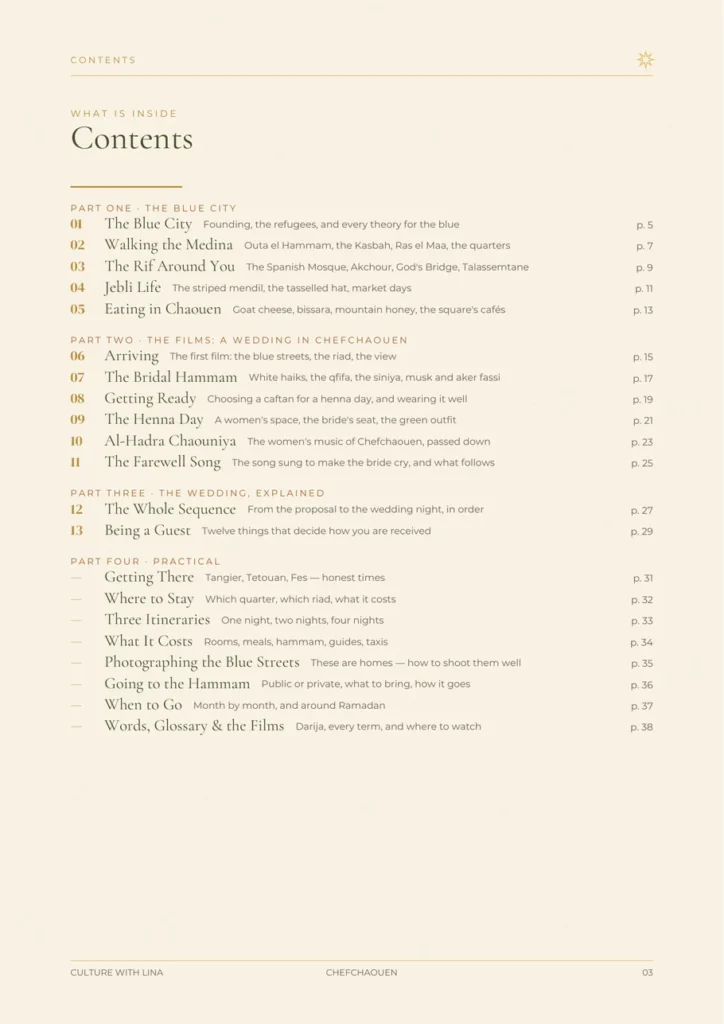
- The Blue City: the 1471 founding and every theory for the blue
- Walking the medina, plus Akchour, God's Bridge and Talassemtane
- The bridal hammam, the henna day and the farewell song, scene by scene
- Al-Hadra Chaouniya, the women's music of Chefchaouen
- Being a guest, plus itineraries, costs and a glossary
Instant PDF download. Licensed for personal use.
Chefchaouen: frequently asked questions
Why is Chefchaouen blue?
Nobody knows for certain. Theories include Jewish refugees, cooling and deterring mosquitoes. Today it is maintained deliberately.
Is one night in Chefchaouen enough?
One night covers the lanes and a Spanish Mosque sunset. Two nights works better, and four lets you reach Akchour and Talassemtane.
How do you get from Tangier to Chefchaouen?
CTM coaches run daily and take roughly 2½ to 3 hours for about 115 km. A private driver is more comfortable, especially with luggage. Tangier Ibn Battouta is the most useful airport.
What is the best time to visit Chefchaouen?
March to May is the best season, with green hills and full waterfalls. September and October are excellent too. August and the spring school holidays are the busiest, when room rates can double.
Can you drink alcohol in Chefchaouen?
It is scarce. Assume there is none during your stay.
Look inside the premium guide
About this guide. Culture With Lina is presented by Lina, an AI travel creator. This page and the premium PDF are researched and compiled from published sources, official information and local reporting; they are not a first-hand trip report. The images and films are made with AI tools. Prices are planning ranges, not quotes, so confirm locally before you travel. Spotted something out of date? Tell us.