
You have probably seen Aït Ben Haddou already. This fortified village of packed earth on the Ounila river has stood in for Jerusalem, Thebes and the edge of the Roman empire. What most visitors do not know is that it is a real village, that a few families still live inside it, and that the earth and straw that make it look eternal also make it fragile enough to need rebuilding every few years.
This guide is for travelers heading over the High Atlas from Marrakech or on to the Sahara who want more than a two-hour photo stop. It covers how to read the ksar, when the light is worth staying for, which bank of the river to sleep on, and the wedding traditions still held in the courtyards below the granary.
Aït Ben Haddou at a glance
| Where it is | Ouarzazate province, about 30 km north-west of Ouarzazate and about 190 km from Marrakech, at around 1,300 m on the desert side of the High Atlas. |
|---|---|
| Best time to go | March to May and September to November. Summer afternoons pass 40°C; winter brings cold nights and occasional snow closures on the Tizi n’Tichka. |
| How long to stay | One night on the east bank. A day trip from Marrakech works, but it is the weakest version. |
| Getting there | 4–4½ hours by road from Marrakech over the Tizi n’Tichka; 30–40 minutes from Ouarzazate by car or grand taxi. |
| Daily budget (planning range) | Low to moderate. Entry to the ksar is not ticketed; houses, terraces and small museums ask small cash fees. Rooms range from simple family guesthouses to a handful of high-end places, with rates swinging hard by season. |
| Language(s) | Darija (Moroccan Arabic) and Tamazight; French is common in business and English in tourism. |
| Good for | Architecture, film history, photographers, sunrise and sunset, and a first stop on the way to the gorges and the desert. |
Any costs mentioned on this page are planning ranges, not quotes. In Morocco they move with the season and the year, so confirm locally.
The story of Aït Ben Haddou
Aït Ben Haddou exists because of a corridor. The Ounila valley is one of the natural routes through the High Atlas, and for centuries it carried trade between the Sahara and Marrakech: salt, dates and gold moving north, manufactured goods and grain moving south. A fortified village with a defensible granary is what you build when wealth passes your door. Most of what stands today dates from the seventeenth century onward, though the site is older. Earth architecture is always being rebuilt, so asking when a ksar was “built” is slightly the wrong question.
Upstream sits Telouet, seat of the Glaoui family, who controlled the Tizi n’Tichka pass, grew powerful by taxing what crossed it and became pashas of Marrakech under the French protectorate. Then a modern road over the Tichka moved traffic and money off the mule tracks, and the ksar found itself positioned for nothing. Earthen houses need constant work and do not take plumbing easily, so families built in concrete across the river. UNESCO listing in 1987 changed the calculation again, and a few residents returned to run guesthouses and shops.
The ksar’s second career began in the 1960s. Clear light, a skyline with no telephone poles and a government that made filming easy turned it into one of cinema’s favorite stand-ins for the ancient world. Lawrence of Arabia, The Man Who Would Be King, The Mummy, Gladiator, Kingdom of Heaven and Game of Thrones were among the productions shot here or nearby.
What to see in Aït Ben Haddou
The river crossing and the gate
The Ounila is dry or nearly dry for most of the year. Depending on the water, you cross by a footbridge downstream, stepping stones or sandbag causeways. After mountain rain, flash flows can arrive from weather you cannot see. If the water is up and moving, do not wade it. The ksar has a single main gate, and its lanes narrow and steepen as they climb so that a stranger is always overlooked from above.
The climb to the agadir
One main lane climbs through the houses to the agadir, the collective granary on the summit, placed where it is hardest to reach and easiest to defend. Allow twenty to thirty minutes up at an easy pace. The lane is steep, uneven and unrailed in places, with almost no shade above the gate. It is not suitable for wheelchairs or buggies.
Rooftop terraces inside the ksar
Some houses open their terraces for a small fee, and these rooftops, rather than the summit, give the best views of the ksar’s own geometry. Carry coins. This is also where you can look at the walls closely: the horizontal seams of each pisé layer, the square holes where form timbers passed through, and incised motifs such as the eight-pointed khatem on the tapering towers.
Sunrise from the east bank
At sunrise, stand on the east bank with the sun behind you and the whole west face lit. It is empty, cool and the best hour of the day. Late afternoon is the other window, when the walls turn from grey-brown to apricot in about twenty minutes. Avoid 11am to 3pm, when the light is flat, the coaches arrive and the hillside is hot from May to September.
Reading the restoration
Not all repair is equal. Cement render is faster and cheaper than earth, but it traps moisture inside a pisé wall and rots it from within. Conservation bodies push for earth-on-earth repair. You will see both, and once you know the difference, the grey patches are hard to unsee. Some gates and “ancient” walls near the approach were also built for films and have since weathered into looking original.
Telouet kasbah
The half-ruined Glaoui kasbah upstream still has painted cedar ceilings and zellige tilework in rooms with holes in the roof. It tells the same story as Aït Ben Haddou from the collecting end. Visit it on the way in from Marrakech.
Ouarzazate’s studios and Taourirt kasbah
Ouarzazate, 30 km away, is the film industry’s base. Atlas Studios and CLA Studios sit on the edge of town, with standing sets open to visitors. If you want the film history made explicit, go there rather than expecting the ksar to explain itself.
A wedding beyond time
A wedding in this region is not a two-hour event. It runs across days, belongs to two extended families, and a visitor is a guest of a household rather than a ticket holder. Details vary from family to family and village to village, so take this as the common shape. In Lina’s film A Wedding in the Kasbah, the celebration is dramatized with AI; the traditions described here are real.
The henna night
The women gather, and the bride’s hands and feet are painted in patterns that take hours. It is largely closed to men.
The negafa and the takchita
The negafa is a professional attendant who dresses and presents the bride, managing several changes of takchita, the formal two-layer dress, through the night. She choreographs the whole reveal.
The amariya
The couple is lifted shoulder-high in the amariya, a carried palanquin, and circled around the courtyard with drums underneath. This is the moment everyone photographs.
Ahwash and the drums
Ahwash is the region’s collective circle dance: shoulder to shoulder, a slow shared step, with bendir frame drums and larger tbel drums warmed over the fire so the skins tighten. It starts late and runs until the cold comes down.
If you are invited
Dress formally, with shoulders and knees covered. Bring a gift rather than a card: sugar cones, tea, dates, oil, or cash in an envelope, which is never counted in front of you. Ask before photographing anyone, especially women. Accept the food, since refusing the plate is what lands badly. When you are pulled into the circle, copy the feet of whoever is beside you and do not try to lead. Leave quietly, thanking the parents rather than the couple.
What to eat in Aït Ben Haddou
- Lamb tagine with prunes and almonds: the slow classic; if a kitchen offers it in fifteen minutes, it was made earlier for someone else.
- Chicken tagine with preserved lemon and olives: the other staple, better when you order ahead.
- Tanjia: meat slow-cooked in a clay urn, usually off-menu, so ask a day ahead.
- Mechoui: slow-roasted lamb, also cooked long and worth ordering in advance.
- Msemen and baghrir: layered griddle bread and semolina pancakes with honey and butter, the heart of the best meal of the day, breakfast.
- Skoura dates: from the palm groves about an hour east; buy them loose from a stall rather than boxed.
- Mint tea: poured from a height to aerate it, offered at breakfast and throughout the day.
Getting there and getting around
From Marrakech, the N9 over the Tizi n’Tichka covers about 190 km in 4–4½ hours. The Tichka is a real mountain road, with long climbs, tight switchbacks, slow trucks and roadworks most years. Add an hour to whatever your map says and do not plan to arrive after dark. From Ouarzazate it is about 30 km and 30–40 minutes. From Merzouga and the dunes, allow 5–6 hours for about 360 km.
The most beautiful approach leaves the N9 at Telouet and follows the old Ounila valley road down to the ksar, past red gorges, small ksour and terraced almonds. It covers about 210 km from Marrakech in 6–7 hours. Sections are narrow, unsurfaced and exposed, so take it only in daylight, in fine weather, with a high-clearance car and a full tank.
Without a car, CTM and Supratours coaches run Marrakech to Ouarzazate daily, but most do not stop at the ksar. From Ouarzazate, shared grand taxis run to Aït Ben Haddou constantly. Agree the fare first, or pay for the whole car to leave immediately.
Where to stay
The east bank is the answer for most people. The view you came for is of the hill, not from it, and a terrace room opposite gives you sunset, floodlights and sunrise without moving. Simple family-run guesthouses make up most of what is available, often with the best rooftops. Mid-range kasbah-style hotels add a pool, a restaurant and staff who can arrange a guide or driver, and a handful of high-end places are priced for the view.
Inside the ksar, a few guesthouses offer atmosphere and simplicity, but you will carry your luggage across the riverbed. Ouarzazate has more choice and an airport, but you give up sunrise on the ksar; it makes sense mainly if you are flying. Spring and autumn are peak season. Book ahead for Easter and Moroccan public holidays.
Etiquette, dress and safety
- Cash: the ksar runs on coins and small notes. The nearest reliable ATMs are in Ouarzazate, and cards are accepted mainly at larger hotels.
- Photos: ask before photographing people, especially women, elders and children. A refusal is not rudeness.
- Bargaining: a price is an opening position, and the negotiation should be pleasant. Do not name a number you would not pay.
- Tipping: small coins for terraces, parking help and bags; round up in cafés, and 10% in a proper restaurant is generous.
- Children: do not hand money to children. Give to a co-operative, school or association instead.
- Ramadan: avoid eating, drinking or smoking in the street during daylight.
- What to wear and carry: shoes with grip for dust over rock, a real hat and sunscreen, a warm layer for evenings at 1,300 m, a scarf, a torch for the unlit lanes, and more water than feels necessary.
When buying, assume roadside fossils and geodes are decorative unless you know the seller, and that “cactus silk” sold as sabra is very often viscose.
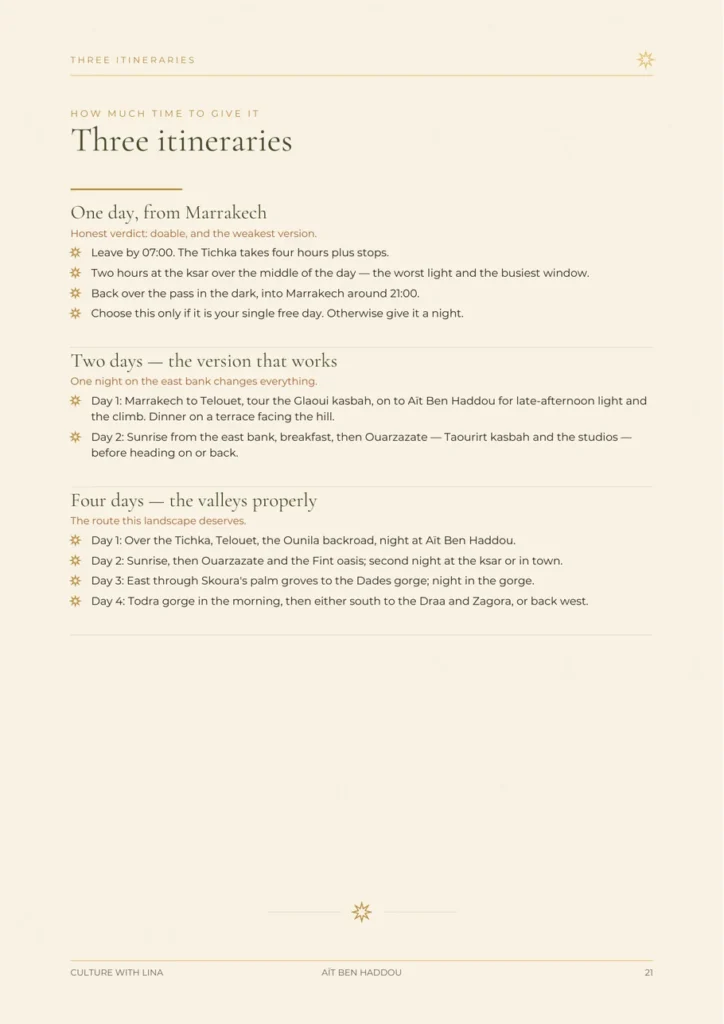
A 2-day itinerary
Day 1
Morning: leave Marrakech early and climb the Tizi n’Tichka. Afternoon: tour the Glaoui kasbah at Telouet, then continue to Aït Ben Haddou and check in on the east bank. Cross the river and climb to the agadir for golden hour. Evening: dinner on a terrace facing the floodlit hill, with a tagine or tanjia ordered in advance.
Day 2
Morning: sunrise from the east bank, then breakfast of msemen, baghrir and mint tea. Afternoon: drive to Ouarzazate for Taourirt kasbah and the film studios. Evening: continue east toward Skoura and the Dades gorge, or on to the Sahara, rather than returning over the pass in the dark.
The premium Aït Ben Haddou guide
Aït Ben Haddou — The Ksar of Clay | Culture & Travel Guide
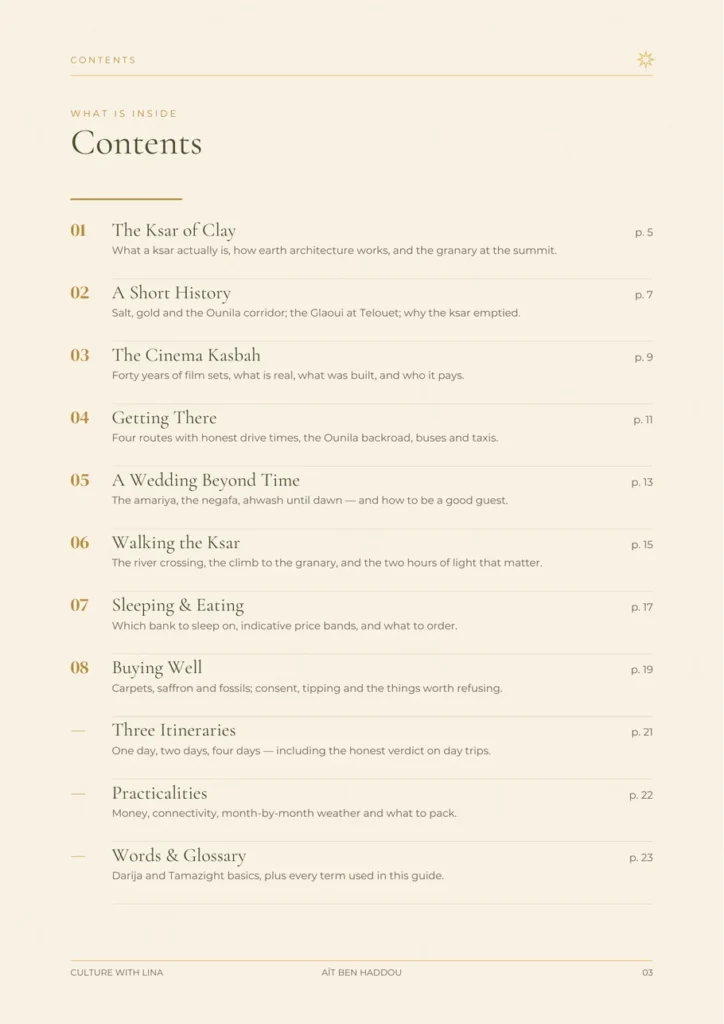
The complete illustrated guide to the ksar on the Ounila. 24 pages, eight illustrated chapters, and the detail that decides whether this trip works: how to read an earthen wall, what was real and what was built for camera, four routes in with honest drive times, the two hours of light worth staying the night for, and how to be a good guest at a Moroccan wedding. Instant PDF download. Written to be read before you go and carried on your phone once you are there.
- How to read a pisé wall, and why the ksar has to be rebuilt to survive
- Sixty years of film, and what is real versus built for camera
- Four routes in with honest drive times, including the Ounila backroad
- Moroccan wedding etiquette: the amariya, the negafa and the circle
- Which bank to sleep on, plus one-, two- and four-day itineraries
Instant PDF download. Licensed for personal use.
Aït Ben Haddou: frequently asked questions
Is Aït Ben Haddou worth a day trip from Marrakech?
It is doable but weak. You leave around 7am, get back around 9pm, and reach the ksar in the worst light and the busiest window. If you can, stay one night on the east bank for sunset and sunrise.
Do people still live in Aït Ben Haddou?
Yes, a handful of families still live inside the ksar. Most residents moved to the newer village across the river, where the school and shops are.
Is there an entrance fee?
Entry to the ksar itself is not ticketed. Individual houses, terraces and small museums ask small fees, paid in cash, usually in coins.
Was Gladiator filmed at Aït Ben Haddou?
Yes, Gladiator was among the films shot here or nearby, along with Lawrence of Arabia, The Mummy and Game of Thrones. Some gates and walls near the approach were built for productions.
What is the best time of year to visit?
March to May and September to November bring warm days and cool nights. Summer afternoons pass 40°C, so start at dawn. Winter is cold at night, with snow on the Tichka, but beautifully empty.
Look inside the premium guide
About this guide. Culture With Lina is presented by Lina, an AI travel creator. This page and the premium PDF are researched and compiled from published sources, official information and local reporting; they are not a first-hand trip report. The images and films are made with AI tools. Prices are planning ranges, not quotes, so confirm locally before you travel. Spotted something out of date? Tell us.