
Tetouan is forty minutes from Europe, and it shows. The medina is whitewashed rather than ochre, the doors are a particular sea green, the pastries are Andalusian, the old orchestras play music carried out of Granada, and the second language on the street is Spanish rather than French. Almost every visitor to northern Morocco drives straight past it on the way to Chefchaouen, which is exactly why it is worth stopping: this is a working old town where nobody is selling to you.
This guide is for travelers who want to understand the north rather than just cross it. It covers the UNESCO-listed medina, the Granada refugees who rebuilt the city, the Spanish Art Deco quarter beside it, the coast ten minutes away, and the Tetouani wedding, a multi-day sequence that explains more about the city than any monument. Prices and customs here are guidance: planning ranges, not quotes, and traditions that vary by family.
Tetouan at a glance
| Where it is | In the Rif foothills on the slope of Jebel Dersa, 10 km from the Mediterranean and about 60 km from both Tangier and Chefchaouen. |
|---|---|
| Best time to go | April to June, or September to October. July and August are Moroccan beach season; November to March is wet and green. |
| How long to stay | One night at least. Two days does the city properly; four makes it a base for the coast and the Rif. |
| Getting there | About 1–1¼ hours by road from Tangier and its airport, 1¼ hours from Chefchaouen, 45 minutes from the Ceuta border at Fnideq. |
| Daily budget (planning range) | Modest by Moroccan standards. A bowl of bissara costs a few dirhams, markets run on cash and small notes, and hotels in the Ensanche are better value than the few inside the walls. |
| Language(s) | Darija first, Spanish second, French third, English in hotels. |
| Good for | Andalusian heritage, crafts, architecture, Andalusian music, a quiet coast, and anyone curious about Moroccan weddings. |
The story of Tetouan
Granada fell in 1492. What followed was a century of expulsion: first the Muslims and Jews of the city, then, in 1609, the Moriscos, families who had converted under pressure and were pushed out anyway. Many crossed to this coast, and Tetouan was rebuilt to receive them. They arrived as a complete urban society rather than a wave of poor migrants: masons, tilemakers, silk weavers, embroiderers, musicians, judges and merchants with contacts on both sides of the water. That is why a city this size has its own embroidery tradition, a formal craft school and one of Morocco’s great Andalusian orchestral traditions, and why families here still name the Andalusian towns they came from.
Four centuries later, from 1913 to 1956, Tetouan was the capital of the Spanish protectorate in northern Morocco. Rather than rebuild the medina, Spain built a new quarter beside it, the Ensanche, on a grid with wide streets, balconies, cinemas, a cathedral and a great deal of Art Deco. Those decades are why Spanish, not French, is the second language of the north.
So when a visitor says Tetouan feels Spanish, the more accurate word is Andalusian. The Spanish quarter came much later. What arrived first came as a refugee. The medina has been on UNESCO’s World Heritage list since 1997, and the city is known as the White Dove, al-Hamama al-Baida.
What to see in Tetouan
The whitewashed medina and its seven gates
The walled medina covers roughly ten hectares, with seven gates, one long commercial spine and lanes branching into quarters once organized by origin and trade. It is lime-washed white, with doors, shutters and grilles in green. The lime reflects heat, seals walls against sea damp and is refreshed constantly, so the city looks scrubbed rather than aged. Look for Andalusian doorways: horseshoe arches, tiled thresholds and studded doors with a small door set into the large one.
Tip: enter at Bab Rouah from Place Hassan II for the easiest orientation. You can cross the whole medina in twenty minutes if you do not stop, which you will.
Souk el Hout and Guersa el Kebira
Souk el Hout, the fish market, is the liveliest corner of the medina in the morning, stocked with fish landed at Martil a few hours earlier. Guersa el Kebira is the cloth and clothing market, where Jbala women in striped mendil come down from the hills to sell.
Tip: both are busiest early. Much of the medina shuts by mid-afternoon, and Friday is quiet around midday prayer.
Dar Sanaa, the School of Arts and Crafts
Opposite Bab Okla, Dar Sanaa teaches zellige, carved plaster, wood, leather and embroidery formally rather than only by apprenticeship. You can watch apprentices at work.
Tip: enter the medina at Bab Okla instead of Bab Rouah if you care about how things are made; you start right beside the school.
The Ethnographic Museum
In the bastion at Bab Okla, the museum holds the city’s wedding costume, jewelry and instruments. Visit before you read about or attend a wedding and the details will make sense. Museums usually close one day a week, so check before you go.
The Ensanche and Place Moulay el Mehdi
Step out of Bab Rouah and within thirty seconds you are on a boulevard that could be in Cádiz. Avenue Mohammed V runs between the new town and the medina with Deco facades, iron balconies and pastelerías. Place Moulay el Mehdi, the central roundabout, still has the Spanish church on it.
Tip: take a café table on Place Moulay el Mehdi in the early evening and watch the city walk past.
Place Hassan II (the Feddan)
The great square joining the two cities, with the Royal Palace on one side. It is floodlit at night and the natural place to end a walk or eat dinner nearby.
The Archaeological Museum
A small museum in the Ensanche with mosaics and finds from Roman Tamuda and from Lixus further down the coast. An easy hour after lunch.
The Tetouani wedding, stage by stage
A Tetouani wedding is not a party with a ceremony in it. It is a sequence run by professionals, lasting three to seven days, with anywhere from 200 guests in a family house to 600 in a hired hall, and a main night that runs from about 22:00 to sunrise. Lina’s film of a Tetouan wedding is dramatized with AI; the traditions it shows are real. Customs differ between families and between the medina and the new town.
- Before. The families negotiate, the engagement is announced and the contract is signed. This can take a year and is not a party.
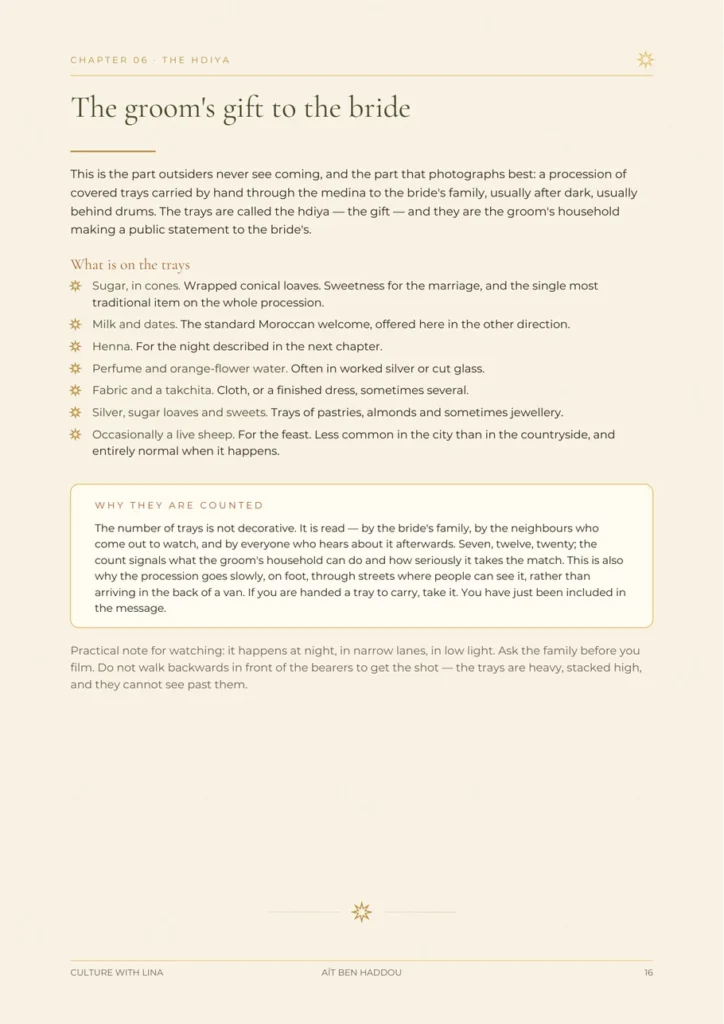
- The hdiya. The groom’s gift is carried by hand through the medina to the bride’s family, usually after dark and behind drums. The covered trays hold sugar cones, milk and dates, henna, perfume and orange-flower water, fabric or a takchita, pastries and sometimes jewelry, occasionally even a live sheep. The number of trays is read by everyone watching as a signal of the groom’s household. If you watch, ask before filming and never walk backwards in front of the bearers.
- The hammam and the henna night. The bride visits the bathhouse with female relatives, then a hennaya paints her hands and feet over hours while the women eat pastries and take turns on the drums. Largely closed to men.
- The bride’s changes. On the night, the negafat (the bride’s dressers and stage managers) take over. The bride appears in a series of outfits, commonly five to seven, including the heavy Andalusian costume with embroidered bodice, wide mdamma belt and high taj crown, and often closing in a white European-style gown.
- The amariya. The bride is lifted on a canopied platform carried by four to six men and circles the courtyard, announced by ululation. There is often more than one entrance.
- The music. A formal wedding opens with an al-Ala orchestra playing selections from the nuba, the long Andalusian suite, on oud, violin, rebab, qanun and percussion. When the room goes quiet, listen. After midnight a chaabi band or DJ often takes over.
- The table and the dawn. The main meal lands around midnight: briouat, then often a seafood pastilla, tagines, fruit. Pastries and mint tea arrive between four and six in the morning.
Andalusian ensembles also perform publicly through the year, particularly in spring. Ask at your hotel or the tourist office what is on.
What to eat in Tetouan
- Bissara: dried fava bean soup with olive oil and cumin, eaten standing up for a few dirhams, the best winter breakfast in the medina.
- Seafood pastilla: layered warqa pastry over fish, prawns and vermicelli, the northern celebration dish. In a restaurant, ask in the afternoon for the evening.
- Andalusian pastries: almond, cinnamon, orange-flower water and honey, bought by weight from pastelerías in the Ensanche.
- Grilled fish at Martil: the catch that fills Souk el Hout, eaten by the sea ten minutes away.
- Briouat: small folded pastries filled with cheese, chicken or shrimp.
- Chicken with preserved lemon and olives: a standard of the celebration table, along with lamb with prunes.
Getting there and getting around
By air. Fly to Tangier’s Ibn Battouta airport, about an hour away, for the useful European connections. Tetouan’s own Sania Ramel airport is small and seasonal, so check before building a plan around it.
By sea. Ferries run to Tangier Med or to Ceuta. Ceuta is Spanish territory, so the crossing at Fnideq, about 45 minutes away, is an EU external land border: quick when quiet, slow at holidays.
By coach. CTM and other companies run from Tangier, Chefchaouen, Fes and Casablanca. The Tangier service is frequent. Fes is about 4–4½ hours.
By grand taxi. Constant departures to Tangier, Chefchaouen, Martil and Fnideq. Pay by the seat or buy the whole car.
Driving. A good fast road to Tangier, a slower mountain road to Chefchaouen. Parking inside the medina is impossible, so leave the car in the Ensanche and walk.
Where to stay
Tetouan has never built a riad-hotel industry, so there are very few places to sleep inside the walls.
- The Ensanche is where most hotels are, a five-minute walk from the medina and better value. Best for a first visit and for anyone arriving by car.
- Inside the medina suits travelers who want to be in the old town at night and do not mind limited choice.
- Martil and M’diq on the coast suit a beach stay, especially in summer. Cabo Negro and M’diq are where Moroccan families holiday.
Etiquette, dress and safety
Tetouan is a conservative, residential city with few tourists. Covered shoulders and knees make every interaction easier. Keep out of doorways, ask before photographing anyone at work, and accept that a lane ending at someone’s front door is normal. Bargaining is gentler than in Marrakech: a price is still an opening position, but pushing hard mostly causes confusion. Guides can be arranged through your hotel; agree the rate and the length up front.
Carry cash. ATMs are plentiful in the Ensanche and scarce in the medina. If you are invited to a wedding, say yes: dress formally, bring sugar, tea, pastries or cash in an envelope, arrive late by your standards, greet both sets of parents first, expect no alcohol, and thank the parents rather than the couple when you slip out.
A 3-day itinerary
Day 1
Morning: arrive by 09:00, enter at Bab Rouah, walk the spine to Souk el Hout and Guersa el Kebira, and leave by Bab Okla. Afternoon: Dar Sanaa and the Ethnographic Museum, then the Ensanche. Evening: a café on Place Moulay el Mehdi at golden hour, dinner near Place Hassan II with the palace floodlit.
Day 2
Morning: bissara for breakfast, then drive the Oued Laou road east along the Mediterranean, with cliffs, coves and small Jbala villages. Afternoon: go as far as you like and turn back. Evening: Andalusian pastries from an Ensanche pastelería, and ask about any al-Ala concerts.
Day 3
Morning: Martil for the promenade and grilled fish. Afternoon: Cabo Negro, or Talassemtane National Park in spring or autumn. Evening: continue to Chefchaouen or Tangier.
The premium Tetouan guide
Tetouan — The White Dove & A Moroccan Wedding | Culture & Events Guide
A city guide and a complete guide to a Moroccan wedding, in one book. 32 pages, eleven chapters, eleven original illustrations. Part One is Tetouan: the whitewashed Andalusian medina, the Granada refugees who rebuilt it, and the Spanish Art Deco quarter beside it. Part Two is the wedding, in the order it happens — the groom’s gift carried through the medina at night, the bride’s seven changes of takchita, the amariya lifted shoulder-high, the orchestra, the table at midnight, and ten rules for being a good guest.Instant PDF download. Written to be read before you go and carried on your phone once you are there.
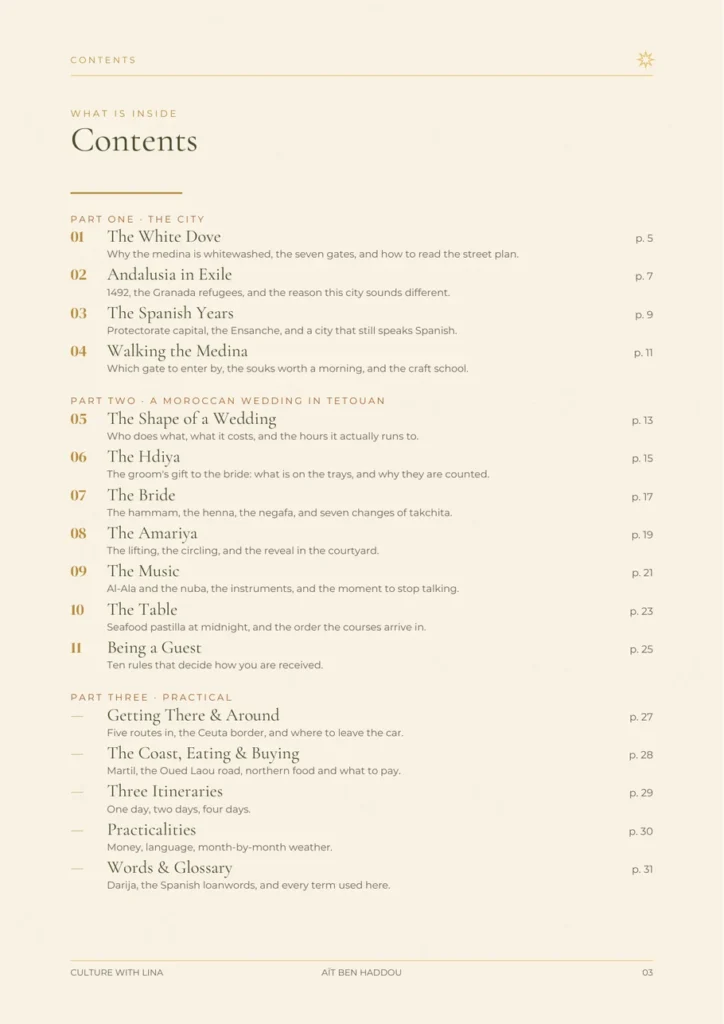
- The White Dove, Andalusia in exile, the Spanish years and a medina walking route
- Seven chapters on the wedding, from the shape of the night to the table at midnight
- The hdiya trays, the bride's changes of takchita and the amariya explained
- Al-Ala music and ten rules for being a good wedding guest
- Getting there, the coast, three itineraries, practicalities and a glossary
Instant PDF download. Licensed for personal use.
Tetouan: frequently asked questions
Is Tetouan worth visiting?
Yes, especially for an overnight. Its UNESCO-listed medina is residential and unhurried, the Ensanche adds Art Deco architecture, and the evening is the best part, which day-trippers miss.
Can you do Tetouan as a day trip from Tangier?
Yes. It is about an hour by road. One day covers the medina if you arrive by 09:00, but one night turns a stop into a city.
Is Tetouan safe?
It is a quiet, conservative city with far less tourist hustle than larger centers. Dress modestly, carry cash and use normal care at night.
What language is spoken in Tetouan?
Darija, with Spanish as the second language because of the protectorate years. If you speak any Spanish, Tetouan is one of the easiest cities in Morocco to travel in.
How long is a Moroccan wedding in Tetouan?
Usually three to seven days of events, from the hdiya and henna to the main night, which runs from about 22:00 until sunrise. Details vary by family.
Look inside the premium guide
About this guide. Culture With Lina is presented by Lina, an AI travel creator. This page and the premium PDF are researched and compiled from published sources, official information and local reporting; they are not a first-hand trip report. The images and films are made with AI tools. Prices are planning ranges, not quotes, so confirm locally before you travel. Spotted something out of date? Tell us.