
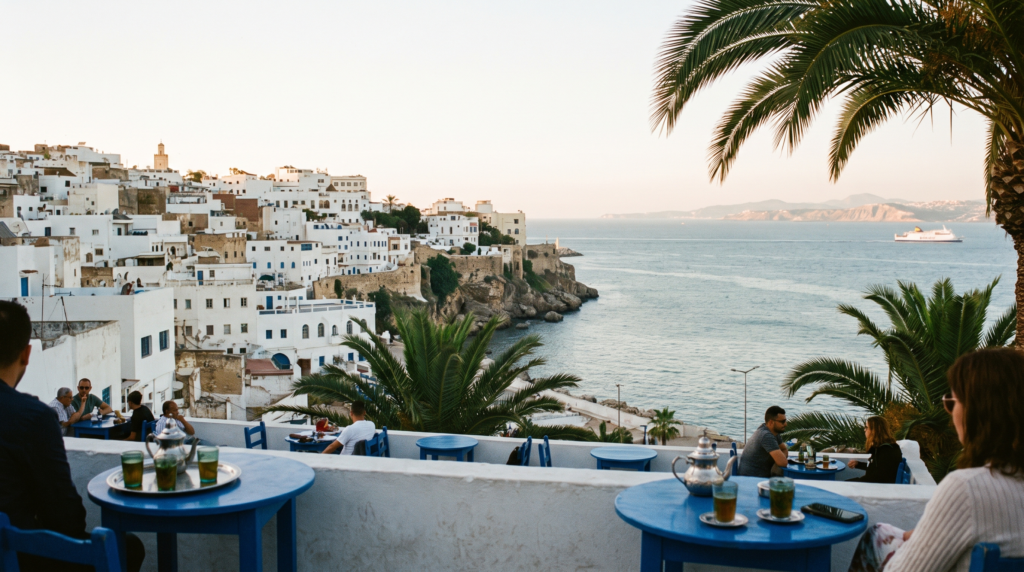
Tangier sits at the northern tip of Morocco on the Strait of Gibraltar, with Spain about 14 km away at the narrowest point. Most people meet it from a ferry ramp on the way somewhere else, carrying an old reputation of hustlers, spies and writers. Much of that is out of date. Today’s Tangier has a restored seafront, a walkable old town and very good fish, and it still feels unlike anywhere else in Morocco because it has always belonged a little to everyone.
This guide is for travelers who want to give Tangier more than the gap between a boat and a train. It covers the medina and Kasbah, the International Zone years, the coast where two seas meet, the food, and the northern wedding with its three kinds of music. Prices are planning ranges compiled from published sources, not quotes.
Tangier at a glance
| Where it is | The northern tip of Morocco, on the Strait of Gibraltar, facing Spain. |
|---|---|
| Best time to go | April to June, or September to October. |
| How long to stay | Two days for the city and coast; four to use it as a base for the north. |
| Getting there | About an hour by fast ferry from Tarifa, about 2¼ hours by Al Boraq high-speed train from Casablanca, or fly into Ibn Battouta airport. |
| Daily budget (planning range) | Rooms 30–50 EUR (simple guesthouse) to 140–250 EUR (sea-view riad). Street breakfast 1–3 EUR, grilled fish lunch 8–15 EUR, city taxis 1–4 EUR. |
| Language(s) | Darija. Spanish is often more useful than French; English in hotels. |
| Good for | History, literary Tangier, sea views, street food, and a base for the north. |
The story of Tangier
Tangier began as a trading post on the Strait and became Tingis, the Roman capital of Mauretania Tingitana. For two thousand years whoever wanted the Strait wanted Tangier, so its history reads like a list of owners. The Portuguese took it in 1471. In 1661 it passed to England as part of Catherine of Braganza’s dowry when she married Charles II; the English left in 1684, blowing up the harbor defenses behind them. Under Moulay Ismail the city returned to Moroccan rule. Ibn Battuta, the fourteenth-century traveler, was born here in 1304.
The legend came later. From the 1920s until independence in 1956, Tangier was an International Zone run by foreign powers: a tax haven and free port that drew bankers, smugglers, spies and artists. Matisse painted here in 1912 and 1913. Paul Bowles settled in 1947 and stayed until his death in 1999, and William Burroughs wrote much of Naked Lunch here in the 1950s.
Those decades explain the Spanish, French and English on the signs and the churches beside mosques. The last fifteen years added a restored corniche, a marina, the Tangier Med port and the high-speed line south. The old reputation has not caught up.
What to see in Tangier
The Grand Socco and Petit Socco
The Grand Socco is the big square where the new town meets the medina, officially Place du 9 Avril 1947, after Sultan Mohammed V’s Tangier speech. The old Cinema Rif here is now the Cinémathèque de Tanger. Walk down Rue es-Siaghine, the old goldsmiths’ street, to the Petit Socco, a small café-ringed square that was once the center of the city’s gossip. Take a table early for mint tea; it is still the best place to sit and watch.
The Kasbah and the Kasbah Museum
The walled quarter at the top has whitewashed lanes, sea views and the former sultan’s palace, Dar el Makhzen, now the Kasbah Museum, with Andalusian gardens and collections from Roman Tingis onward (about 2–3 EUR). Go uphill in the morning, before the heat and the ferry day-trippers, in shoes with grip. If you get lost, go downhill: you will reach the port or the Grand Socco.
Bab Bhar
Bab means gate and bhar means sea. This old opening of the Kasbah quarter faces the water, and in the late afternoon the Strait fills the arch. It makes a natural end to a morning loop.
The American Legation
The first property the United States owned abroad, given by the sultan in 1821, is now a museum in the lower medina with paintings, maps and a wing devoted to Paul Bowles (about 2–4 EUR). It is the best single place to understand the zone years.
The new town
The Art Deco boulevards hold the 1913 façade of the Gran Teatro Cervantes, Café de Paris on Place de France, and St Andrew’s, an Anglican church in a Moorish style with a quiet garden. Pair it with the Legation on the same morning.
Café Hafa
Terraced down the cliff since 1921, Café Hafa serves mint tea (1–2 EUR) with a view straight across the Strait. Go in the late afternoon and bring a layer; the menu barely matters.
Cap Spartel and the Caves of Hercules
Cap Spartel, about 14 km from the center, has a lighthouse where the Strait opens into the Atlantic. Just south, the Caves of Hercules have a sea opening that, from inside, looks like the outline of Africa, and beyond lie Achakar and the long Atlantic beaches. Hire a car with driver for the half day (about 30–50 EUR), agree the stops first, and swim only at supervised summer beaches; the currents are strong.
The corniche
The restored seafront along the bay is best in the evening, when families come out to walk. Cap Malabata, east of the bay, gives the view back to the city.
The northern wedding: three musics, one night
Families from the Andalusian towns, the Jbala mountains and the Rif marry in Tangier, and one celebration often mixes their traditions, such as an Andalusian-style bridal costume with a Jebli band. Many weddings are held in hired villas and halls, some on the hills above the Strait. In Lina’s films the wedding is dramatized with AI; the places, music and traditions shown are real. Families add, drop and reorder steps, so this is the usual shape, not a script.
- The proposal. The groom’s family visits the bride’s formally, with sugar and gifts.
- The contract. The marriage is registered before two adouls, notaries of religious law.
- The hdiya. The groom’s gifts are carried to the bride’s house on covered trays.
- The hammam and the henna. The bride’s bathhouse visit with the women of her family, then the henna night.
- The wedding night. Guests arrive at dusk. The bride appears in a series of outfits, each entrance staged by the negafat, her dressers, and the couple is carried round the room on the amariya, a canopied platform.
- The feast. Late: pastilla, chicken or lamb tagines, fruit, then sweets and mint tea toward dawn.
The music is what makes Tangier distinctive. Early in the evening comes al-Ala, the Andalusian classical music of oud, violin held on the knee, rebab and frame drums. Then Jebli music takes over, with driving drums and the ghaita, a loud double-reed pipe; its popular form, taqtouqa jabalia, gets everyone up. Rifian groups bring women’s sung call-and-response. When the music changes hands, the dancing changes with it, and ululation marks every high point.
If invited, wear a caftan, takchita or long modest dress (women) or a djellaba or dark suit (men), bring sugar, tea, pastries or an envelope, arrive late, and greet the parents first. Ask before photographing anyone. Without an invitation, Andalusian ensembles play festivals in Tangier and nearby Tetouan; ask your riad what is on.
What to eat in Tangier
- Grilled fish: sardines, sole and the morning’s catch with bread, cumin and salad, in small places around the port where you choose from the ice.
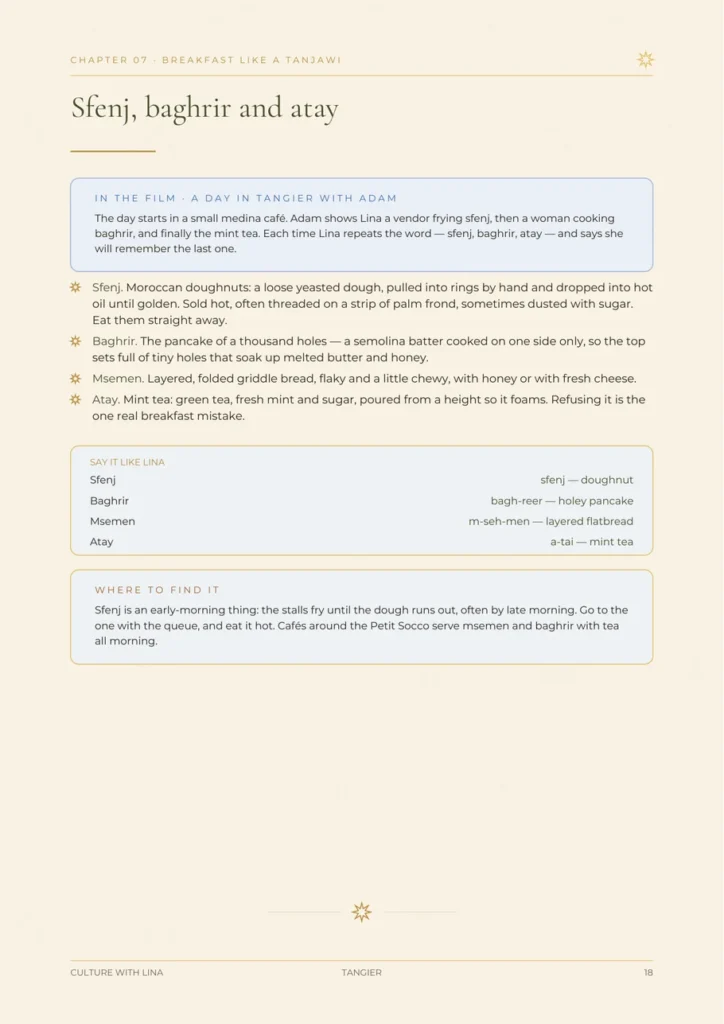
- Sfenj: hand-pulled doughnut rings fried hot in the early morning until the dough runs out.
- Baghrir and msemen: the holey semolina pancake and the flaky layered griddle bread, with honey, around the Petit Socco.
- The bocadillo: a Spanish-named roll of tuna, egg, potato, olives and spicy sauce (2–4 EUR) from counters near the Grand Socco.
- Kalinti: baked chickpea-flour custard sold hot from carts with cumin and salt.
- Harira and bissara: the medina soups of tomato and lentil, and fava bean with olive oil.
Getting there and getting around
By sea. Fast ferries from Tarifa (about an hour, 35–50 EUR one way) arrive in the city port, ten minutes’ walk from the medina. Passports are often stamped on board, so find the police desk before landing. Ferries from Algeciras take about 1½ hours to Tangier Med, about 40 km east; allow for a taxi.
By train. Al Boraq runs from Casablanca and Rabat to Tanger Ville station in the new town (about 20–40 EUR from Casablanca).
By air. Ibn Battouta airport is about 15 km out. Take an official taxi and agree the fare first.
Onward. Asilah is about 45 minutes, Tetouan about an hour and Chefchaouen about 2½ hours, by coach, grand taxi or car with driver.
In the city. Walk the medina and use petits taxis elsewhere, asking for the meter.
Where to stay
- The Kasbah suits couples: riads with roof terraces over the Strait, quiet at night, but steep.
- The medina is lively and sometimes noisy.
- The new town is flat and easy, near the train and cafés; good for families or a night between ferry and train.
- The bay and Malabata have modern seafront hotels for beach and pool.
A double room runs 30–50 EUR in a simple guesthouse, 70–130 EUR in a riad or mid-range hotel, and 140–250 EUR in a sea-view boutique riad. Ask how close a taxi can get and whether there is heating from November to March.
Etiquette, dress and safety
Tangier is generally safe and far calmer than its reputation, but the port and medina still attract people who live off newcomers.
- The unofficial guide offers to show you the way, then asks for money. Say “la, shukran” (no, thank you) and keep walking. You do not need a guide to reach the medina from the port.
- “That street is closed” usually means it is not.
- The shop detour ends in a relative’s shop. Say at the start if you do not want shopping.
- Taxis: meter, or agree the fare first. At night, stick to lit streets and take a taxi back.
For a guide, book a licensed one through your riad (30–50 EUR a half day) and ask to see the card. In carpet shops, tea commits you to nothing and walking away is normal. Solo women may get comments; walking with purpose and dressing modestly help. During Ramadan, eat and drink indoors in daylight. The medina runs on cash; leave around ten percent in restaurants.
A 3-day itinerary
Day 1
Morning: sfenj, baghrir and mint tea in a medina café, then the Grand Socco and Petit Socco. Afternoon: the Kasbah, Bab Bhar, a bocadillo and the Kasbah Museum. Evening: tea at Café Hafa at dusk, dinner in the medina.
Day 2
Morning: the American Legation and coffee in the new town. Afternoon: Cap Spartel, the Caves of Hercules and the Atlantic beaches. Evening: sunset on the corniche.
Day 3
Morning: Asilah, the whitewashed seaside town 45 minutes south, with murals on its medina walls. Afternoon: fish on the ramparts. Evening: back to Tangier, or on to Tetouan or Chefchaouen, which is better as an overnight.
The premium Tangier guide
Tangier — Two Seas & A Wedding | Culture & Events Guide
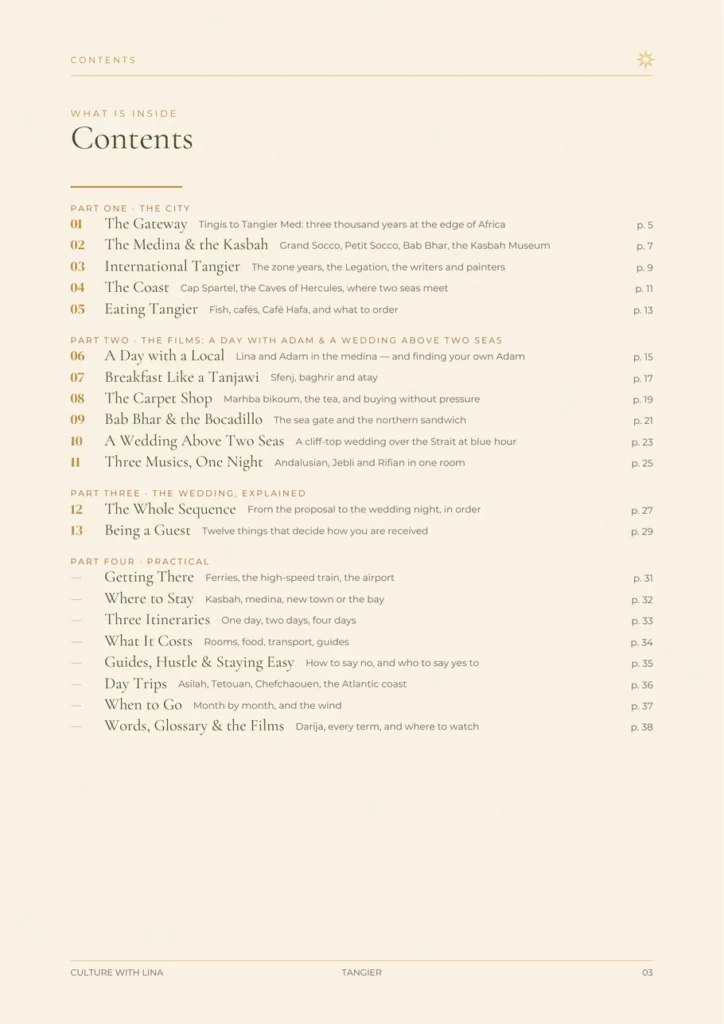
The city at the top of Africa, and a wedding above two seas. 40 pages, thirteen chapters, thirteen original illustrations. Part One is Tangier itself — Roman Tingis, an English royal dowry, the International Zone and its writers, and the coast where the Mediterranean meets the Atlantic. Part Two follows the two Tangier films scene by scene: a day in the medina with a local friend — sfenj, baghrir and atay, a carpet shop, Bab Bhar and the bocadillo — and a cliff-top wedding where Andalusian strings, Jebli drums and Rifian songs share one night. Instant PDF download.
- Three thousand years of Tangier, the medina, the Kasbah and the International Zone
- Both Tangier films explained scene by scene, from sfenj breakfast to Bab Bhar
- The northern wedding in sequence, with Andalusian, Jebli and Rifian music explained
- Twelve rules for wedding guests and an honest chapter on guides and hustle
- Getting there, where to stay, costs, day trips, three itineraries and a glossary
Instant PDF download. Licensed for personal use.
Tangier: frequently asked questions
Is Tangier worth visiting?
Yes. It is compact, renovated and walkable, with good food, a long history and a coast drive to where the Atlantic meets the Mediterranean. Two days is the right amount.
Is Tangier safe for tourists?
Generally yes. Expect some unofficial guides and shop detours. Decline politely, use metered taxis, and stick to lit streets at night.
Can you do a day trip from Spain to Tangier?
Yes. The Tarifa fast ferry takes about an hour, leaving time for the medina, the Kasbah and Café Hafa. Bring your passport.
What language is spoken in Tangier?
Darija day to day. Spanish is widely understood and often more useful than French; English is common in hotels.
When is the best time to visit Tangier?
April to June and September to October. Summer is hot and busy; winter is mild but wet. The Strait is windy year-round, and the levante can blow for days in summer.
Look inside the premium guide
About this guide. Culture With Lina is presented by Lina, an AI travel creator. This page and the premium PDF are researched and compiled from published sources, official information and local reporting; they are not a first-hand trip report. The images and films are made with AI tools. Prices are planning ranges, not quotes, so confirm locally before you travel. Spotted something out of date? Tell us.