
Description
Free to read: the Tangier travel guide on this site covers the essentials (when to go, what to see, getting around, etiquette and an itinerary). This PDF goes deeper.
Tangier, honestly
Most people meet Tangier from a ferry ramp, in a hurry, on the way somewhere else. It has a reputation — hustlers, spies, writers, a city of arrivals and departures — and a good deal of it is out of date. The Tangier of today is renovated, easy to walk, very good to eat in, and still unlike anywhere else in Morocco, because it has always belonged a little to everyone.
Below is the free version of this Tangier travel guide — what the city actually is, what is worth your time, what nobody tells you, and how a northern wedding runs here. The paid Tangier travel guide is what comes after: a city guide and a guide to a Tangier wedding, in one book.
What this Tangier travel guide actually covers
Tangier sits at the northern tip of Morocco, on the Strait of Gibraltar, where the Mediterranean meets the Atlantic — Spain is about 14 km away at the narrowest point. It began as a trading post and became Tingis, the Roman capital of Mauretania Tingitana. The Portuguese took it in 1471; in 1661 it passed to England as part of Catherine of Braganza’s dowry; the English left in 1684. From the 1920s until 1956 it was an International Zone run by foreign powers, and it drew bankers, spies, painters and writers — Matisse painted here in 1912 and 1913, and Paul Bowles lived here from 1947 until 1999.
That mixing is the thread of the city, and of its weddings: families from the Andalusian towns, the Jbala mountains and the Rif, with all three musics in one night.
Five things worth your time
- Breakfast in the medina. Sfenj fried to order, baghrir with honey, and mint tea — go early, before the stalls run out of dough.
- The Kasbah and Bab Bhar. The walled upper quarter, the Kasbah Museum in the old palace, and the sea gate with the Strait framed inside it.
- The American Legation. The first property the United States ever owned abroad, given by the sultan in 1821, now a museum with a wing devoted to Paul Bowles.
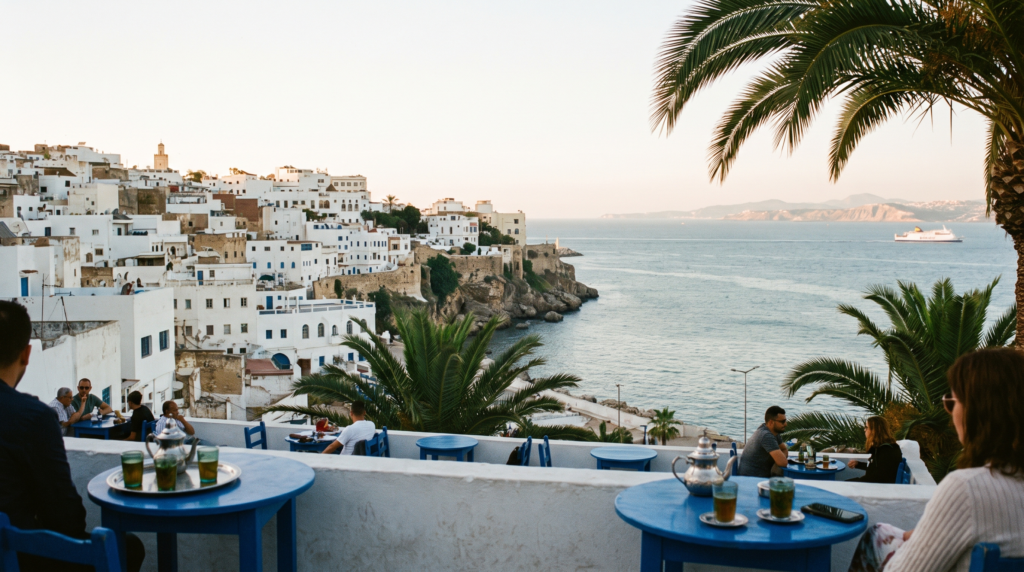
- Café Hafa at dusk. Terraced down the cliff since 1921, with mint tea and a view straight across to Spain.
- Cap Spartel and the Caves of Hercules. The north-west corner of Africa, where the Strait opens into the Atlantic.
Three things nobody tells you
- The hustle is much quieter than its reputation. You may still meet an unofficial guide at the port or in the medina. A friendly, firm la, shukran ends it; a licensed guide from your riad is the one to say yes to.
- Spanish is often more useful than French. Decades of Spanish presence in the north left words everywhere — including the bocadillo, the city’s favourite sandwich.
- The Strait is windy. The east wind, the levante, can blow for days, even in July. Bring a layer.
A day with a local, and a wedding above two seas
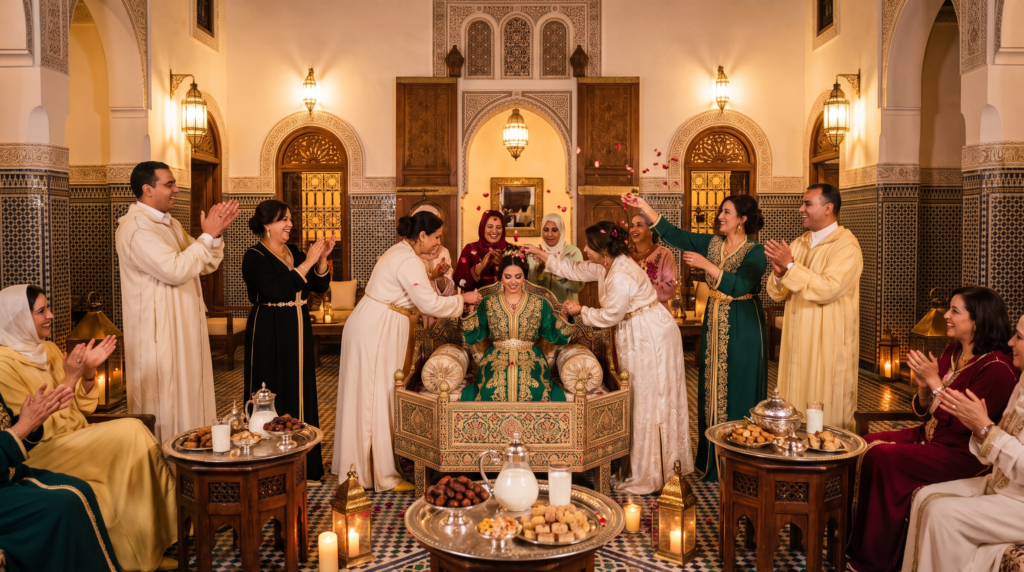
Lina’s Tangier films follow two stories. In the first, she spends a day in the old medina with her friend Adam, who grew up in the city: a street breakfast, a carpet shop, the Kasbah gate and a bocadillo for lunch. In the second, she walks a cliff-top path at blue hour with her friends Sofia and Rania to a wedding above the Strait. The films are dramatised, and the friends are characters — but the places, the food, the music and the traditions they show are real, and they are what the Tangier travel guide explains.
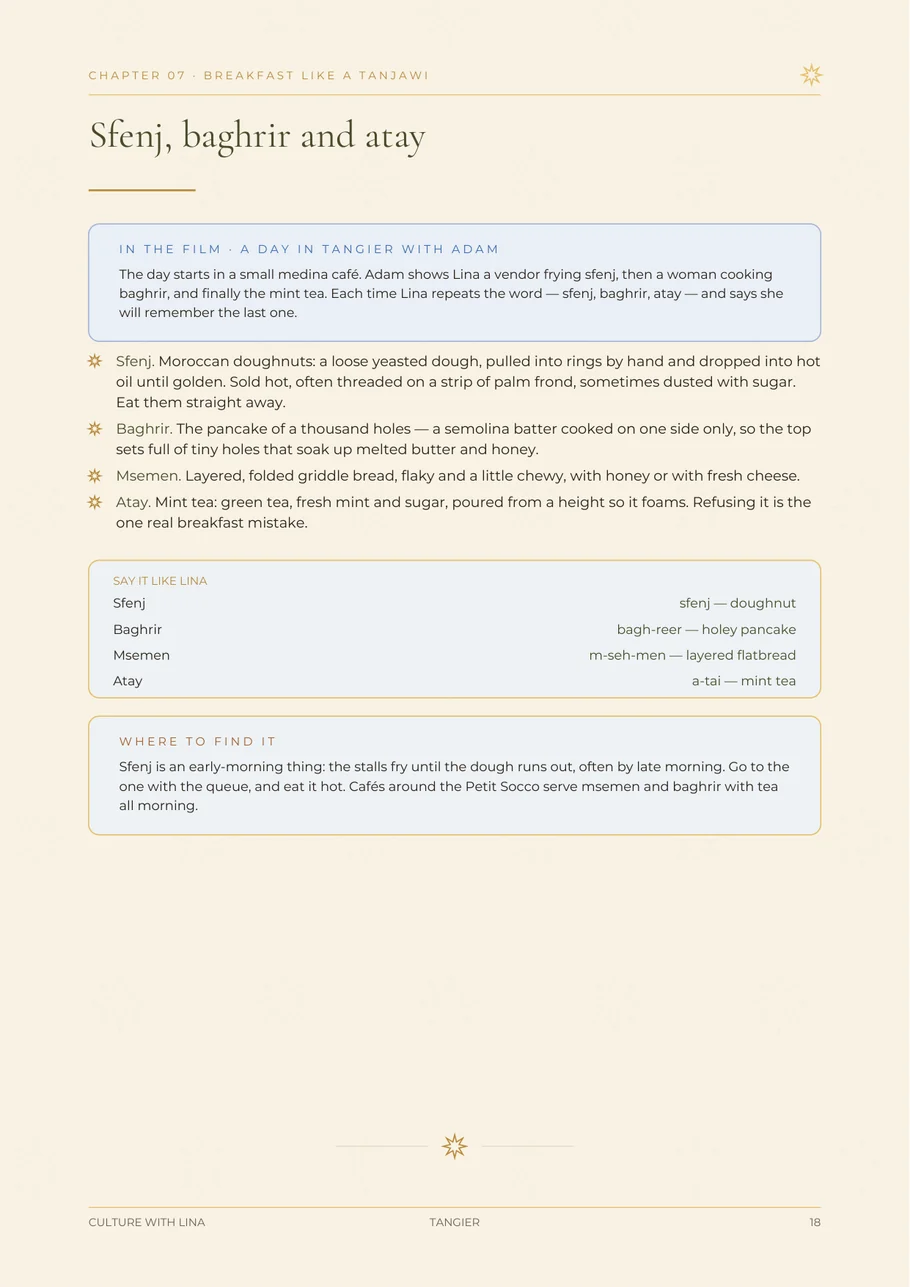
Breakfast like a Tanjawi. Sfenj, Moroccan doughnuts pulled into rings by hand and fried until golden; baghrir, the semolina pancake of a thousand holes; and atay, mint tea poured from a height.
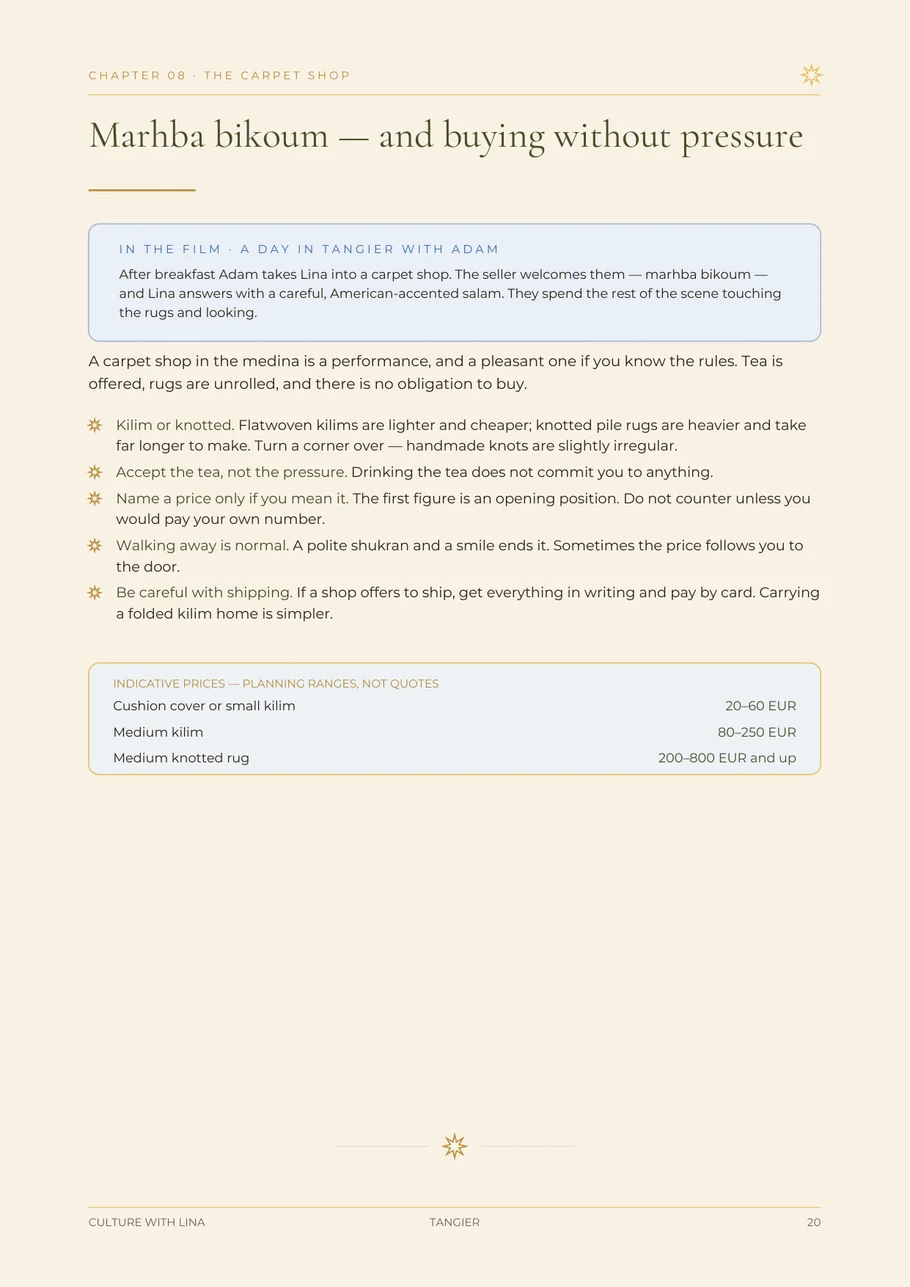
The carpet shop. The seller welcomes them with marhba bikoum. The Tangier travel guide explains kilim versus knotted, why accepting the tea commits you to nothing, and how to walk away politely.
Bab Bhar and the bocadillo. Bab Bhar — the sea gate — opens from the Kasbah quarter towards the water. The bocadillo is the north’s Spanish-named sandwich: a crusty roll with tuna, egg, potato, olives and a spicy sauce.
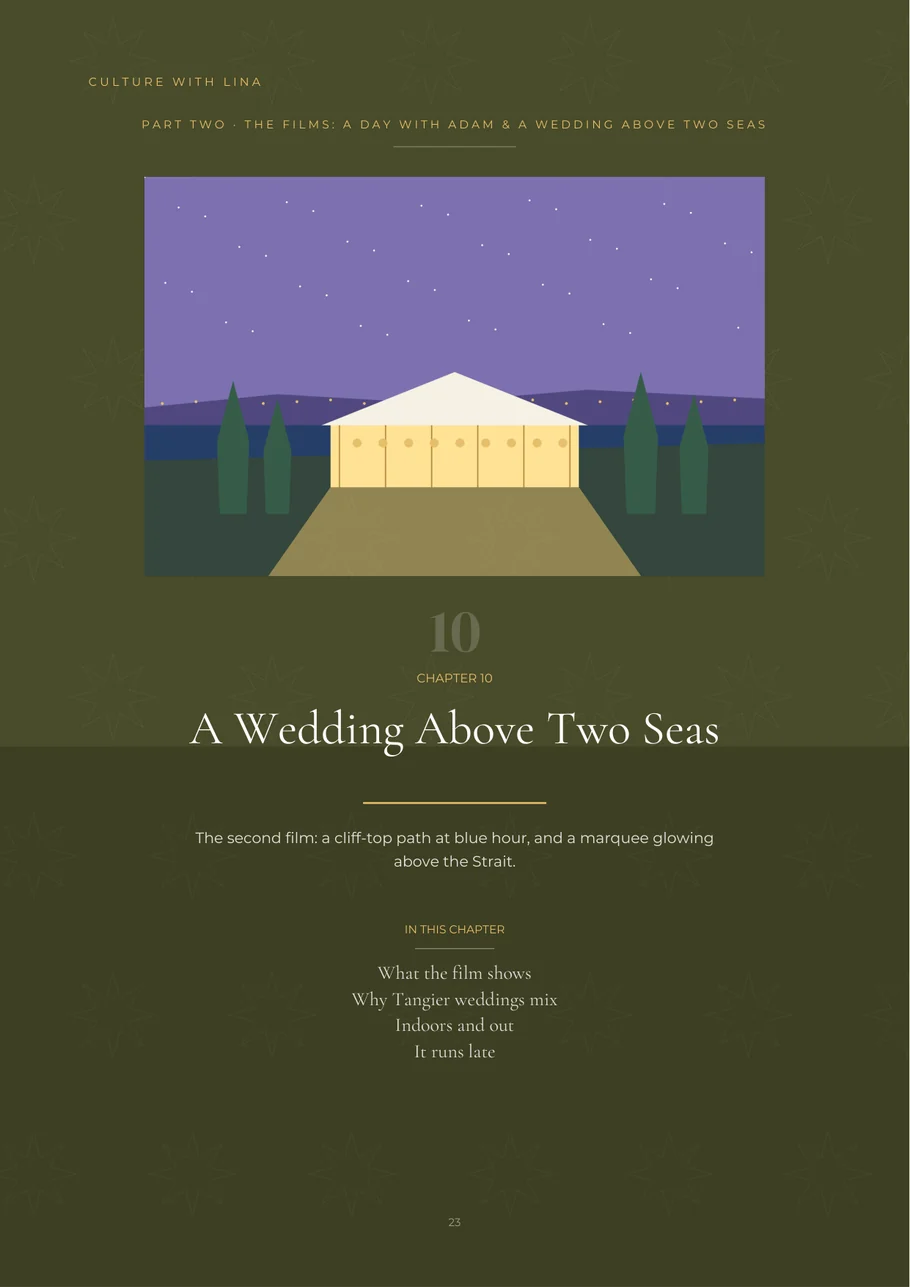
Three musics, one night. At a Tangier wedding the Andalusian strings of al-Ala can hand over mid-phrase to Jebli drums and the loud ghaita pipe, with Rifian women’s call-and-response on top — and the whole floor changes how it dances without anyone saying a word.
Follow @culturewithlina on Instagram, TikTok and YouTube for the Tangier films.
What is inside the Tangier travel guide
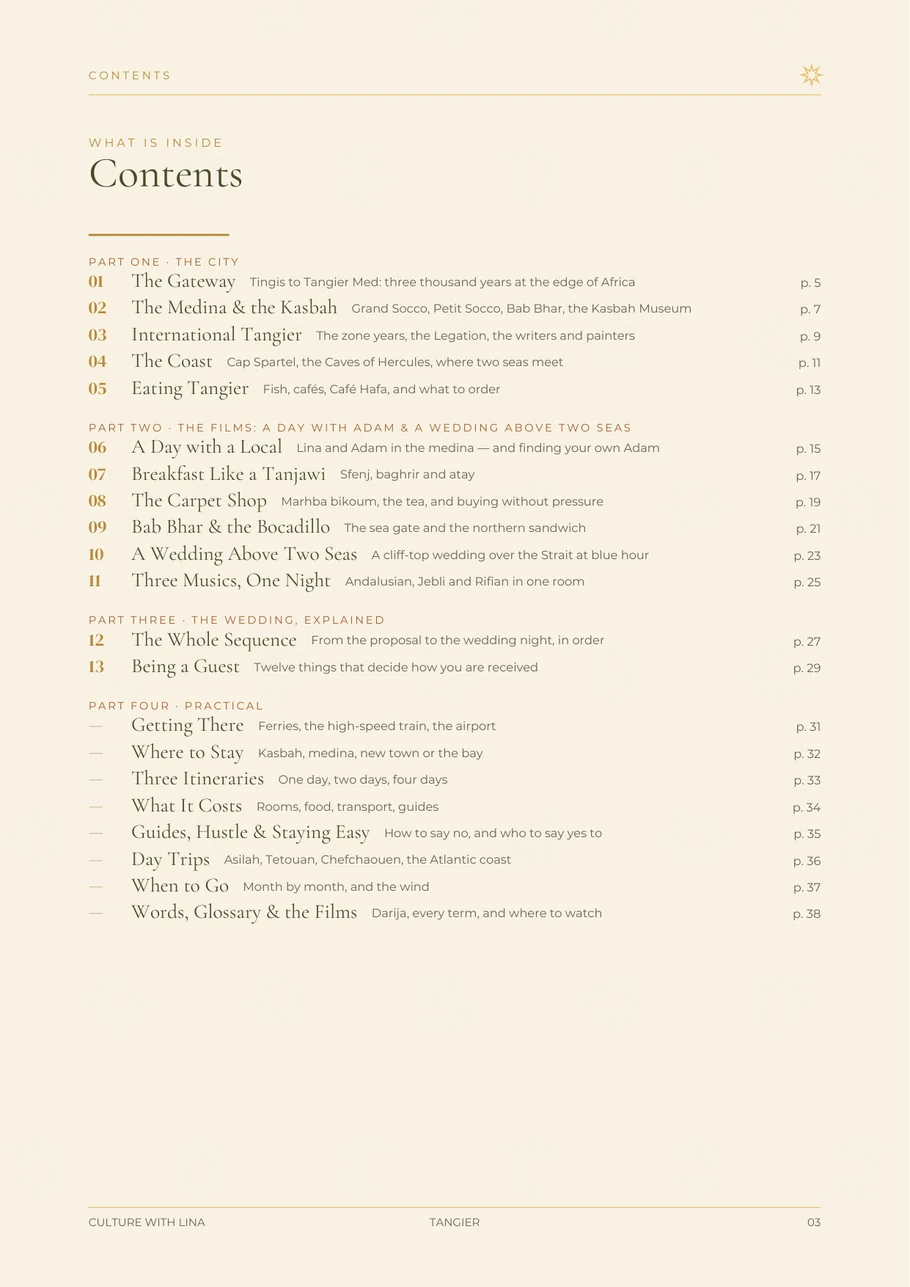
- Part One — The City. Three thousand years from Tingis to Tangier Med, the medina and the Kasbah, the International Zone and its writers, the coast where two seas meet, and eating Tangier.
- Part Two — The Films. Six chapters following both films scene by scene: a day with a local, breakfast, the carpet shop, Bab Bhar and the bocadillo, a wedding above two seas, and three musics in one night.
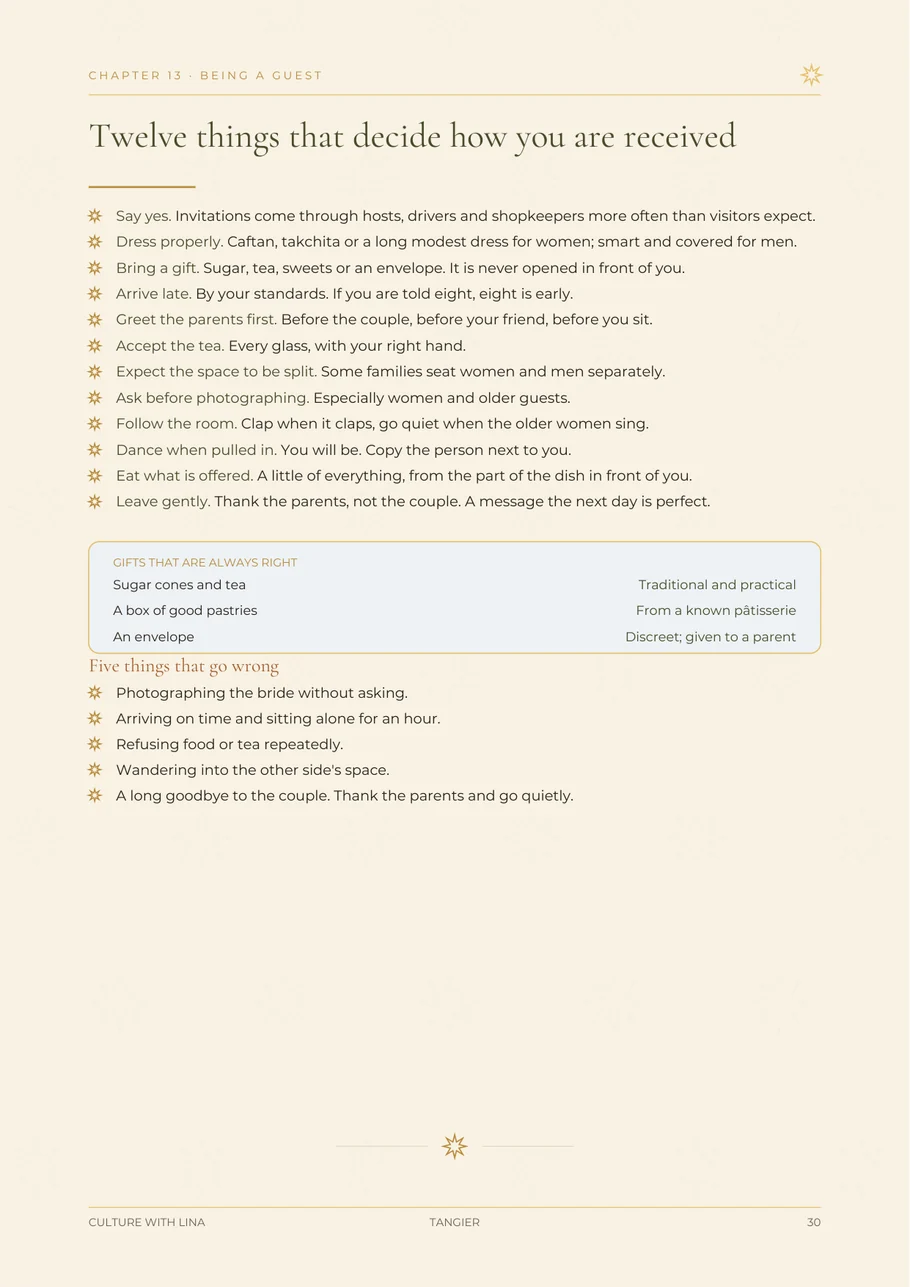
- Part Three — The Wedding, Explained. The whole northern sequence from the proposal to the wedding night, and twelve rules for being a good guest.
- Part Four — Practical. Ferries and the high-speed train, where to stay, three itineraries, what it costs, an honest chapter on guides and hustle, day trips, when to go, and a glossary.
Who it is for
Travellers who want more than an hour between the ferry and the train; anyone invited to a Moroccan wedding in the north; and readers who follow Lina’s films and want the story behind them.
Why this is not another listicle
Every tradition is explained in the order it happens. Where customs differ between families, the Tangier travel guide says so. Prices are labelled as planning ranges, not quotes. And it covers what most guides skip — how the northern wedding mixes three musical traditions, and who to say yes to when someone offers to show you around.
Format and delivery
A 40-page A4 PDF with thirteen chapters and thirteen original illustrations, in the same series as the other Culture With Lina guides. Instant download after checkout. Reads on a phone and prints at home.
Common questions
What does this Tangier travel guide include?
Forty pages in four parts: the city — the medina, the Kasbah, the International Zone and Cap Spartel; the food, from sfenj in the morning to the bocadillo at night; a northern wedding from the engagement to the farewell; and the practical chapters, with itineraries, costs and what to do with only a few hours between boats. The Tangier travel guide is a PDF you download straight after checkout and can print at home.
Is it useful if I only have a few hours between boats?
Yes. There is a short itinerary for exactly that: the Grand Socco, the Petit Socco, the Kasbah and Bab Bhar, and tea at Café Hafa.
Are the films real?
The films are dramatised with AI tools, and Lina, Adam, Sofia and Rania are characters. The places, the food, the music and the traditions they show are real, and the Tangier travel guide explains each one.
How accurate are the details and the prices?
The wedding chapters describe what is typical in Tangier and the north, and note where families differ. Prices are planning ranges compiled from published sources — confirm locally before you rely on them.
Read next
- Chefchaouen — The Blue City & A Wedding in Chefchaouen — two and a half hours away, and a whole wedding told in four films.
- Tetouan — The White Dove & A Moroccan Wedding — an hour away, with the best caftan rentals in the north.
- Tangier: Where Africa Watches Europe Across the Water — the journal story.
- All Morocco guides — the whole series.
Reviews
There are no reviews yet.