
Fes is Morocco’s spiritual and intellectual capital, and its old medina, Fes el-Bali, has been continuously inhabited and working since the ninth century. There are thousands of lanes, no grid and no cars. You will get lost, and that is the design rather than a failure of preparation.
This free guide is for travelers who want to arrive ready: how the medina works, when to hire a guide, which madrasas and monuments deserve your time, how to see the tanneries without being fleeced, and why a Fassi wedding sounds nothing like one in Marrakech.
Fes at a glance
| Where it is | Northern Morocco, in a bowl of hills with the Middle Atlas about an hour away |
|---|---|
| Best time to go | March to May, then September to November; summer is very hot and winter cold and wet |
| How long to stay | Three nights at least, plus a day trip to Meknes and Volubilis |
| Getting there | Train is best: about 4 hours from Casablanca, 3 from Rabat, 40 minutes from Meknes; Fès–Saïss Airport (FEZ) is about 15 km south |
| Daily budget (planning range) | Budget 300 to 500 MAD; mid-range 800 to 1,500 MAD; comfortable to luxury from 2,500 MAD per person, excluding flights |
| Language(s) | Darija day to day; Modern Standard Arabic official; French widespread; English common in tourism |
| Good for | Medieval architecture, crafts, Fassi food, Andalusian music, travelers who like to wander |
The story of Fes
Fes was founded at the end of the eighth century by Idris I and consolidated by his son Idris II, whose shrine sits at the heart of the medina and remains one of the most venerated places in Morocco. Waves of refugees shaped the city. Families expelled from Córdoba settled the Andalusian quarter, and families from Kairouan in Tunisia settled the Qarawiyyin quarter. That Andalusian inheritance is why Fes sounds, tastes and builds the way it does.
In 857 to 859, Fatima al-Fihri, a woman who had inherited money, founded Al-Qarawiyyin, widely recognized, including by UNESCO and Guinness World Records, as the oldest existing, continually operating higher-education institution in the world. Its library, restored by the architect Aziza Chaouni and reopened in 2016, holds manuscripts more than a thousand years old.
The city comes in three layers. Fes el-Bali, inscribed by UNESCO in 1981, is generally described as the largest car-free urban area in the world. Fes el-Jdid, the “new” Fes founded by the Marinids in the 13th century, holds the Royal Palace and the Mellah, the historic Jewish quarter. The French-built Ville Nouvelle is where much of modern Fes lives, works and eats.
What to see in Fes
Ticket prices below are planning ranges and change without announcement, so confirm at the door. First, the one rule that matters: the two main streets, Talaa Kebira and Talaa Sghira, both run downhill from Bab Boujloud and converge near Al-Qarawiyyin. Downhill leads inward, uphill leads out.
Bab Boujloud
The main pedestrian entrance, built in 1913, is blue on the outside and green on the inside. It is the natural starting point for any walk. Tip: photograph the blue face from outside in late afternoon, then step through for the green.
Bou Inania Madrasa
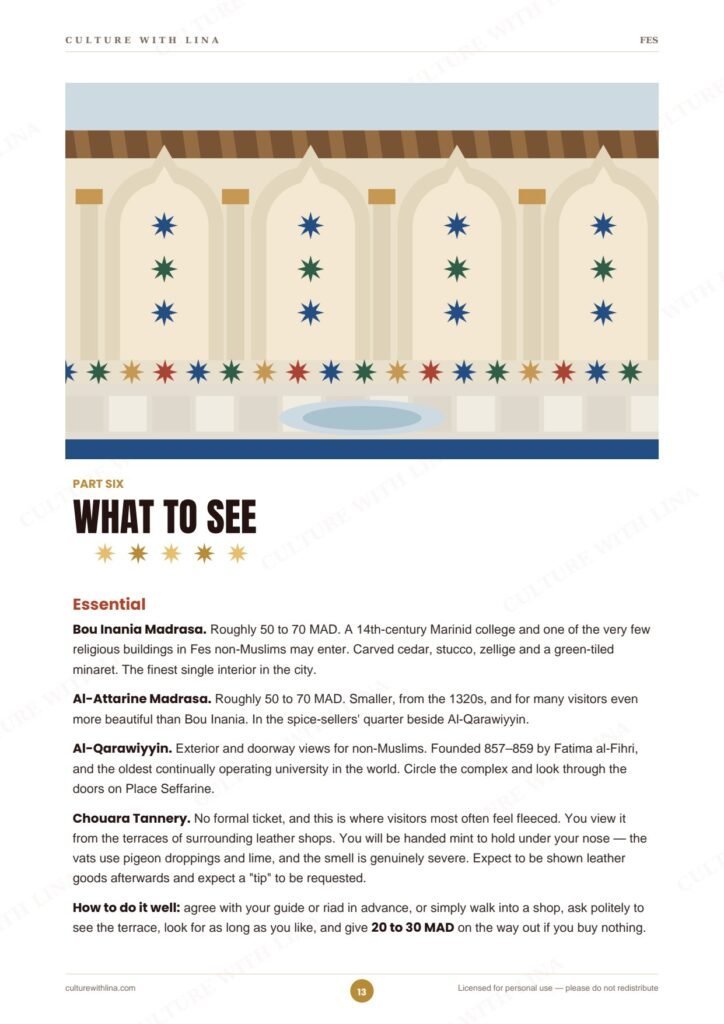
A 14th-century Marinid college and one of very few religious buildings in Fes that non-Muslims may enter, with carved cedar, stucco, zellige and a green-tiled minaret. Planning range: 50 to 70 MAD. Tip: come in the first hour after opening for even light and an empty courtyard.
Al-Attarine Madrasa
Smaller than Bou Inania, dating from the 1320s, and for many visitors even more beautiful. It sits in the spice-sellers’ quarter beside Al-Qarawiyyin. Planning range: 50 to 70 MAD. Tip: combine it with the Qarawiyyin doorways and Place Seffarine in one loop.
Al-Qarawiyyin and Place Seffarine
Non-Muslims cannot enter the mosque, but you can look into the courtyard from several doorways as you circle the complex. Nearby, Place Seffarine is the coppersmiths’ square, where you hear the hammering before you see it. Tip: this is one of the few spots in the medina where lingering costs nothing.
Chouara Tannery
There is no ticket. You view the vats from the terraces of surrounding leather shops, holding the mint you are handed, because the pigeon-dropping and lime vats smell genuinely severe. Expect to be shown leather goods and asked for a “tip.” Tip: arrange the visit through your guide or riad, or walk into a shop, ask politely to see the terrace, and leave 20 to 30 MAD if you buy nothing. Go mid-morning, when the light reaches the vats.
Nejjarine Museum and Dar Batha
The Nejjarine Museum of Wooden Arts occupies a restored fondouk, a merchants’ inn, and its roof terrace has one of the best views of the medina. Dar Batha, a 19th-century palace, displays Fassi ceramics, carved wood and embroidery around an Andalusian garden. Planning range for each: 20 to 50 MAD.
Fes el-Jdid: the Mellah and the Royal Palace
You cannot enter the Royal Palace, but its seven brass doors on Place des Alaouites are a real spectacle. The Mellah’s balconied houses look outward, unlike the inward-facing Muslim quarter, and the Ibn Danan Synagogue is usually open to visitors. Jnan Sbil Gardens, free and shaded, make a good pause afterward.
Merenid Tombs
Ruined 14th-century tombs on the hillside above the medina, free to visit, with the definitive sunset view over Fes el-Bali as the call to prayer rises from hundreds of minarets. Tip: take a taxi up, walk down, and go with someone rather than alone at dusk.
What to skip: “Berber pharmacy” demonstrations a guide suggests unprompted, carpet showrooms you did not ask to see, and the rooftop restaurants at Bab Boujloud that charge for the view.
The Fassi wedding
Fes is where the Moroccan wedding reaches its most refined and formal version. In Lina’s films the wedding is dramatized with AI; the traditions shown are real. The national sequence applies, though each family adapts it:
- Khotba, the engagement, when the groom’s family formally asks for the bride’s hand.
- The contract, signed before two adouls, the traditional notaries.
- The hammam night with the bride’s closest women.
- The henna night, for which the bride traditionally wears green.
- The great night, which in Fes becomes a full production.
- The family breakfast the morning after.
The great night is run by the neggafa and her team of negafat. They supply the entire bridal wardrobe, dress and re-dress the bride between entrances, carry her train, choreograph each appearance and control the pacing. In Fes the best are booked a year ahead and can cost more than the venue.
The signature is the sequence of takchitas: traditionally seven, sometimes five. A takchita has two pieces, an under-dress called the tahtiya and an embroidered over-layer called the dfina, closed with a wide belt called an mdamma. Fassi work uses heavy silver and gold thread, sfifa braid and silk. The sequence usually moves through a green henna-night look, a white first entrance, regional costumes and a final gown. At each reappearance the negafat lead the bride out and turn her slowly so every side of the courtyard sees the dress, and the older women answer with the youyou, a sustained ululation. Her arrival on the amariya, a gilded throne carried on four men’s shoulders, is the emotional peak.
What makes a Fassi wedding audible from the street is the music. Where Marrakech has Dakka Marrakchia drums, Fes has al-Ala, the Andalusian classical tradition brought by families expelled from al-Andalus, played on oud, upright violin, rebab, qanun and frame drums with a chorus. Its form, the nuba, begins slow and stately and accelerates through the evening. If you are invited, dress formally and conservatively, give cash in an envelope to the couple’s family, and move when the negafat wave the crowd back.
What to eat in Fes
- Pastilla: Fes is its home; layered warqa pastry with pigeon or chicken, almonds, cinnamon and icing sugar, so order it here if nowhere else.
- Rfissa: shredded msemen or trid bread under chicken cooked with fenugreek, lentils and ras el hanout, traditionally served to new mothers.
- Harira: tomato, lentil and chickpea soup finished with lemon.
- Bissara: broad bean purée with olive oil and cumin, a breakfast of around 10 MAD.
- Tagines: especially chicken with preserved lemon and olives, and lamb with prunes.
- Sfenj, msemen and pastries: doughnuts and flatbread in the morning; chebakia and kaab el ghzal, the almond-filled gazelle horns, with tea.
Cheap eats cluster along Talaa Kebira and around Bab Boujloud. Many riads cook outstanding Fassi dinners if you book in the morning. Alcohol is much harder to find than in Marrakech; only a few riads and Ville Nouvelle hotels are licensed.
Getting there and getting around
The train is the best way in. ONCF runs to Casablanca in roughly four hours, Rabat in about three, Tangier in around four and Meknes in 40 minutes; first class is a small premium and guarantees a seat. The station is in the Ville Nouvelle, 10 to 15 minutes by taxi from the medina gates. Fès–Saïss Airport is about 15 km south, with a taxi into town at a planning range of 150 to 250 MAD. From Marrakech it is roughly seven to eight hours by train or a one-hour flight, which is why most itineraries pair Fes with Meknes, Volubilis and Chefchaouen instead.
Cars cannot enter most of Fes el-Bali. You will be dropped at a gate, usually Bab Boujloud, Bab Rcif or Bab Guissa, and walk in. Arrange a riad pickup: it is the difference between arriving calmly and arriving 40 minutes late after being “helped” by strangers. Porters with handcarts charge roughly 30 to 50 MAD to your door; agree before they load. Inside, walk. When you hear “balak,” step aside, because a loaded donkey does not stop.
Where to stay
Stay inside Fes el-Bali. Fassi riads are often grander than their Marrakech equivalents, with taller courtyards and more carved cedar, and frequently cheaper. The downsides are stairs, no vehicle access and cold winters.
- Near Bab Boujloud or Talaa Kebira: easiest for coming and going, slightly noisier.
- The northern medina toward Bab Guissa: calmer, with views, at the cost of a longer walk.
- The Ville Nouvelle: modern hotels with lifts and parking, sensible for mobility needs or one night, but you miss the point of Fes.
Planning ranges per double room: budget 150 to 450 MAD, mid-range 600 to 1,400 MAD (the city’s strongest tier), luxury from 2,000 MAD. Ask how far the riad is from the vehicle drop-off and whether it has heating from November to March.
Etiquette, dress and safety
Fes is noticeably more conservative than Marrakech or Essaouira. Women: shoulders and knees covered in the medina, loose clothing, a scarf in the bag. Men: long trousers rather than shorts. Greet before you transact, give and receive with the right hand, and accept the tea. Non-Muslims may not enter mosques or the shrine of Moulay Idriss II, though you can look in from the doorways. Ask before photographing people, including the men working in the tanneries. Public affection is best kept minimal, and same-sex relationships are criminalized under Moroccan law.
Fes is a safe city, and violent crime against visitors is rare. The friction is commercial:
- Faux guides attach themselves and then demand payment or steer you to a shop. A flat “la, shukran” and continuing to walk works.
- “That way is closed” usually means it is not.
- The tannery tip that was never agreed.
The best defense is an official guide for your first half-day, with a planning range of 250 to 400 MAD, booked through your riad. Official guides carry a tourism ministry badge. Say “no shops” at the start. After dark, take a taxi to a gate rather than crossing the medina on foot. Emergency numbers: police 190 from a mobile, ambulance and fire 15.
A 3-day itinerary
Day 1
Morning: enter at Bab Boujloud with an official guide: Bou Inania, down Talaa Kebira to Al-Attarine, the Qarawiyyin doorways, Place Seffarine and the tanneries. Afternoon: lunch in the medina, then retrace the route alone. Evening: sunset at the Merenid Tombs.
Day 2
Morning: the Nejjarine Museum and terrace, then zellige and brass workshops. Afternoon: Dar Batha, then Fes el-Jdid for the Royal Palace doors, the Mellah and the synagogue. Evening: a hammam around 6pm and dinner in a riad.
Day 3
Morning: drive to Volubilis early, before the shadeless site heats up. Afternoon: Moulay Idriss Zerhoun, then Meknes for Bab Mansour and the royal granaries. A driver for the day runs roughly 700 to 1,100 MAD. Evening: back in Fes for pastilla.
The premium Fes guide
Fes — The Oldest Medina | Culture & Travel Guide
A Fes travel guide in 36 illustrated pages. How to survive the oldest medina in the world, the tannery without the argument, and the Fassi wedding with its seven takchitas.
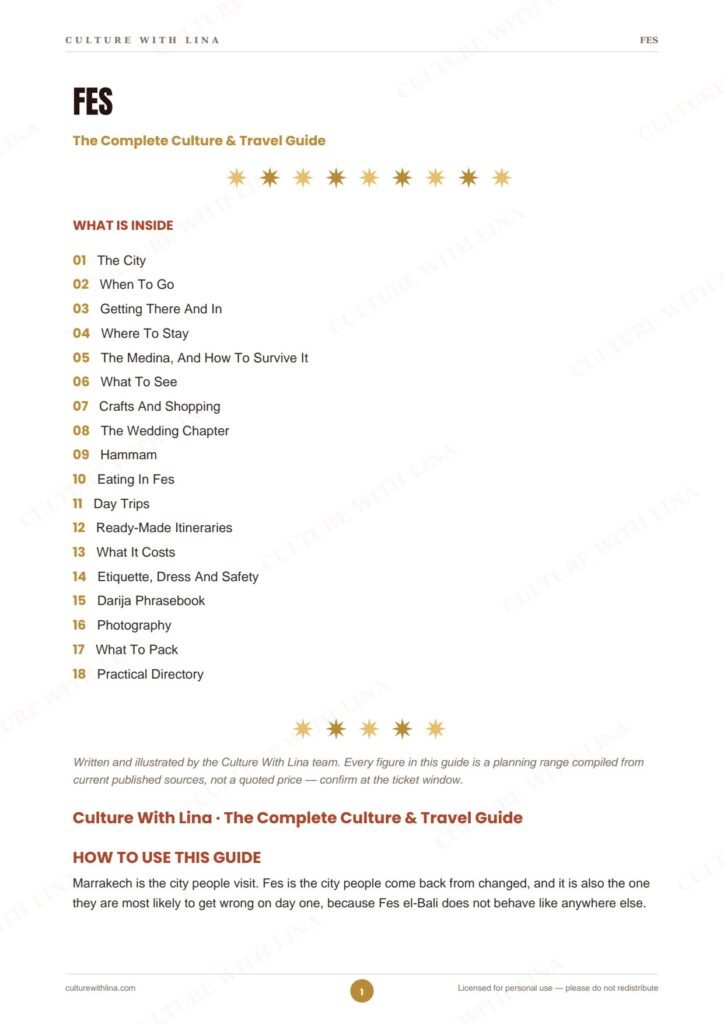
- The medina and how to survive it: guides, main arteries and faux guides
- What to see, plus a chapter on zellige, brass, leather and Fassi crafts
- The wedding chapter: negafat, the seven takchitas and Andalusian nuba music
- Day trips, ready-made itineraries and a what-it-costs breakdown
- Darija phrasebook, photography spots, packing list and practical directory
Instant PDF download. Licensed for personal use.
Fes: frequently asked questions
How many days do you need in Fes?
Three nights is the right minimum: one day with a guide, one day on your own, and one day trip to Meknes and Volubilis or the Middle Atlas.
Do you need a guide in the Fes medina?
Not for the whole trip, but an official guide for the first half-day is the best money you will spend in Fes. It gives you orientation and keeps faux guides away.
Is Fes safe for tourists?
Yes. Violent crime is rare. Expect persistent selling and faux guides, watch your footing on steep, wet lanes, and take a taxi back to a gate at night.
Can non-Muslims visit Al-Qarawiyyin?
Non-Muslims cannot enter the mosque, but you can see into the courtyard from several doorways. Bou Inania and Al-Attarine madrasas are open to all visitors.
Is Fes or Marrakech better?
They suit different trips. Marrakech is more relaxed about dress and centers on Jemaa el-Fna, a square that performs for visitors every evening. Fes has no equivalent; it is more conservative, a working medieval city built around its crafts. Many travelers visit both.
Look inside the premium guide
About this guide. Culture With Lina is presented by Lina, an AI travel creator. This page and the premium PDF are researched and compiled from published sources, official information and local reporting; they are not a first-hand trip report. The images and films are made with AI tools. Prices are planning ranges, not quotes, so confirm locally before you travel. Spotted something out of date? Tell us.
Before you eat out: our practical guide to eating in Morocco covers the dishes you will see on menus, table manners and how to approach street food.