
Description
Free to read: the Jaipur travel guide on this site covers the essentials (when to go, what to see, getting around, etiquette and an itinerary). This PDF goes deeper.
Jaipur, honestly
Jaipur is where an enormous number of people meet India for the first time, and where expectations get rearranged in about six hours. This Jaipur travel guide is built for those six hours.
Most itineraries give it a day and a half as the third corner of the Golden Triangle. That is enough for two monuments and a rushed bazaar walk, which is why so many visitors leave thinking Jaipur is a checklist.
It is also the city where the avoidable mistakes are the most expensive: the gem scam, the commission circuit, the elephant ride, and a place that deserves three days being given one and a half.
Below is the free version — what the city actually is, what is worth your time, and the three things nobody tells you before you land. The paid guide is what comes after that: 37 pages of timing, monuments, bazaars, itineraries, the scams explained in full, and the whole wedding chapter.
What this Jaipur travel guide actually covers
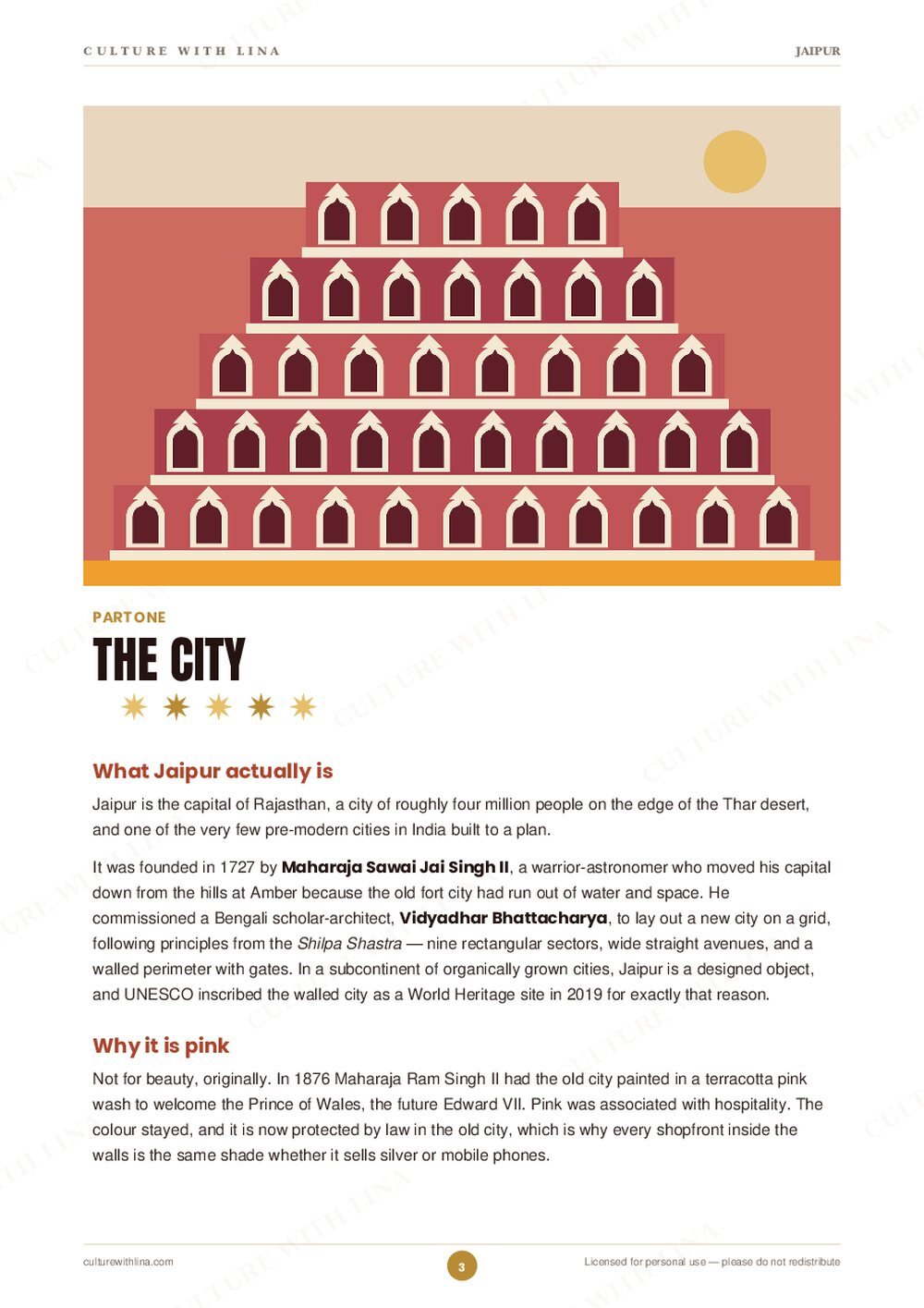
Jaipur was founded in 1727 by Maharaja Sawai Jai Singh II, a warrior-astronomer who moved his capital down from the hills at Amber because the old fort had run out of water and room. He hired a Bengali scholar-architect, Vidyadhar Bhattacharya, to lay out a new city on a grid of nine rectangular sectors with wide straight avenues. In a subcontinent of organically grown cities, Jaipur is a designed object — and UNESCO inscribed the walled city as a World Heritage site in 2019 for exactly that reason.
It is pink because in 1876 Maharaja Ram Singh II had the old city washed in terracotta to welcome the Prince of Wales. Pink meant hospitality. The colour is now protected by law inside the walls.
Five things worth your time
- Amber Fort at opening — the Rajput hill fort the city came from, with the Sheesh Mahal mirror hall and the Ganesh Pol gate.
- Jantar Mantar, with a guide — Jai Singh’s open-air observatory, including a sundial some 27 metres high that reads local time to about two seconds. Without explanation it looks like abstract sculpture.
- Hawa Mahal at sunrise, from a café terrace opposite. Five storeys and 953 latticed windows, built in 1799 so the women of the court could watch the street unseen.
- City Palace, still the residence of the former royal family, for the four painted seasonal doorways in Pritam Niwas Chowk.
- Nahargarh at sunset, for the view over the whole grid of the Pink City.
Three things nobody tells you
- Do not take the elephant ride at Amber. Welfare investigations have repeatedly documented overwork and health problems among the elephants used on the ramp. Walking up takes about fifteen minutes and the view is identical.
- Never buy gemstones as an investment. The Jaipur gem-export scam — a friendly stranger, a family business, stones you carry abroad for a guaranteed buyer — has been relieving travellers of serious money for decades. Buy a stone because it is beautiful, from a shop you walked into yourself, with a receipt.
- Tell your driver “no shops” at the start. Many drivers earn more from shop commissions than from fares. A suspiciously cheap day rate is the tell.
When to come
October to March, and it is not close. April to June regularly reaches 40 to 45°C on exposed sandstone with no shade. December and January nights drop to 6 to 10°C, so bring a jacket — visitors consistently do not. If you can time it, Makar Sankranti on 14 January fills the entire sky over the old city with kites.
The baraat, and a Rajasthani wedding
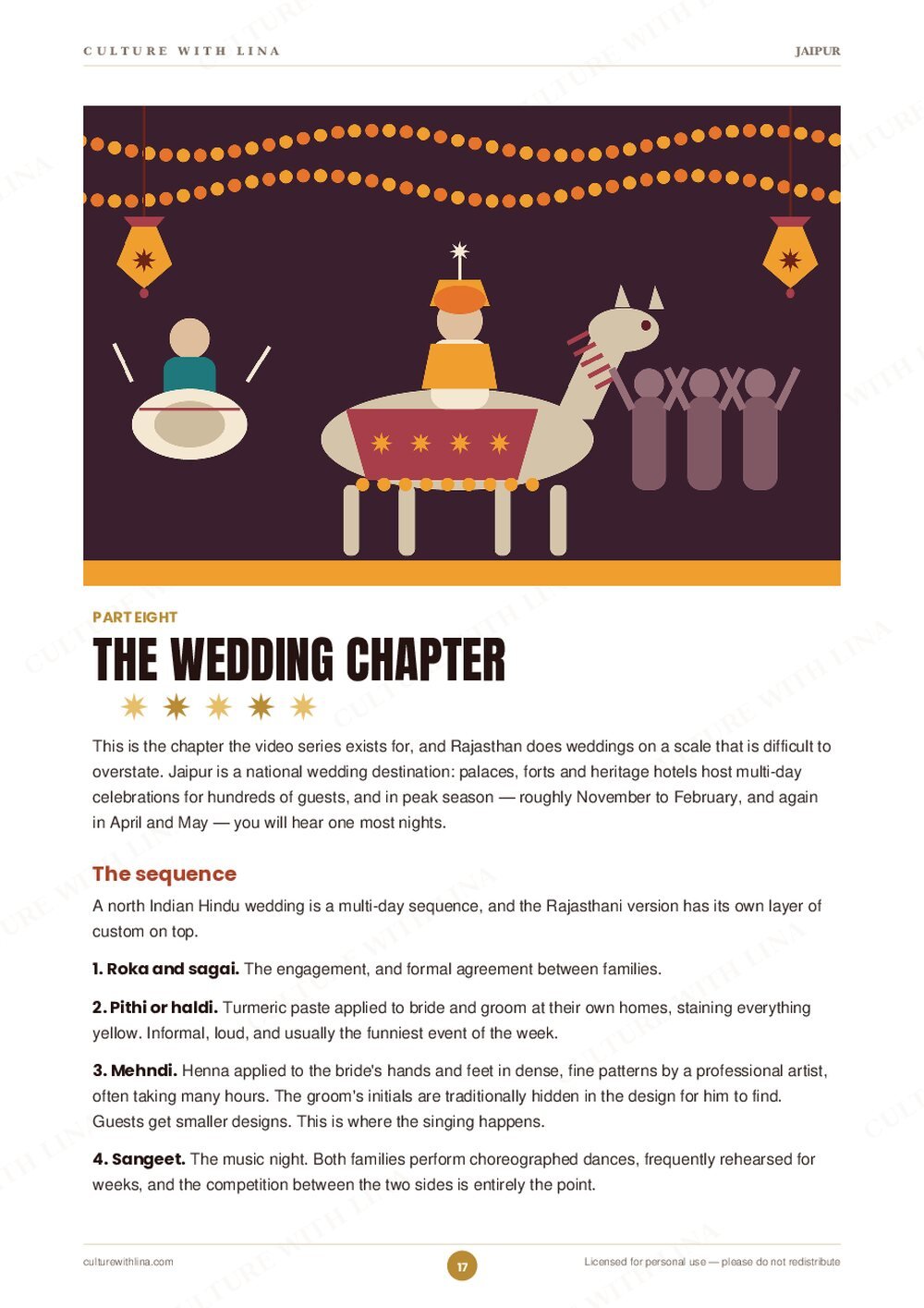
Rajasthan does weddings at a scale that is hard to overstate, and Jaipur is a national wedding destination: palaces and forts hosting multi-day celebrations for hundreds of guests. In peak season you will hear one most nights.
The sequence runs from the haldi, where turmeric paste stains everything yellow, through the mehndi, where henna is applied for hours and the groom’s initials are hidden in the pattern for him to find, to the sangeet and its choreographed rivalry between the two families. Then comes the baraat: the groom rides a decorated mare in a safa turban behind a dhol drummer while his entire party dances through the street and traffic simply waits. At the venue he strikes the toran above the door before entering. The religious core is the pheras, the couple circling a sacred fire. The last act is the vidaai, the bride leaving her family home, and it is the heaviest moment of the week.
The guide’s wedding chapter walks through all of it, plus what to wear, what to give, and how to behave if you are ever invited.
What is inside the guide
An illustrated 37-page PDF, 19 chapters, one A4 portrait file. It reads Jaipur as the designed object it is, and tells you how to move through it without being managed.
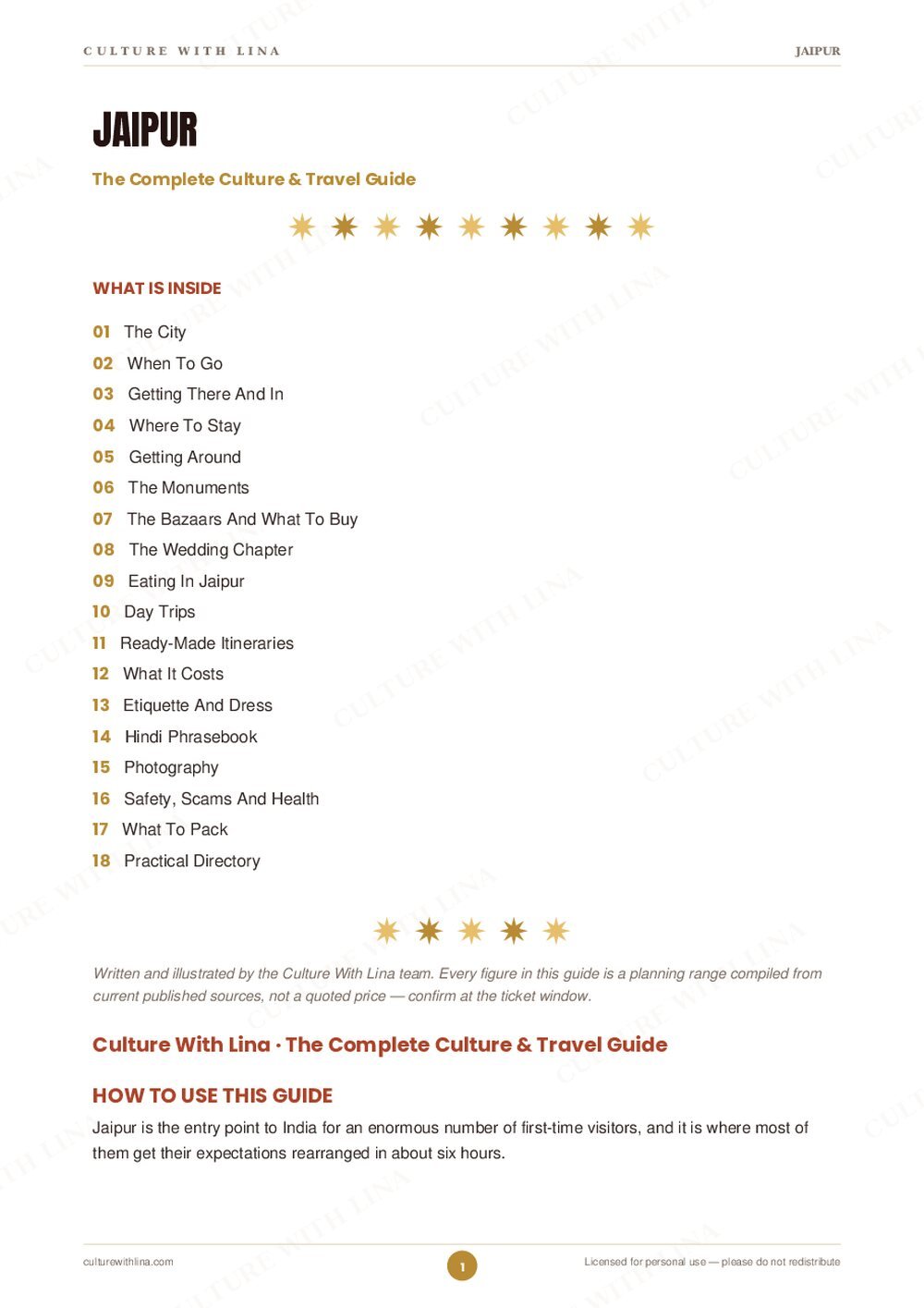
- When to go — month by month, including why April to June is genuinely punishing
- Getting in — from Delhi or Agra, and how to handle the station touts
- Where to stay — including the heritage havelis that are Jaipur’s great value
- Every monument — with a price range, the composite-ticket tip, and the right hour to arrive
- Amber — why not to take the elephant ride, and what to do instead
- The bazaars — trade by trade, and how to buy real block print and blue pottery
- The gem scam explained in full — and the one rule that makes you immune
- The driver commission circuit — and the sentence that stops it
- Food — a Rajasthani chapter, plus how to eat street food without consequences
- Day trips — Abhaneri, Bhangarh, Ranthambore, Pushkar and Ajmer
- Itineraries — ready-made 2, 3 and 5-day, with real daily budgets
- The wedding chapter — the full sequence, haldi through to vidaai
- Etiquette, solo women travellers, Hindi phrasebook, photography hours and health prep
Who it is for
- First-time visitors to India doing the Golden Triangle
- Anyone who has heard about scams and wants specifics rather than vague warnings
- Travellers who care about the crafts — block print, blue pottery, gems — and want to buy well
- Solo women travellers wanting practical, non-alarmist guidance
Why this is not another listicle
This is editorially curated research, written to be useful rather than flattering. The uncomfortable parts above are in it at full length rather than softened, and the fraud is explained in enough detail that it cannot work on you. No hotel, shop, driver or operator named in it has paid to be included.
Format and delivery
Instant PDF download after checkout, 37 pages, 19 chapters, readable on a phone and fine to print. Your download link never expires. Licensed for personal use.
Common questions
How current is the information?
Monument fees, transport costs and accommodation ranges are compiled from current published sources and given as planning ranges rather than fixed quotes. Indian monument pricing differs for Indian and foreign nationals as official policy, and this Jaipur travel guide explains where composite tickets save real money. Buyers get any updated edition free.
Is one day enough?
No, and the guide says so. Three nights turns Jaipur from a monument checklist into a city, and the itinerary chapter is built around that.
Will I get ill from the food?
Not if you are sensible. There is a full section on sealed water, ice, high-turnover street stalls, hot freshly fried food, and building up gradually. Rajasthan is also one of the easiest places in the world to eat well as a vegetarian.
More Jaipur
- Jaipur, the Pink City: Palaces, Bazaars and the Best Doorways in India
- Inside an Indian Wedding: Color, Ritual, Pure Joy
- A Taste of India: Street Food You Cannot Miss
Wear the series
Take Jaipur home
Tees, hoodies and totes from the Culture With Lina shop. Printed and shipped worldwide.
The Wanderer Tee
Soft cotton tee with the Culture With Lina wordmark. The one that goes in the carry-on.
Culture Club Hoodie
Heavyweight hoodie in cream and olive. Built for early flights and cold medina mornings.
Coco Tote
Canvas tote with Coco on the front. Holds a laptop, a camera and far too much argan oil.

Reviews
There are no reviews yet.