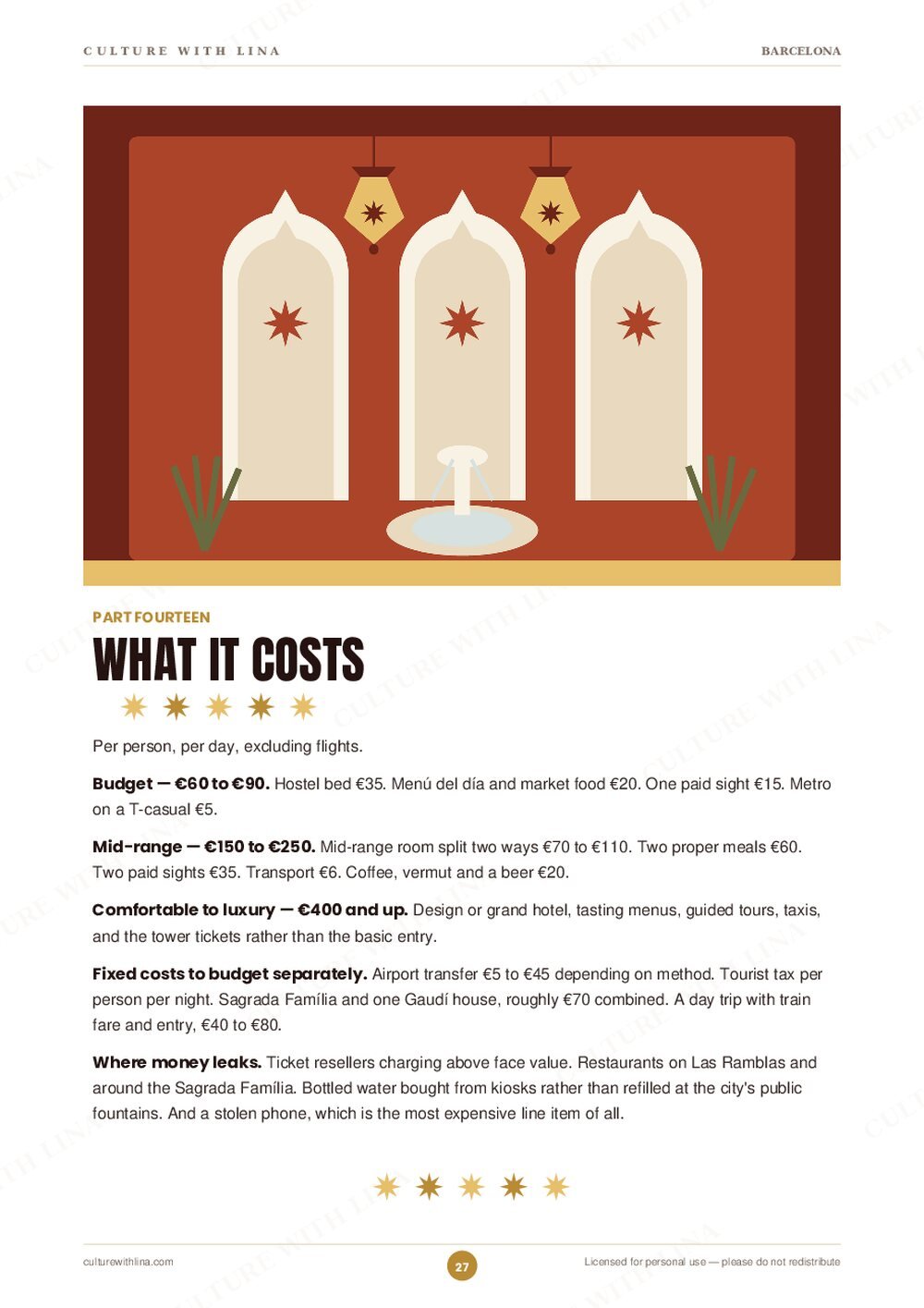
Description
Free to read: the Barcelona travel guide on this site covers the essentials (when to go, what to see, getting around, etiquette and an itinerary). This PDF goes deeper.
Barcelona, honestly
Barcelona is the easiest great city in Europe to get wrong. Most visitors do the same four sights in the same four hours, queue for each one, and eat a bad paella on a boulevard that locals avoid. This Barcelona travel guide is built to keep you out of that queue.
The city rewards the opposite approach: book two things, then let the days happen.
Below is the free version — what the city actually is, what is worth your time, and the things nobody tells you before you land. The paid guide is what comes after that: 38 pages of timing, neighbourhoods, booking rules, itineraries, budgets and the full festa major chapter.
What this Barcelona travel guide actually covers
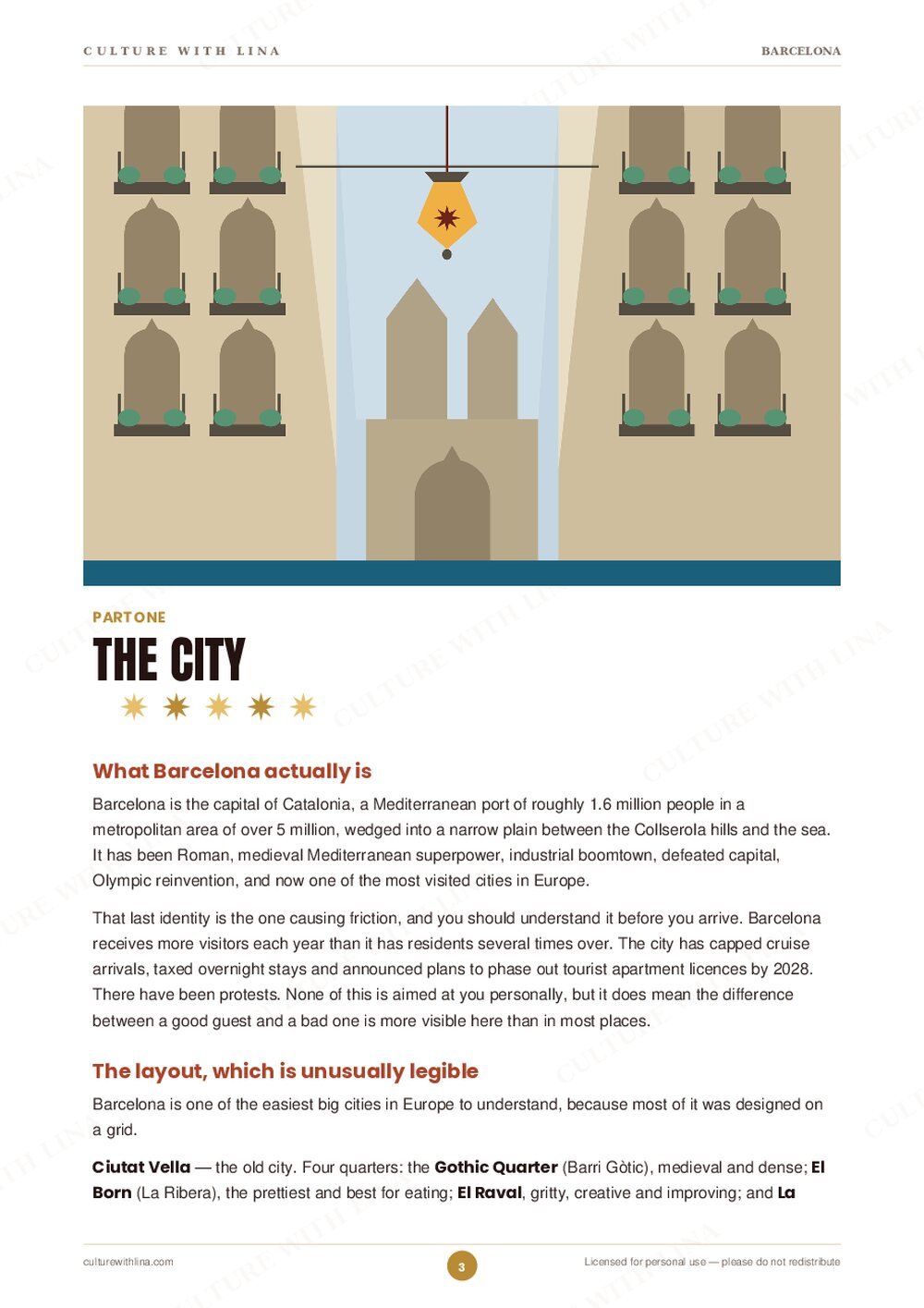
Capital of Catalonia, a Mediterranean port of 1.6 million wedged between the Collserola hills and the sea. Roman, then a medieval Mediterranean power, then an industrial boomtown, then an Olympic reinvention in 1992, and now one of the most visited cities in Europe — which is the source of the friction you may read about.
Most of it is unusually easy to navigate, because the Eixample was designed on a grid of octagonal blocks with chamfered corners. Around it sit Ciutat Vella (the Gothic Quarter, El Born, El Raval and Barceloneta), Gràcia, a former village that is still the best neighbourhood to actually live in, and Montjuïc, the museum hill.
Five things worth your time
- Sagrada Família — go for the interior, not the exterior. Morning slots give cool blues from the Nativity side; late afternoon gives fiery reds through the Passion windows. Book direct, days ahead.
- The Gothic Quarter before 9am. The same lanes that are unbearable at noon are empty and properly lit two hours earlier.
- Palau de la Música Catalana — not Gaudí, and for many visitors the most beautiful interior in the city. Better still, go to an actual concert.
- Hospital de Sant Pau — a vast modernista complex ten minutes from the Sagrada Família, and almost empty by comparison.
- Vermut in Gràcia, ideally on a Sunday. The pre-lunch ritual, and the most local hour of the week.
Three things nobody tells you
- Do not eat paella on Las Ramblas. Paella is Valencian, and the twelve-euro version with a photo menu is dyed with colouring rather than saffron. Order arròs a la cassola or fideuà somewhere that cooks it to order for two people and takes forty minutes. That wait is the sign you are in the right place.
- Pickpocketing is the real risk, not violence. Las Ramblas, metro line L3, Barceloneta and the Gaudí sites. Bag zipped and worn in front, phone in a front pocket, never on a restaurant table, never on the back of a chair.
- Catalan is not a dialect of Spanish. It is a distinct language with around ten million speakers. Four words — bon dia, si us plau, gràcies, adéu — change the temperature of every interaction, because visitors almost never bother.
And one more: be a good guest. Barcelona receives many times its own population in visitors each year, and residents feel it. Keep your voice down in residential streets at night, especially in Gràcia and El Born where flats face directly onto the lanes. Do not walk around in swimwear away from the beach; there are fines for it. Book only accommodation with an official HUT licence number. And spend in neighbourhood businesses rather than only on the main drags.
Castellers, correfoc and the festa major
Every destination in this series has a way of celebrating that explains it. In Barcelona it is the festa major. A colla castellera builds a tower of people up to nine or ten levels high, with a child called the enxaneta climbing to the top to raise four fingers for the four stripes of the Catalan flag. Below, hundreds of people pack together into the pinya to hold the structure up and catch anyone who falls. The motto is força, equilibri, valor i seny — strength, balance, courage and common sense.
Then there is the correfoc, a fire run where devils and dragons carry fireworks through the streets while people dance underneath the sparks. If you join in, wear old cotton, cover your neck and keep your mouth closed. Synthetics melt.
The best week to see all of it is La Mercè, around 24 September. The guide has a whole chapter on the city’s celebrations.
What is inside the guide
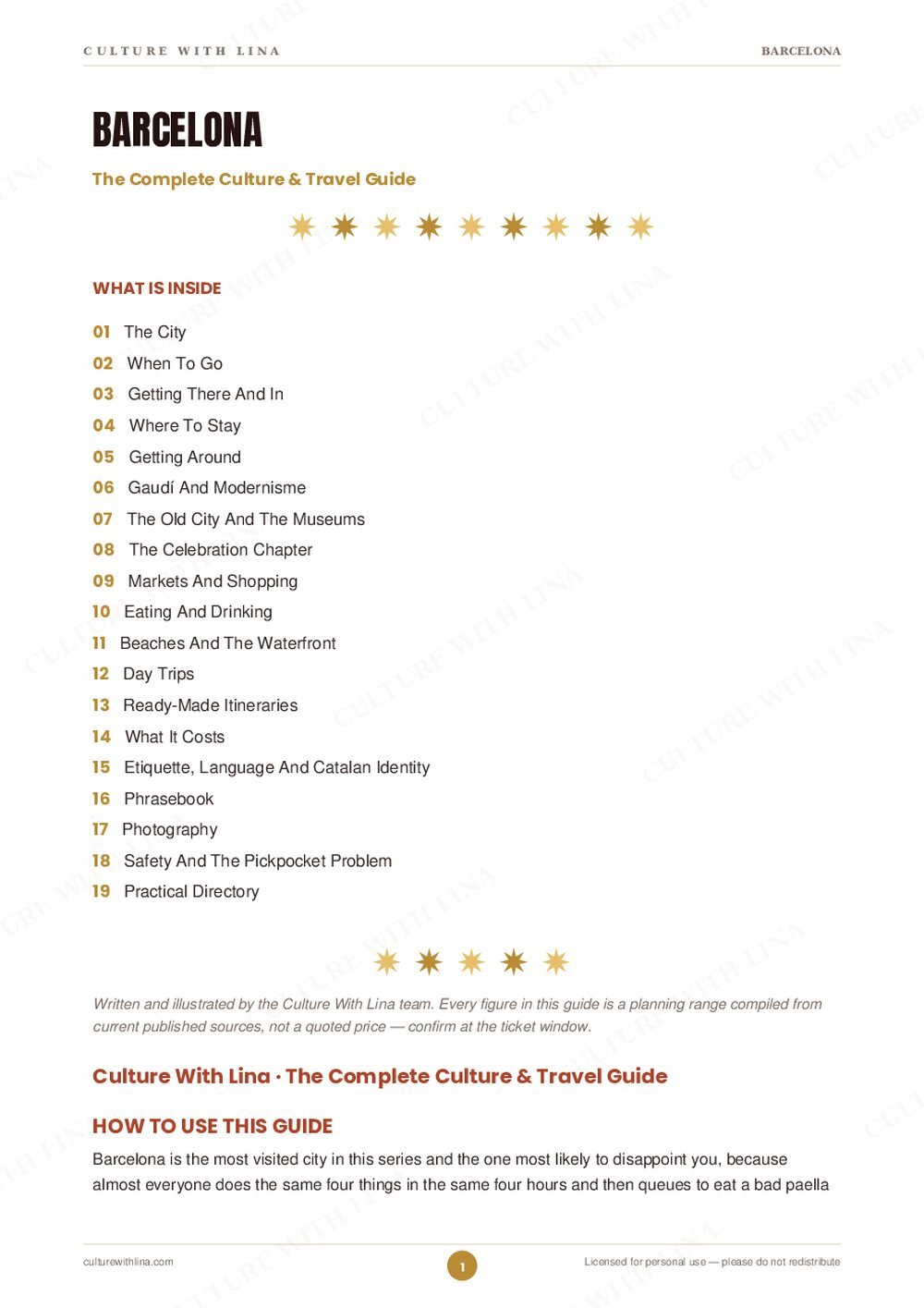
An illustrated 38-page PDF, 19 chapters, organised the way you will actually need it. Decide when to come, pick the right neighbourhood, book the two or three things that genuinely sell out, then spend the rest of your time in the city rather than in its queues.
- Month-by-month timing, including Sant Jordi, Sant Joan and La Mercè, and the week to avoid entirely
- Airport options with real fares, and the T-casual travel card explained
- Where to stay, neighbourhood by neighbourhood, from El Born to Gràcia to Poblenou
- The HUT licence rule and the 2028 tourist-flat phase-out, which can strand a booking
- Gaudí and modernisme, with the booking warnings that actually matter
- The old city, the museums, and Bunkers del Carmel with its new curfew
- Markets, and what is genuinely worth buying versus mosaic tat
- A food chapter that tells you what to order instead of paella
- Beaches and day trips to Montserrat, Sitges, Girona and the Penedès
- Ready-made 2, 3 and 5-day itineraries, plus real daily budgets
- A full pickpocket chapter, because that is Barcelona’s actual risk
- The celebration chapter — the sardana, the gegants, and how Catalan weddings actually work, with cava poured throughout and a colla sometimes engaged to build a tower for the couple
- Catalan and Spanish phrasebook, photography hours and a practical directory
Who it is for
- First-time visitors who want more than the Sagrada Família and Las Ramblas
- Anyone who has been warned about pickpockets and wants specifics rather than vague caution
- Travellers booking an apartment who do not know what an HUT number is
- Repeat visitors looking for Gràcia, the Penedès and the quieter museums
Why this is not another listicle
This is editorially curated research, written to be useful rather than flattering. Where something is overrated, it says so. The guide is direct about Barcelona being an over-touristed city and about how to be a good guest in one. No hotel, restaurant or operator named in it has paid to be included.
Format and delivery
Instant PDF download after checkout. 38 pages, 19 chapters. Your download link never expires. Licensed for personal use.
Common questions
How current is the information?
Entry fees, transport fares and accommodation ranges are compiled from current published sources and given as realistic planning ranges rather than fixed quotes.
Do I need it if I have already booked?
Probably more, not less. The chapters that save the most money are about what happens after you land.
Is it useful in winter?
Yes. The timing chapter covers all twelve months, including why January and February are the smartest time to see the Sagrada Família and what closes when.
More Barcelona
- Gaudí’s Barcelona: A City Built by Imagination
- Tapas, Sunshine and Slow Evenings: Eating Your Way Through Spain
- La Tomatina and Las Fallas: Spain at Its Most Joyfully Wild
Wear the series
Take Barcelona home
Tees, hoodies and totes from the Culture With Lina shop. Printed and shipped worldwide.
The Wanderer Tee
Soft cotton tee with the Culture With Lina wordmark. The one that goes in the carry-on.
Culture Club Hoodie
Heavyweight hoodie in cream and olive. Built for early flights and cold medina mornings.
Coco Tote
Canvas tote with Coco on the front. Holds a laptop, a camera and far too much argan oil.
Reviews
There are no reviews yet.