
Description
The city at the end of the line
Every train in Morocco that goes east eventually stops at Oujda, because there is nowhere else for it to go. Fifteen kilometres further on is the Algerian frontier, closed since 1994. The rails stop. The road stops. The city carries on.
That single fact explains the place. Oujda was founded in 994 as a garrison on the road between Fez and Tlemcen, and for a thousand years its entire purpose was being the crossing. Then the crossing shut — and Oujda did not go quiet. It kept the music of both sides, kept the food of both sides, and turned up the volume.
Part One — The City on the Border
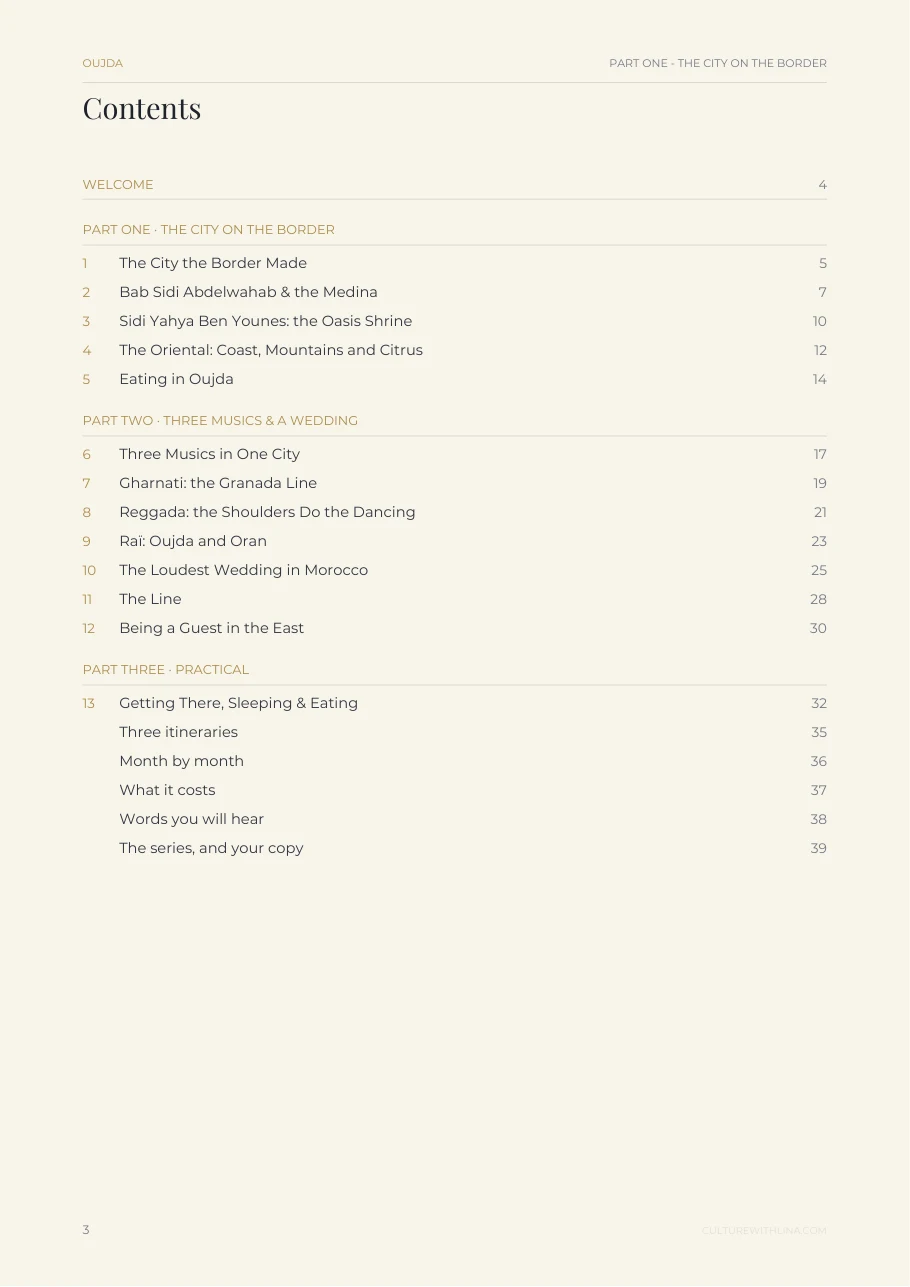
- 994, Ziri ibn Atiyya, and why Oujda changed hands more often than any comparable city
- 1907: why the French took Oujda five years before the rest of Morocco
- Bab Sidi Abdelwahab — the gate, its saint’s name, and the grim nickname attached to it
- Souk El Ma, the market where irrigation water itself was bought and sold
- Sidi Yahya Ben Younes — the oasis shrine identified with John the Baptist, venerated by Muslims, Jews and Christians together
- Saidia’s sixty kilometres of sand, the Zegzel gorge, Berkane citrus, and Taforalt — one of North Africa’s most important prehistoric sites
- Karane, and the night food street outside the gate
Part Two — Three Musics and a Wedding
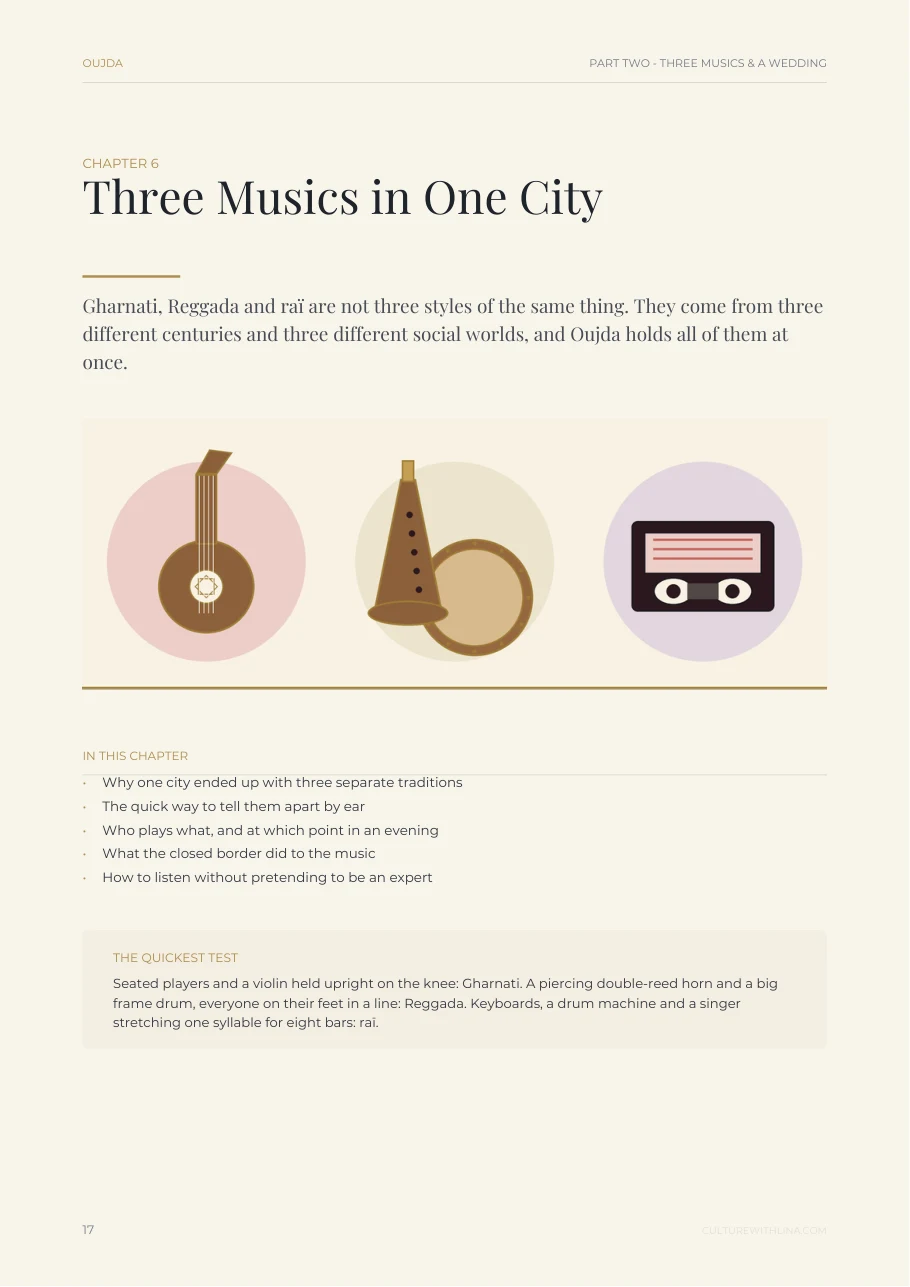
No other Moroccan city holds three distinct musical traditions at once. Oujda does, and they come from three different centuries and three different social worlds.
- Three Musics in One City — how one city ended up with all three, and the quickest way to tell them apart by ear
- Gharnati — the Granada branch of Andalusian classical music, preserved here and in Tlemcen; the nuba, the ensemble, the violin held upright on the knee
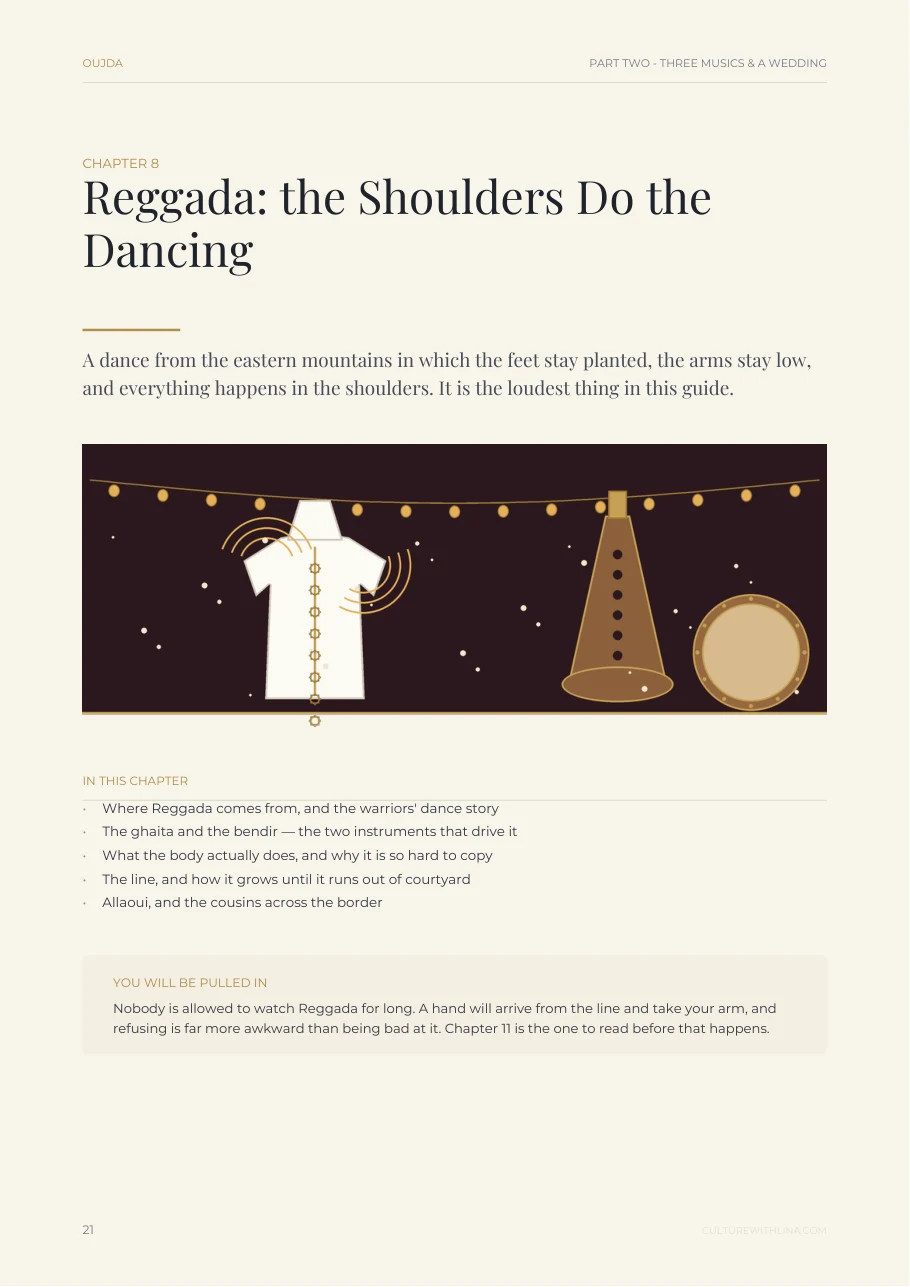
- Reggada — the shoulder dance of the eastern mountains, driven by ghaita and bendir; what the body actually does, and why you will be bad at it
- Raï — born in Oran, adopted by Oujda; the cassette boom, the names, and what it means after midnight
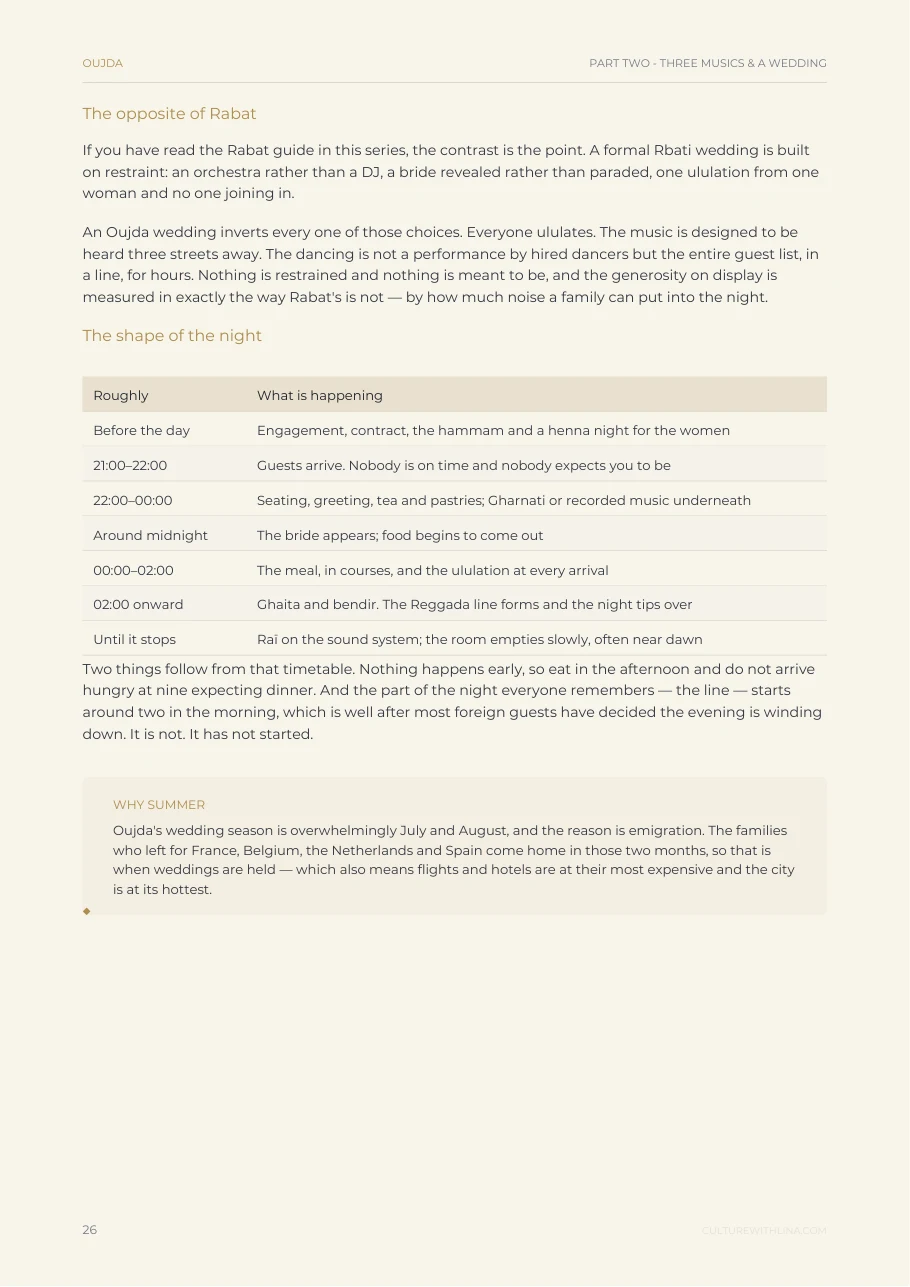
- The Loudest Wedding in Morocco — the shape of the night hour by hour, why the season is July and August, and who is running it
- The Line — how it forms, how it grows until it wraps the courtyard, and what to do when a hand reaches in and pulls you into it
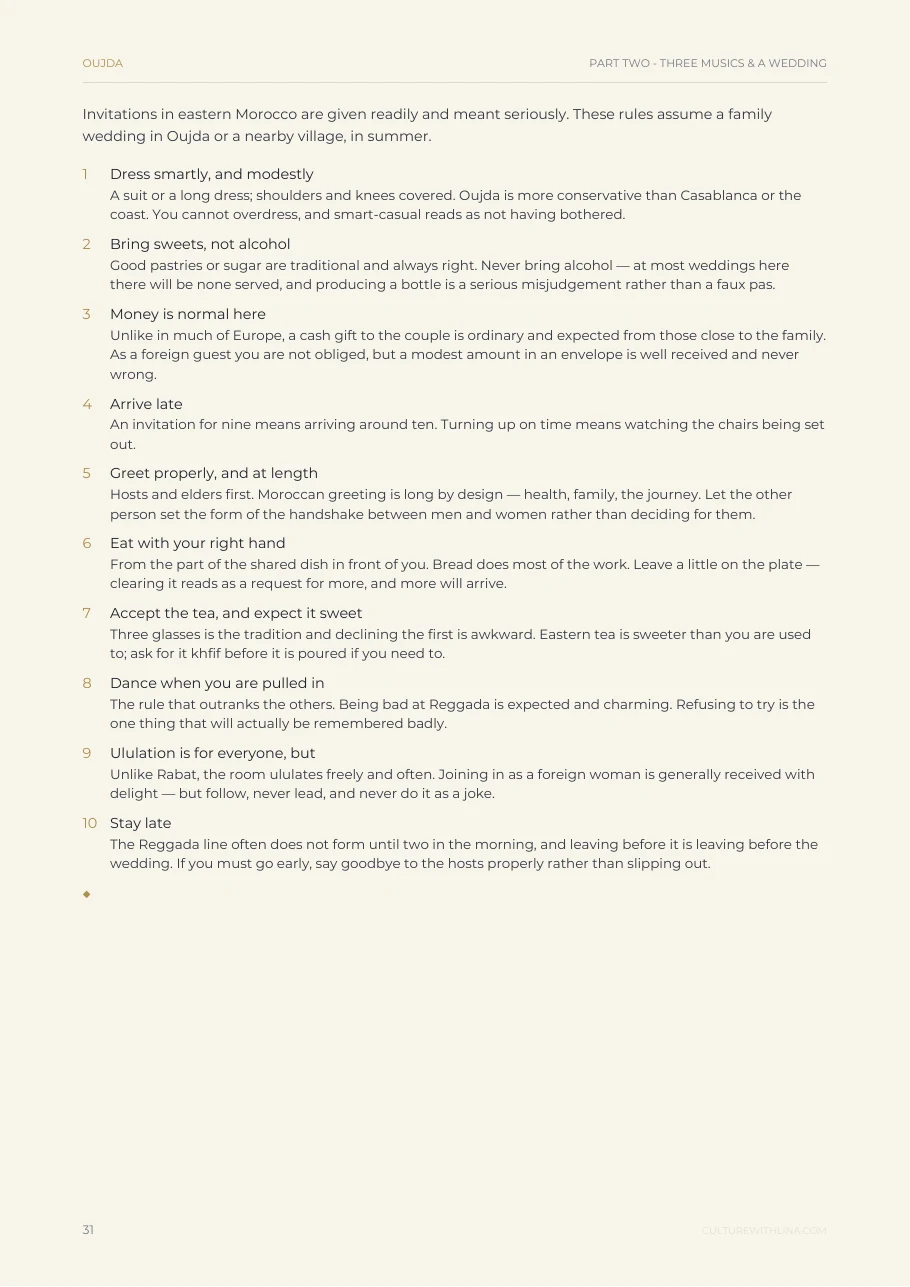
- Being a Guest in the East — ten rules, two of which are the opposite of Rabat’s
Part Three — Practical
Direct European flights and why Oujda has so many, the eastern end of the railway, where to sleep, three itineraries, month-by-month timing, a full cost table in dirham, and a glossary.
What it is
A 40-page A4 PDF with thirteen original illustrations, one per chapter. Instant download after checkout. Reads on a phone and prints at home.
A free two-chapter sampler is available on the site.
Wedding customs vary between families, and between Oujda, the Beni Snassen villages and the coast. Where practice differs the guide says so rather than inventing one correct version. Prices are indicative planning bands compiled editorially, not quotes.

Reviews
There are no reviews yet.