
Jaipur is the capital of Rajasthan, a city of roughly four million people on the edge of the Thar desert, and one of the very few pre-modern cities in India built to a plan. For many first-time visitors it is the entry point to India, and it rewards them with hill forts, a painted old city, bazaars sorted by trade and old mansions turned into hotels.
This guide is for travelers who want more than the day and a half most Golden Triangle tours allow. It covers when to come, what is worth your time, how a Rajasthani wedding unfolds, and how to sidestep the well-known scams. All prices are in Indian rupees and are planning ranges, not quoted prices.
Jaipur at a glance
| Where it is | Capital of Rajasthan, northwest India, on the edge of the Thar desert; about 270 km from Delhi |
|---|---|
| Best time to go | October to March. April to June is extreme heat; July to September is monsoon |
| How long to stay | Three nights at minimum; five if you add day trips or Ranthambore |
| Getting there | Jaipur International Airport (JAI), fast trains from Delhi in about 4 to 5 hours, or by road from Delhi or Agra |
| Daily budget (planning range) | Budget ₹1,500 to ₹2,500; mid-range ₹4,000 to ₹8,000; luxury ₹20,000 and up, per person, excluding flights |
| Language(s) | Hindi, with Rajasthani dialects such as Marwari; English is widely understood in tourism |
| Good for | Forts and palaces, craft shopping, heritage hotels, festivals, food, and first trips to India |
The story of Jaipur
Jaipur was founded in 1727 by Maharaja Sawai Jai Singh II, a warrior and astronomer who moved his capital down from the hill fort at Amber because the old city had run out of water and space. His scholar-architect, Vidyadhar Bhattacharya, laid out the new city on a grid following the Shilpa Shastra: nine rectangular sectors, wide straight avenues and a walled perimeter with gates. UNESCO inscribed the walled city as a World Heritage site in 2019 precisely because it was designed as a single object.
The pink came later, and not for beauty. In 1876 Maharaja Ram Singh II had the old city washed in terracotta pink to welcome the Prince of Wales, the future Edward VII, because pink was associated with hospitality. The color is now protected by law inside the walls, which is why a silver shop and a phone stall share the same shade.
The newer districts of Civil Lines, C-Scheme and Bani Park lie west and south of the walls, greener and quieter. The northern hills hold Amber, Jaigarh and Nahargarh forts, all within about 30 minutes of the center.
What to see in Jaipur
Foreign nationals pay higher monument fees than Indian citizens across India; this is official policy. Composite tickets covering several sites are usually better value than singles, so ask at the first site. Monuments generally open 9am to 5pm.
Amber Fort (Amer)
About 11 km north, this is the Rajput hill fort the city grew from, with the Sheesh Mahal mirror hall, the Ganesh Pol gateway and terraced courtyards above Maota Lake. Expect roughly ₹500 to ₹600. Go at opening and allow two to three hours, including Jaigarh.
Skip the elephant ride. Welfare investigations have repeatedly documented overwork and health problems among the elephants used on the ramp. The walk up takes about fifteen minutes, or take the shuttle jeep.
City Palace
Still the residence of the former royal family, with a standard foreign-national ticket of roughly ₹500 to ₹1,000. The highlights are the Mubarak Mahal, the armory, and the four painted seasonal doorways of Pritam Niwas Chowk: Peacock, Lotus, Green and Rose. Allow two hours.
Jantar Mantar
Jai Singh’s open-air observatory is a UNESCO site in its own right. Its nineteen masonry instruments include a sundial about 27 meters high that reads local time to within about two seconds. Tickets are roughly ₹200 to ₹300. Hire a guide; without one the instruments look like abstract sculpture.
Hawa Mahal
Built in 1799, this five-story screen of 953 latticed windows let the women of the court watch street processions unseen. Pay the roughly ₹200 to ₹250 to go inside for the light through the lattice. For the classic photo, sit on a café terrace opposite at sunrise, when the facade catches the first light.
Jaigarh and Nahargarh forts
Jaigarh, above Amber and linked by a walkway, holds the huge Jaivana cannon and is far quieter than its neighbor. Nahargarh sits on the ridge above the city. Save it for sunset, when the view over the Pink City grid is the best in Jaipur.
The bazaars of the walled city
The bazaars are organized by trade. Johari Bazaar is for jewelry and gems, Bapu Bazaar for textiles and jutti shoes, Tripolia for lac bangles and brass, Chandpole for marble carving. Walk them between 8am and 10am, before the heat. Many close on Sundays.
Galtaji, Albert Hall and Patrika Gate
Galtaji, the Monkey Temple, sits in a gorge with spring-fed tanks and many macaques; keep food and sunglasses out of sight. Albert Hall Museum has a fine decorative arts collection and is beautifully lit at night. Patrika Gate, painted floor to ceiling in Rajasthani motifs, is free but queues, so go early.
What to skip: the Chokhi Dhani “village experience,” which is a themed dinner rather than a cultural site, any block-printing demonstration a driver suggests unprompted, and costumed figures outside monuments who charge for photos.
The Rajasthani wedding
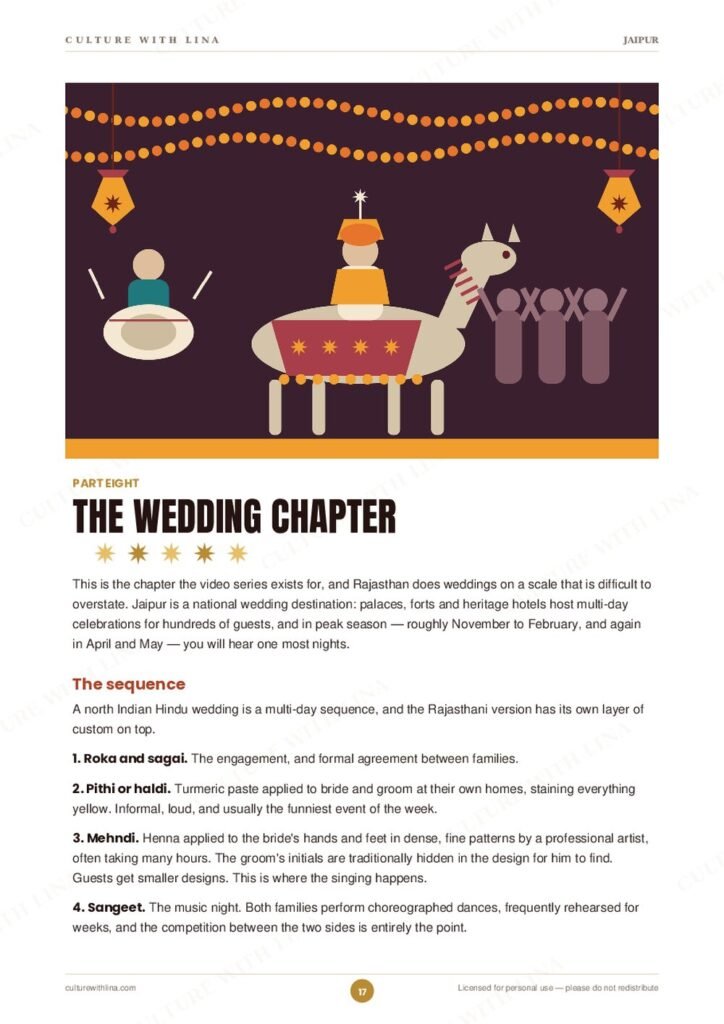
Jaipur is a national wedding destination, with palaces, forts and heritage hotels hosting multi-day celebrations for hundreds of guests. In peak season, roughly November to February and again in April and May, you will hear one most nights. The Rajasthani version of the north Indian Hindu wedding adds its own customs, and details vary by family and community.
- Roka and sagai. The engagement and formal agreement between families.
- Pithi or haldi. Turmeric paste is applied to bride and groom at their homes. Informal, loud and often the funniest event of the week.
- Mehndi. An artist applies fine henna patterns to the bride’s hands and feet, traditionally hiding the groom’s initials for him to find.
- Sangeet. The music night, where both families perform dances rehearsed for weeks.
- Baraat. The groom rides a decorated mare to the venue in a safa turban, behind a dhol drummer and his dancing party. In Rajasthan he may carry a sword, a Rajput inheritance.
- Toran and milni. The groom strikes the toran above the door, then the families formally greet each other.
- Jaimala. The couple exchange garlands, often while friends lift them out of reach.
- Pheras. Under a mandap the couple circle a sacred fire, traditionally seven times, with a vow for each circuit. The timing is set by an astrologer and may fall well after midnight.
- Vidaai. The bride’s departure from her family home, the most emotional moment of all.
Foreign visitors are invited surprisingly often. Wear strong colors and avoid white and black, which carry mourning associations. Give cash in an amount ending in one, such as ₹501 or ₹1,100, and ask before photographing the ceremony. In Lina’s films the wedding is dramatized with AI; the traditions shown are real.
What to eat in Jaipur
Rajasthani cooking grew up in an arid region, so it leans on dried lentils, beans and generous ghee. It is one of the easiest places in the world to eat well without meat.
- Dal baati churma: the state dish, hard-baked wheat balls broken into ghee with spiced lentils and sweet crumbled churma.
- Laal maas: a fiery red mutton curry made with Mathania chilies, originally a Rajput hunting dish.
- Ker sangri: dried desert berries and beans cooked with spices.
- Gatte ki sabzi: gram-flour dumplings in a yogurt gravy.
- Pyaaz kachori and mirchi bada: the classic street snacks, a flaky onion-stuffed pastry and a battered chili fritter.
- Ghewar: a disc-shaped honeycomb sweet soaked in syrup, eaten especially at Teej.
- Lassi: thick and served in a clay kulhad.
Street snacks run about ₹30 to ₹100 and a good thali ₹200 to ₹500. Drink sealed or filtered water, skip pre-cut fruit, and eat street food where there is a queue.
Getting there and getting around
By air. Jaipur International (JAI) is about 12 km from the center. A prepaid taxi or app cab into town costs roughly ₹400 to ₹700.
By train. The best option from Delhi. Fast services take about 4 to 5 hours to Jaipur Junction, close to the center. Book through IRCTC or an authorized agent early.
By road. Delhi is 5 to 6 hours on the expressway; a car with driver runs around ₹5,000 to ₹9,000 one way. Agra is 4 to 5 hours, with the Abhaneri stepwell near the route.
If a tout at the station says your hotel is closed or full, call the hotel yourself, and use the prepaid counter or an app cab. In town, agree auto-rickshaw fares before getting in; short hops run about ₹80 to ₹200. Ola and Uber remove the haggling. For two or more people, a car and driver for the day, roughly ₹2,000 to ₹3,500 including the forts, is the best choice. Many drivers earn commissions from shops, so say “no shops” at the start. Do not self-drive.
Where to stay
- Inside or beside the walled city: best for atmosphere and dawn bazaar walks, but noisier, with fewer good mid-range options.
- C-Scheme and Civil Lines: the sweet spot for most visitors. Leafy, central, full of restaurants, and about ten minutes by auto from the old city.
- Bani Park: quiet streets with heritage guesthouses and family-run havelis. Good value.
- Amber and the northern hills: converted forts with views, but every outing means a drive.
Heritage hotels in converted mansions and palaces are Jaipur’s specialty. Doubles run roughly ₹800 to ₹2,500 on a budget, ₹3,000 to ₹8,000 mid-range, and ₹15,000 and up for luxury. Mid-range is where the city over-delivers. Ask whether rooms are heated for December and January nights.
Etiquette, dress and safety
Dress modestly: shoulders and knees covered for women, long trousers for men at temples. Take shoes off where others do, use your right hand for eating and giving, and do not point your feet at people or religious images. Ask before photographing people, especially women. The sideways head wobble usually means yes.
Violent crime against tourists is rare; the risks are commercial. In the gem scam, a friendly stranger asks you to carry stones abroad for a partner who will buy them at a profit, after a deposit. There is no partner. Never buy gems as an investment, and never hand money to someone who approached you first. Watch also for fake tourist offices, “government emporiums” with no government status, and the temple “blessing” thread followed by a demand for a donation.
Traffic is the real physical risk; cross at a steady pace. From March, heat exhaustion is a concern. Solo women generally find Jaipur manageable but should expect staring; app cabs after dark help. The emergency number is 112.
A 3-day itinerary
Day 1
Morning: Amber Fort at opening, walking up, then Panna Meena ka Kund stepwell and Jaigarh, with a stop at Jal Mahal on the way back. Afternoon: City Palace. Evening: sunset at Nahargarh.
Day 2
Morning: Hawa Mahal from a café terrace at sunrise, then inside, followed by Jantar Mantar with a guide. Afternoon: a bazaar walk through Johari and Tripolia, then Albert Hall and Patrika Gate. Evening: dinner on a rooftop near the old city.
Day 3
Morning: a block-printing workshop at Bagru or Sanganer, 30 to 60 minutes away, or the Abhaneri stepwell. Afternoon: a cooking class with a market visit, typically ₹1,500 to ₹3,000. Evening: a Rajasthani thali at a heritage hotel.
The premium Jaipur guide
Jaipur — The Pink City | Culture & Travel Guide
A Jaipur travel guide in 37 illustrated pages. The Pink City decoded, the gem scam explained so it cannot work on you, the full Rajasthani wedding sequence, and why to walk up to Amber.
- When to go, where to stay and how to get around, with planning-range costs
- The monuments, bazaars and what to buy, including the gem scam in detail
- The full wedding chapter: every ceremony, what to wear and what to give
- Rajasthani food, day trips and ready-made 2, 3 and 5-day itineraries
- Hindi phrasebook, photography spots, safety, packing and a practical directory
Instant PDF download. Licensed for personal use.
Jaipur: frequently asked questions
How many days do you need in Jaipur?
Three nights is the sensible minimum. A day and a half covers the City Palace and Amber Fort with a rushed bazaar walk; three nights turns it into a city.
What is the best month to visit Jaipur?
October to March, with days around 22 to 28°C. December and January nights can drop to 6 to 10°C, so pack a jacket. Makar Sankranti on 14 January fills the sky with kites.
Why is Jaipur called the Pink City?
In 1876 Maharaja Ram Singh II had the old city painted pink, a color linked to hospitality, to welcome the future Edward VII.
Is it worth riding an elephant at Amber Fort?
No. Welfare investigations have repeatedly documented problems with the elephants used there. The walk up takes about fifteen minutes.
Do you need a visa for India?
Most nationalities need a visa in advance, and India’s e-Visa covers tourism for many countries. Apply only through the official government portal, since lookalike sites charge large fees.
Look inside the premium guide

About this guide. Culture With Lina is presented by Lina, an AI travel creator. This page and the premium PDF are researched and compiled from published sources, official information and local reporting; they are not a first-hand trip report. The images and films are made with AI tools. Prices are planning ranges, not quotes, so confirm locally before you travel. Spotted something out of date? Tell us.